


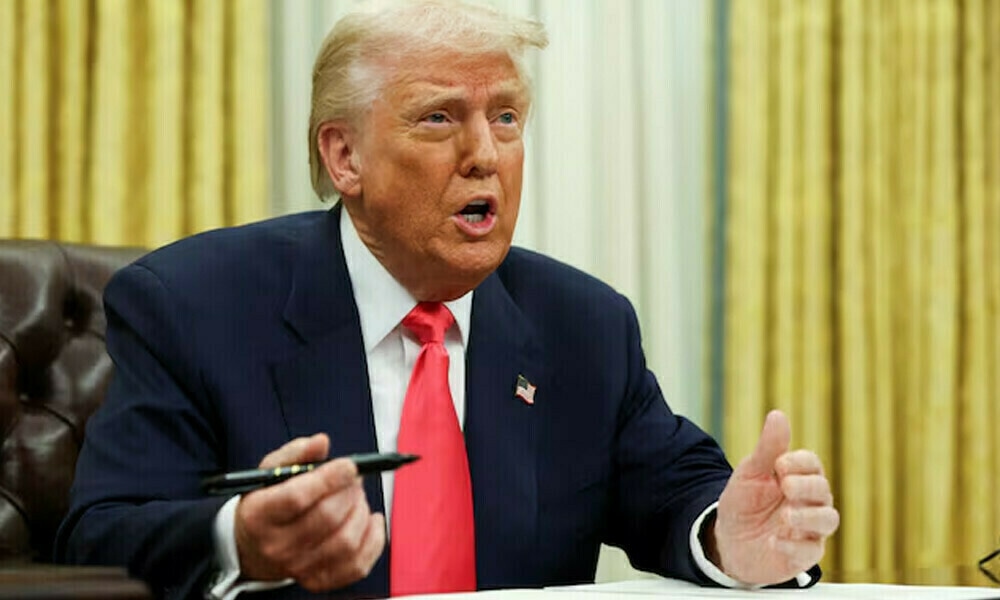

Donald Trump returned to the Oval Office in January with immense popular support, promising world peace and a return to America’s glorious past.
Yet, just over 100 days later, his policies represent a stark departure from America’s foundational values, creating precisely the chaos he vowed to avert. His execution blueprint follows a predictably disturbing pattern: aggressive escalation followed by abrupt U-turns. From initiating trade wars to brokering truces, the new Trump doctrine comes with frequent pauses and reversals.
His economic strategies, centred on imposing retaliatory tariffs and industrial-era protectionism, are strikingly anachronistic — old rules from an outdated playbook. Rather than sparking a manufacturing renaissance, Trump’s tariffs rattled global markets, triggered uncertainty and economic turmoil, and destabilized sophisticated supply chains that took decades to optimize.
Attempting to punish consumerism through tariffs, while hoping to restore America’s industrial might, signals a fundamental misunderstanding of how America became great in the first place.
Indeed, the central fallacy of Trump’s tariff strategy lies in its nostalgic misunderstanding of America’s economic trajectory. America’s greatness was not simply due to protectionism or its industry prowess.
America rose to glory because of its innovation, strategic investment in education, and forward-looking global engagement built around multilateralism.
Today’s supply chains are complex, intertwined global networks, reflecting structural realities far beyond Trump’s simplified view that industries and factories can simply return to American shores. His policies overlook fundamental American values such as liberty, freedom, whilst completing disregarding how the twenty-first century has dynamically evolved.
The recent pause in tariffs with China, a 90-day respite, saw tariff rates reduced from 145 percent to 30 percent, revealing the irrationality behind Trump’s so-called trade war. His premature celebration of a “total reset”, barely 40 days after “Liberation Day”, masks the reality that this truce was borne not of strategy but of desperation — amid plunging approval ratings, surging prices, and mounting supply chain costs.
Trump’s simultaneous slashing of higher education funding further compounds this erroneous calculation. American universities — once magnets for global talent and innovation—now face funding crises, declining international student enrolment, and weakening research ecosystems. This deprivation of vital intellectual capital has paradoxically weakened America’s capacity to compete globally.
Domestically, Trump’s record is equally troubling. By issuing 137 executive orders in the first 100 days alone—far exceeding the 33 executive orders from the same period in 2017—Trump has set a dangerous, autocratic precedent. Slashing tens of thousands of federal jobs under the newly created DOGE (Department of Government Efficiency), his cost-savings rhetoric has also considerably fallen short. This has, in effect, weakened the very institutional foundations which made America the torch-bearer of democracy, setting a dangerous precedent for other countries abroad.
Diplomatically, Trump’s approach has been defined by chaos, impulsivity, and sudden policy reversals that risk undermining America’s credibility. In Ukraine, Trump projected himself as a peacemaker. Yet, there has been anything but decisive peace. Despite briefly endorsing Putin’s unilateral ceasefire proposal, Trump’s administration failed to achieve any meaningful or sustained truce.
Trump’s inaction and a lack of clear direction are costing civilian lives, as Russian missiles continue to strike Ukraine. At this time, Trump’s celebrated US-Ukraine minerals deal remains largely symbolic, failing to meaningfully address Ukraine’s immediate security and humanitarian crises.
Further evidence of diplomatic miscalculation is Putin’s lavishly orchestrated Victory Day parade, attended prominently by leaders from China, Brazil, and even an EU member state, as civilians continue to die in Kharkiv and Sumy under Russian missile fire. This simply illustrates how Trump’s indecisive diplomacy has mistakenly internationalized and legitimized Russian aggression.
In the Middle East, Trump’s unilateral defunding of USAID programmes in Palestine reveals similar shortsightedness.
Once a critical instrument for humanitarian engagement and regional stability, USAID’s abrupt withdrawal has intensified suffering in Gaza, exacerbating rather than calming regional tensions. Israel’s prolonged operations in Gaza, recently escalated by Prime Minister Netanyahu, emphasize how America’s diplomatic withdrawal creates dangerous power vacuums, emboldening extremism rather than curbing it. The refusal of reservists to participate in Netanyahu’s ‘forever war’ is a testament to this reality.
Trump’s administration similarly claimed success in mediating a recent ceasefire between India and Pakistan—an arrangement reactive rather than proactive. Instead of dealing with the real sources of conflict, Trump merely took credit for temporarily halting hostilities.
Grave Pakistani concerns, such as an independent international investigation into the Pahalgam attack and the restoration of the Indus Waters Treaty, remain unaddressed, leaving unresolved tensions ripe for re-ignition. Trump’s short-term transactional diplomacy is no substitute for genuine strategic foresight.
Trump’s recklessness in dealing with China is another such example. Impulsively imposing tariffs to punish Chinese imports was only met by retaliation and reciprocation of tariffs.
The result was disrupted bilateral trade and global economic instability. After weeks of mounting economic damage—including severe disruptions in supply chains, falling Chinese exports, and collapsing global markets—the two giants came to the table in Geneva.
The Geneva negotiations, although proclaimed a “total reset” by Trump, have left core issues unresolved. Trump’s improvised suggestion of an 80 percent tariff — “a number the president threw out”— underscored the chaotic nature of these talks. Beijing’s participation reflected economic pressure, not diplomatic breakthrough.
Economists have warned that even the revised 30 percent import rate could spark inflation and cripple business growth in the US. Trump’s conversation with Apple CEO Tim Cook about “building a lot of plants in the US.” epitomizes his fixation with a Kodak-era vision—disconnected from modern networks where cost, speed, and specialization reign.
In the midst of this, Trump turned his firepower toward Europe. Right after the Geneva talks, he claimed that the EU was “nastier than China,” accusing it of unfair trade and underpaying for pharmaceuticals. The stakes are high: trade between the US and EU exceeds USD 1 trillion annually. Trump’s executive order on pharmaceutical pricing demanded that Europeans “pay more” to relieve US burdens.
Trump’s withdrawal has created openings for rivals. China has filled vacuums in ASEAN, strengthening bilateral ties. His protectionism has isolated America economically, pushing partners toward Beijing. Russia, sensing indecisiveness, has intensified military build-ups along NATO’s periphery. E.U too is looking towards Asian nations to build valuable trade networks.
Trump’s isolationism, somewhat, draws a parallel to a distorted version of the Monroe Doctrine. Rather than strengthening leadership, Trump risks isolating the US, reversing decades of strategic engagement. His actions manifest a geopolitical paradox: nations often trigger their greatest fears through impolitic attempts to avoid them. By retreating economically and diplomatically, Trump has precipitated the instability he pledged to prevent. America’s strength arose from interconnectedness, intellectual dynamism, and multilateral cooperation—far from where it is headed today.
An urgent reset is required. America must recommit to education, innovation, integration, and principled diplomacy. Tariffs and isolationism will not restore stature; engagement will. The US must also reaffirm alliances, stabilize trade, and restore educational funding.
Trump’s first 100 days offer a cautionary tale. If there is a “trump” card to be played, it will need to deliver more than just executive orders and symbolic truces.
It must validate four risky assumptions: that aggressive tariffs will coerce concessions from rivals without permanently damaging US supply chains or bankrupting American businesses; that defunding institutions like USAID and cutting education will be offset by private-sector realignment or efficiency gains; that the ceasefires brokered by the US are not temporary fixes; and that a media-savvy, dealmaker image—backed by headline wins like the Apple pledge or Ukraine minerals deal—will outweigh long-term trust deficits. Without tangible outcomes, the chaos, and instability Trump pledged to avoid will tragically become the defining legacy of his second term.
Copyright Business Recorder, 2025
The writer is an economist and an educationist


























Comments
Comments are closed for this article.