


Australia’s prime minister, opposition make final election pitch in Trump’s shadow
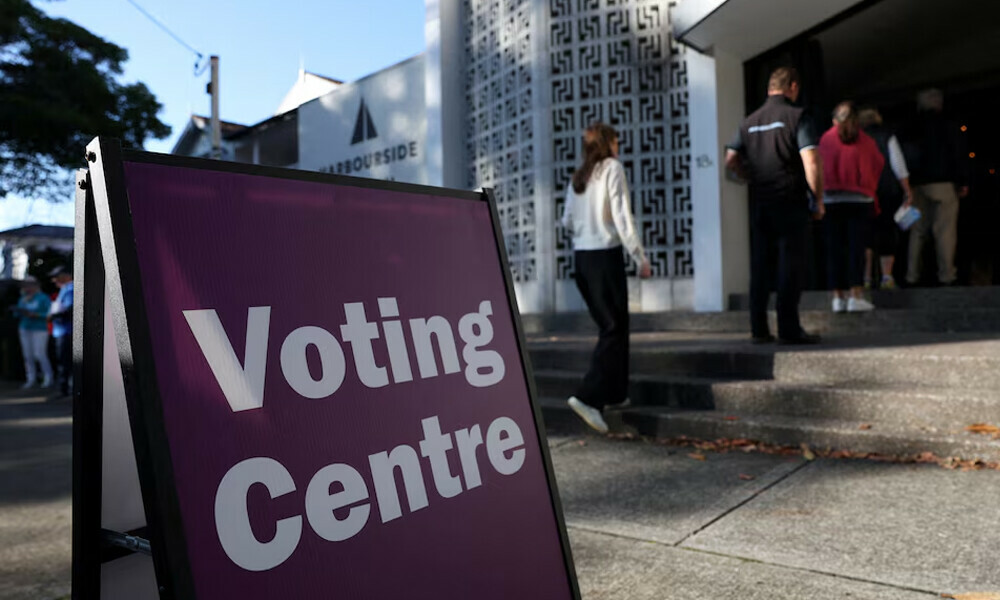

SYDNEY: Australia’s Prime Minister Anthony Albanese campaigned in his conservative opponent Peter Dutton’s constituency on the final day before Saturday’s election, with polls favouring the incumbent in a campaign overshadowed by Donald Trump’s volatile diplomacy.
Australia is among the few democracies with mandatory voting, and close to 7 million out of an eligible 18 million voters had already cast a ballot by Friday at early voting centres or by postal voting, the Australian Electoral Commission said.
All published opinion polls show Albanese’s centre-left Labor ahead of the conservative Liberal-National coalition on a two-party preferred basis, although the polls also show that Labor could find itself leading a minority government.
Both major parties have focused on cost-of-living pressures and high housing costs, but polls show that global uncertainty driven by Trump’s stop-start tariffs rapidly became a top issue for voters during the campaign.
Dutton has sought to distance himself from comparisons with Trump but has fallen behind after leading in opinion polls as recently as February.
Political strategists said Trump was not the decisive factor - Albanese has run a strong campaign, and Dutton made mistakes including a short-lived policy to ban public servants working from home. But the Trump effect, they said, has added to reservations for voters who became risk-averse.
“In uncertain times you can be certain that Labor has a plan to build Australia’s future and you can be certain that the Coalition have cuts and chaos,” Albanese said on Friday at a press conference, honing his final pitch to voters.
In a radio interview with the Australian Broadcasting Corporation, Albanese said Australia was “a different country to the United States” and voters are concerned about Dutton’s election pledges to “slash climate change policies” and cut 41,000 public servants.
Dutton, campaigning in his own electorate a day before Albanese, highlighted difficulties facing Australian families and small businesses. “Are you better off today than you were three years ago?” he told voters.
Australian prime minister’s party launches election campaign
Pointing to a 2019 election result that had defied the opinion polls by returning a conservative government, Dutton said on Friday he could still win.
A Red Bridge-Accent poll published by News Corp newspapers on Thursday showed Labor leading 53%-47% against the conservative Liberal-National coalition under Australia’s two-party preferential voting system, with voters citing concerns about Trump and about Dutton’s plan to build nuclear power stations in a nation where nuclear energy is banned.
An Australian Financial Review/Freshwater poll on Friday had Labor leading 51.5%-48.5%.
Albanese, who flew 1,600 km (1,000 miles) from Queensland in the north to the southernmost state of Tasmania, cautioned that there were a large number of undecided voters. He will proceed to Victoria, where analysts said Labor is at risk of losing outer suburban seats, and to his home state of New South Wales.
Albanese said on Friday he would not strike policy deals for support from minor parties or independents, as occurred in the most recent minority Labor government in 2010.




















Comments
Comments are closed for this article.