


DG ISPR provides evidence: India involved in cross-border terrorism
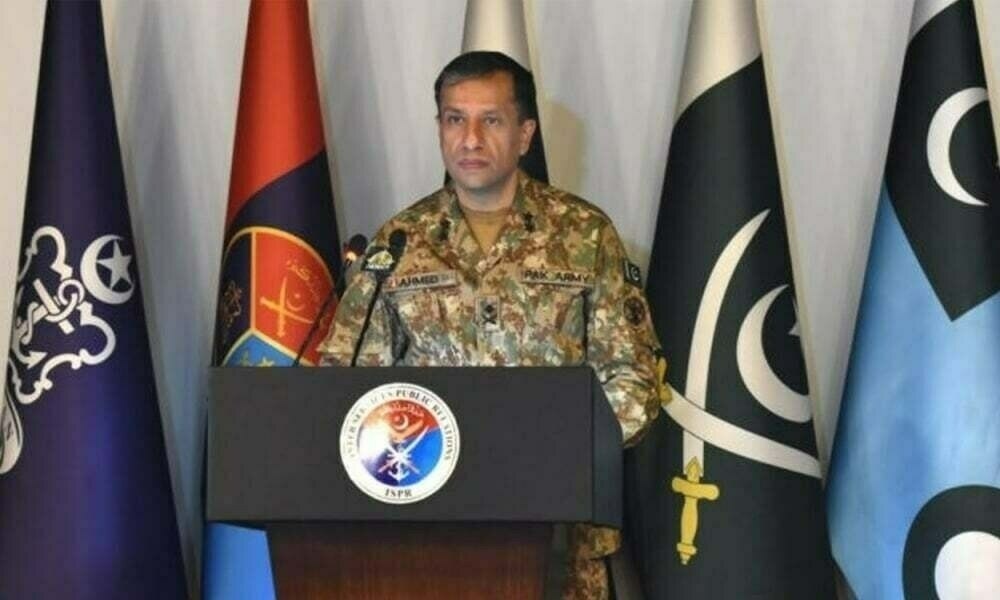

ISLAMABAD: Director General Inter-Services Public Relations (DG ISPR) Lieutenant General Ahmed Sharif Chaudhry on Tuesday accused India of executing a deliberate and calculated campaign of state-sponsored terrorism inside Pakistan.
He presented what he termed “complete and irrefutable evidence” of Indian military officers orchestrating cross-border attacks to destabilise Pakistan and manipulate global narratives.
The press conference came amid escalating tensions between the two nuclear-armed neighbours, following the April 22 Pahalgam attack in Indian-occupied Kashmir that claimed 26 lives, mostly tourists. India had quickl blamed Pakistan but, Lt Gen Chaudhry asserted, failed to provide any evidence.
“Seven days have passed, and India has not presented a single shred of evidence for its baseless allegations,” he stated. “In contrast, we are presenting verified and actionable proof of India’s direct involvement in terrorism within Pakistan.”
Lt Gen Chaudhry revealed that on April 25, Pakistani security forces arrested Abdul Majeed, an Indian-trained terrorist, from a bus terminal near Jhelum. Authorities recovered 2.5 kg of explosives, an Indian-made drone, and over Rs1 million in cash from his possession.
Subsequent forensic analysis and digital investigations traced Majeed’s communications to serving Indian Army officers, including Subedar Sukhwinder and Major Sandeep Verma. Two other Indian officers, Havaldar Amit and a junior-ranked sepoy, were also identified as handlers in this network. “These Indian handlers were not just guiding these militants but actively instructing them to target civilians to portray Pakistan as a hub of terrorism before the international community,” said the ISPR chief.
Lt Gen Chaudhry provided a timeline of attacks allegedly directed by the Indian handlers:
On September 24, Subedar Sukhwinder directed Abdul Majeed to collect explosives from Barnala, Bhimber. On October 13, Majeed attacked a military vehicle in Bagh district, injuring three soldiers. He was paid Rs180,000 for this operation. On November 22, he retrieved an IED and a damaged drone near Head Marala.
On November 30, he planted that IED under a military vehicle in Jalalpur Jattan, leading to the martyrdom of four soldiers. He received Rs656,000 as payment.
On March 18, Indian handlers provided coordinates for another explosive near Kotli, which was discovered the next day by schoolchildren, prompting a safe recovery by the Pakistan Army. Despite the incident happening in Pakistan, Indian media falsely claimed five bombs were recovered in Kashmir — an act Lt Gen Chaudhry condemned as “blatant misinformation.”
On April 22, another IED was delivered near Nadalah, and Majeed was ordered to target a local bus stand the following day.
Lt Gen Chaudhry noted that India is using drones to deliver explosive materials, including IEDs, to terrorists operating in Pakistan, and is also sharing bomb-making tutorials through digital channels. He added that Major Sandeep Verma confessed to overseeing attacks from Balochistan to Lahore, demonstrating the wide geographical span of India’s alleged campaign.
The ISPR chief also disclosed that Indian intelligence has activated sleeper cells, and is working through TTP militants, separatist elements, and independent terrorist cells, especially in Balochistan and along the Afghan border.
As evidence, he cited a major military operation carried out two nights ago in North Waziristan, where 54 terrorists attempting to infiltrate from Afghanistan were killed, raising the total number of militants neutralised to 71 in the past few days.
Amid these developments, cross-border firing was reported for the fifth consecutive night, effectively ending four years of relative calm along the Line of Control (LoC). The Pakistan Army also shot down an Indian surveillance drone near the LoC earlier today.
In his closing remarks, Lt Gen Ahmed Sharif Chaudhry emphasised that Pakistan would not be intimidated by such tactics. “No one can undo Pakistan,” he said firmly, warning India against underestimating Pakistan’s capacity to defend itself.
The DG ISPR also urged the international community to take notice of India’s actions and the emerging threat of state-sponsored terrorism disguised as internal militancy in Pakistan.
Copyright Business Recorder, 2025




















Comments
Comments are closed for this article.