


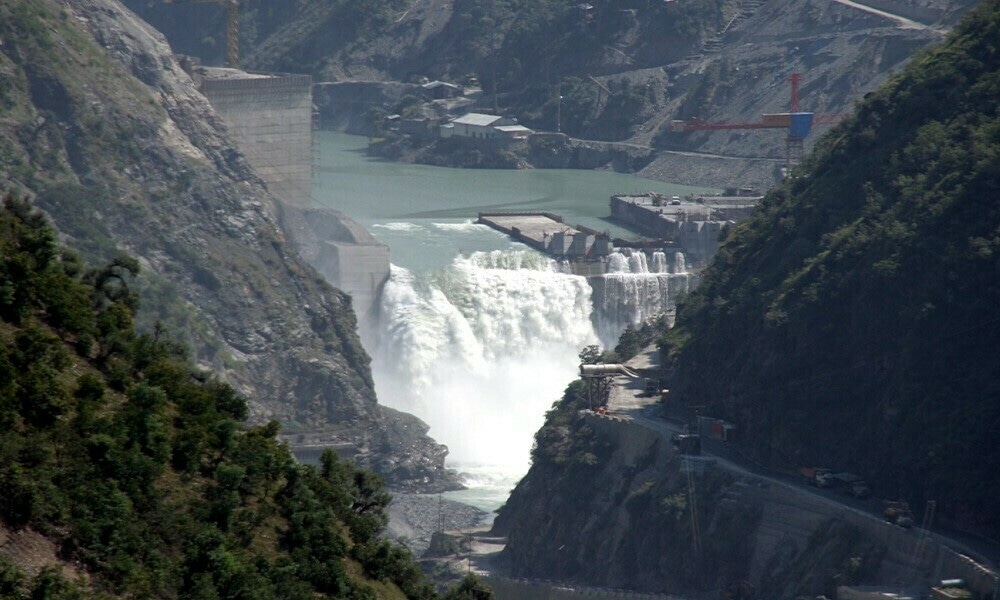

KARACHI: Pakistan’s business community has strongly criticised India’s suspension of the Indus Waters Treaty (IWT), calling it a harmful decision for South Asian stability.
In response to India’s “water war” after the Pahalgam incident, Pakistan’s move to ban Indian goods entirely has received positive support from the national business community, which has assured full backing of the government’s decisions.
The business community pointed out that while direct trade with India is already suspended several Indian products still enter Pakistan via third countries like Dubai, Singapore, and Sri Lanka.
The entire world is now aware of the hasty and staged new drama orchestrated by Indian Prime Minister Narendra Modi against Pakistan. Not only is Modi facing internal resistance within India due to this fabricated narrative, but Indians around the globe are also calling it an obsession of his. India's stubborn policies are not only straining its economy but also worrying Indian traders who are troubled by the Modi government’s provocative actions.
Due to the suspension of trade via Pakistan to Afghanistan, India is suffering a trade loss of approximately $1.14 billion. It is estimated that goods worth around $640 million were annually transported via Pakistan to Afghanistan, which has now been disrupted.
From April 2024 to January 2025, India exported nearly $500 million worth of goods to Pakistan, while imports from Pakistan stood at only $422,000, highlighting a significant trade imbalance. Banning this indirect trade would severely impact India economically.
In a survey, FPCCI Senior Vice President Saqib Fayyaz Magoon said that halting trade between the two countries would hurt India more than Pakistan. He emphasised that India had already imposed non-tariff barriers and that the existing trade balance favoured India. He noted that medicines previously imported via Dubai and other nations could now be sourced from China, Malaysia, and elsewhere.
He further stated that India’s malicious intentions are now clear to the world. Pakistan has already paid a heavy price in the war against terrorism—thousands of lives lost and billions in economic damage. While Pakistan desires peace, it will never compromise on its sovereignty, security, or national interests.
The United Business Group (UBG) patron-in-chief and former Punjab Minister of Commerce and Industry, S M Tanveer, said he has heard India’s empty threats since childhood. He stated that whenever Pakistan’s economy starts improving, India attempts to sabotage it under various pretexts. But now, Pakistan has given a strong response: if India violates the water treaty, it’s tantamount to war—and India can test that if it wishes. He referenced an Indian soldier’s own statement questioning how a terrorist attack could happen in a no-go area. He asserted that Pakistan’s business community is ready to sacrifice everything for the country and has no need for trade with India.
UBG President Zubair Tufail echoed this, stating that the trade suspension will hurt India, not Pakistan. He added that medicines can be imported from Europe, China, Malaysia, and Indonesia— India is not indispensable. Ending Indian imports would boost Pakistan’s own industries, and the business community must align with the government and military to strengthen the national economy rather than the enemy’s.
Karachi Chamber of Commerce and Industry (KCCI) President Javed Bilwani expressed complete support for all government and institutional decisions regarding national security. He endorsed the firm stance of Prime Minister Shehbaz Sharif and Army Chief General Asim Munir against Indian aggression. He stressed that peace is essential for economic independence and growth, and that national unity and good governance are crucial for Pakistan’s future.
On India-Pakistan trade, Bilwani noted that India had already imposed trade restrictions, and while disruption would affect both countries, the business community prioritises national integrity and stands by the leadership.
Captain Abdul Rasheed Abro, a central leader of the Pakistan Business Forum, stated that the Modi government's baseless and misleading propaganda against Pakistan is now exposed globally. He affirmed that Modi is facing strong resistance even within India. The entire Pakistani population— over 250 million people— supports the government and armed forces in their actions, acknowledging that India has long been exploiting Pakistan’s economy through deceptive means. He added that Indian goods entering via Dubai and other countries have hurt local industries, and strict decisions must now be taken in the national interest.
FPCCI Vice President Aman Pracha condemned India’s use of incidents like Pahalgam for advancing its narrow political agenda, stating that such actions only fuel regional instability. He asserted that Pakistan and its armed forces are fully prepared to defend the country's sovereignty and territorial integrity, and reiterated that Pakistan no longer desires trade with India.
All City Traders Ittehad Association patron-in-chief and All Pakistan Timber Traders Association chairman Sharjeel Goplani emphasised the need for establishing timber processing zones within Pakistan to reduce reliance on Indian wood imports through third countries. He said Pakistan could source timber from countries like the US, Canada, Europe, Malaysia, Cambodia, Vietnam, and African nations, and even re-export it to the Middle East as India does from Gujarat’s Kandla Port. He confirmed that his association has already banned Indian timber and fully supports the government and armed forces.
Goplani pointed out that Pakistan has paid a heavy price to defeat terrorism, and Indian intelligence agencies continue their malicious efforts, falsely blaming Pakistan for incidents like Pahalgam.
However, Karachi Electronics Dealers Association President Rizwan Irfan said that no Indian electronics are currently being imported into Pakistan, and although peaceful conditions would benefit Pakistan more in trade, India does not want Pakistan’s economy to strengthen. He declared that for Pakistan’s business community, the country always comes first—trade second. He pledged full support to the government and military, stating that any Indian aggression will receive a strong response and that the electronics community stands shoulder to shoulder with the nation.
Copyright Business Recorder, 2025




















Comments
Comments are closed for this article.