



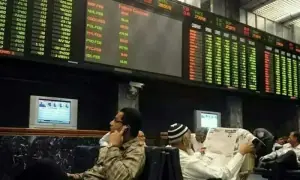
EDITORIAL: Amid escalating geopolitical tensions and instability in the region – intensified by the ongoing repercussions of the Pahalgam tragedy, pushing Pakistan and India further towards a dangerous confrontation — the Pakistan Stock Exchange (PSX) witnessed a turbulent trading session on April 24.
The KSE-100 Index plummeted by 2,206.33 points, or 1.88 percent, closing at 115,020 compared to the previous day’s 117,226, reflecting growing investor anxiety over looming economic instability. It must be noted, however, that even before tensions between the South Asian neighbours had reached boiling point, investor confidence had already been eroded by a combination of the Trump Administration’s erratic trade tariff policy, a persistently weakening rupee and volatile foreign exchange reserves, prompting downward revisions of Pakistan’s GDP growth forecasts by the IMF and the World Bank.
Inevitably, this had led to patchy stock market performance of late, with the wider economy also under pressure from these headwinds, and appearing increasingly susceptible to significant underperformance as geopolitical risks intensify.
Here, the unpredictability of President Donald Trump’s trade tariff decisions in particular carries broader implications, as such disruptions tend to ripple across global markets via trade and financial linkages. For developing economies like ours, which already grapple with elevated debt burdens, fragile foreign exchange buffers and institutional weaknesses, the likelihood of external shocks — such as a reckless, reactionary trade policy pursued by the world’s preeminent economic power, shaped more by flawed ideology than solid economic logic – triggering systemic instability becomes significantly higher. By injecting deep uncertainty into global trade norms, such erratic policymaking has not only undermined confidence in the US as a stable economic leader but also eroded trust in the dollar’s credibility as the anchor currency of international commerce.
The resulting volatility has unsettled markets and disrupted long-standing supply chains — including ironically in the US itself — and could prompt a broader re-evaluation of reliance on dollar-denominated assets and US-centric financial systems. Governments and businesses worldwide are grappling with the chaos and struggling to contain its impact.
While geopolitical events like terrorism, diplomatic rifts and military conflicts can severely disrupt economic activity by shaking investor confidence, driving down asset prices and straining financial systems – and the ramifications of the Pahalgam incident will prove this in the coming days — it is evident that the impact of trade-related geopolitical tensions, particularly erratic tariff policies, can be just as severe.
The flip-flopping trajectory of US tariff policy exemplifies this volatility: initial blanket tariffs on all countries were partially rolled back for 90 days except in the case of China, followed by signals that there may be an easing of Chinese tariffs as well. This extreme policy shock represents a pattern of the US deliberately using unpredictability as a tool to negotiate with its trading partners. While the Trump Administration may have softened its initial stance, it has demonstrated a disturbing willingness to escalate towards a broader global trade war.
For Pakistan, such global trade volatility amplifies existing vulnerabilities, disrupting export markets, deterring foreign investment and complicating economic planning. As has been previously noted, this uncertainty has already rattled the PSX, where investor sentiment is highly sensitive to external shocks, leading to heightened instability and sustained downward pressure on valuations. And with a constrained fiscal space and a heavy reliance on external financing, Pakistan remains particularly exposed to the spillover effects of global economic turbulence.
It is evident then that geopolitical shocks, especially in the form of foolish and short-sighted economic and trade policies, can inflict widespread damage, disrupting global economic stability and undermining long-term economic resilience. Struggling economies like Pakistan’s are especially vulnerable, as such disruptions exacerbate existing challenges and hinder the path to sustainable growth.
Copyright Business Recorder, 2025











Comments
Comments are closed for this article.