


BR100 Increased By (0.05%)
BR30 Decreased By (-0.02%)
KSE100 Increased By (0.24%)
KSE30 Increased By (0.29%)
BECO 5.77 Increased By ▲ 0.46 (8.66%)
BML 53.00 Increased By ▲ 1.42 (2.75%)
BOP 33.99 Increased By ▲ 0.03 (0.09%)
CNERGY 8.11 Decreased By ▼ -0.20 (-2.41%)
DCL 12.20 Increased By ▲ 0.40 (3.39%)
FCCL 52.83 Decreased By ▼ -0.17 (-0.32%)
FCSC 5.07 Increased By ▲ 0.12 (2.42%)
FFL 17.95 Decreased By ▼ -0.20 (-1.1%)
FNEL 1.29 Decreased By ▼ -0.03 (-2.27%)
HUMNL 10.88 Decreased By ▼ -0.12 (-1.09%)
KEL 8.02 Decreased By ▼ -0.12 (-1.47%)
KOSM 5.52 Decreased By ▼ -0.06 (-1.08%)
MLCF 86.51 Decreased By ▼ -1.37 (-1.56%)
NBP 185.16 Decreased By ▼ -2.53 (-1.35%)
PACE 10.58 Decreased By ▼ -0.23 (-2.13%)
PAEL 39.42 Decreased By ▼ -0.65 (-1.62%)
PIAHCLA 26.22 Decreased By ▼ -0.27 (-1.02%)
PIBTL 16.67 Decreased By ▼ -0.09 (-0.54%)
PPL 228.18 Decreased By ▼ -2.19 (-0.95%)
PRL 34.68 Decreased By ▼ -0.36 (-1.03%)
PTC 65.33 Increased By ▲ 0.82 (1.27%)
SEARL 90.13 Increased By ▲ 0.25 (0.28%)
SSGC 26.60 Decreased By ▼ -0.37 (-1.37%)
TELE 8.28 Decreased By ▼ -0.09 (-1.08%)
THCCL 58.50 Decreased By ▼ -0.58 (-0.98%)
TPLP 8.22 Increased By ▲ 0.04 (0.49%)
TREET 24.53 Decreased By ▼ -0.47 (-1.88%)
TRG 69.71 Decreased By ▼ -0.92 (-1.3%)
WAVES 9.94 Decreased By ▼ -0.07 (-0.7%)
WTL 1.28 Decreased By ▼ -0.01 (-0.78%)
BR Research

Too many young, too few factories

Published April 11, 2025 Updated April 11, 2025 08:50am

More than half of Pakistan’s 241 million citizens are under the age of 19. Every year, millions of them join the workforce—only to find the industrial economy moving in the opposite direction. If there was ever a recipe for demographic disaster, this might be it.

The employment data from Punjab and Sindh’s large-scale manufacturing (LSM) sector paints a bleak picture. In Punjab, employment has declined steadily from an index value of 100 in July 2022 to 96.3 by June 2024. Sindh has done worse - falling to 95.4 over a similar period. This isn’t seasonal fluctuation—it’s a structural decline. And it’s happening at a time when Pakistan should be expanding industrial output just to keep pace with its youth bulge.

And these aren’t fringe numbers either. In Punjab, the data covers 72 percent of the province’s LSM value-added. For Sindh, the coverage is even higher at 84 percent. Put together, this suggests that employment opportunities have either stagnated or declined across at least three-fourths of the country’s large-scale manufacturing. It’s unlikely the remaining quarter has been marching to a different, rosier beat.

But the factories aren’t humming. They’re slowing, stalling, or, in some cases, shutting down. Large manufacturing has been in the doldrums for over two years, and in many sectors, output is now lower than it was 5–7 years ago. The oft-cited concern that Pakistan is deindustrializing prematurely is no longer a cautionary tale. It’s a live reality.

True, LSM isn’t the whole economy. Construction, retail, and wholesale—sectors that employ millions—aren’t reflected here, and employment numbers for these are patchy at best. Small-scale industries, often more labour intensive, are also missing. But LSM still accounts for a significant chunk of value addition, and with data available on a time series, it remains a useful proxy for overall employment health. And that health is clearly deteriorating.
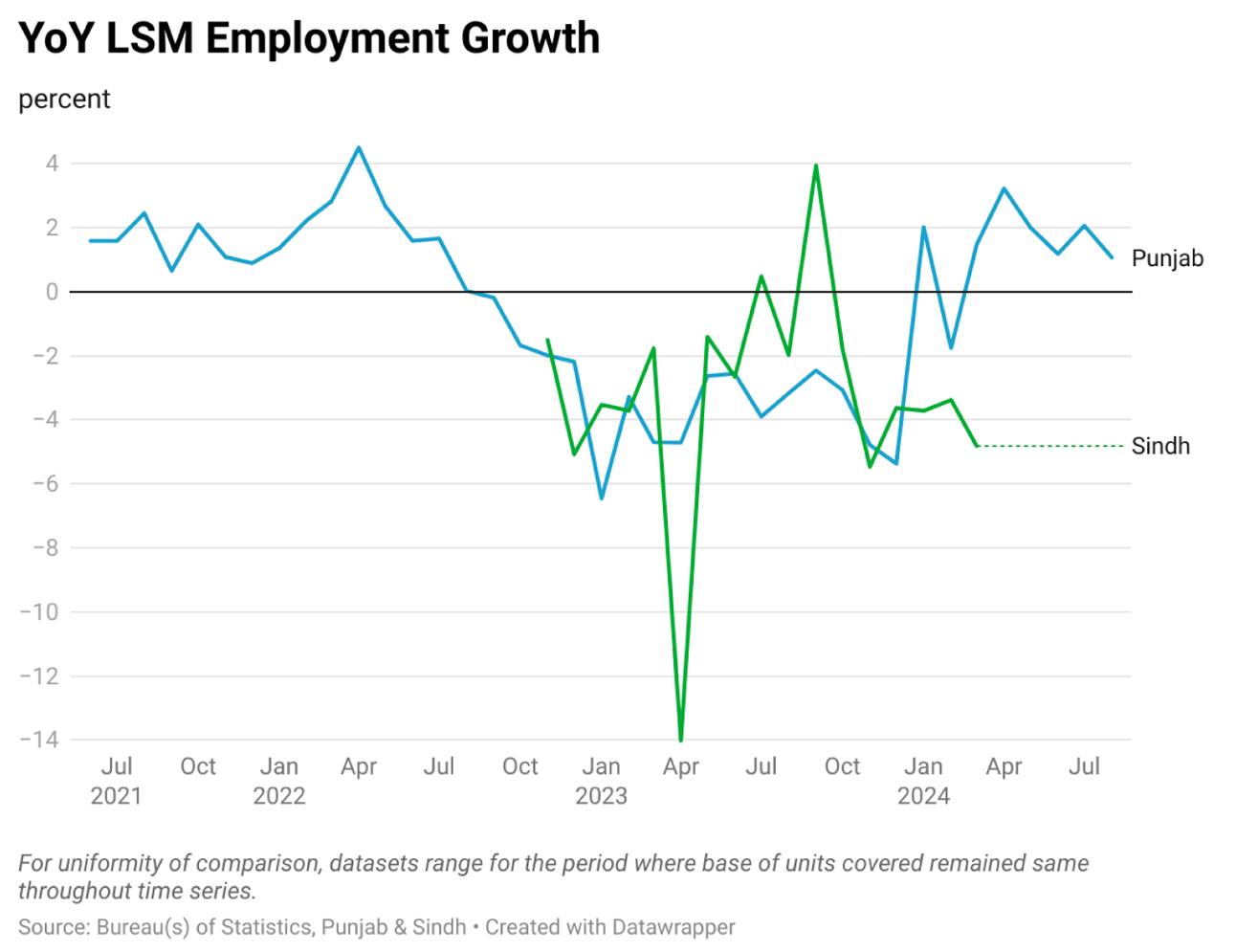
In more advanced economies, jobs data are treated with the gravity of GDP or inflation numbers. In Pakistan, they’re often relegated to footnotes and forgotten until the next crisis. Yet employment is a crucial input into understanding the output gap—how much potential the economy has and how much it’s actually producing.

That gap seems to be widening. This brings us back to the young population: if jobs don’t keep pace with the workforce, what comes next? Idle labour, wasted potential, social unrest?

Unless industry, government, and academia collaborate to align skill supply with actual demand, Pakistan risks squandering its biggest asset—its people. And with charts like these, the squandering has already begun.

Comments

Comments are closed for this article.

Rizwan Apr 11, 2025 11:36am
Why do I feel this information won't reach the target audience and only general public who can't do much about it is cursed with reading these gloomy newspaper articles.
0
Fatima Apr 11, 2025 02:49pm
Market flooded with cheap Chinese tat, that’s the root issue
0
Imran Siddiqi Apr 12, 2025 10:00am
Any country whose population growth rate is greater than is economic growth rate will face unemployment. Population control is the answer to our problems as we simply cannot create these jobs.
0
Fouzi. Apr 12, 2025 10:12am
The export sector deliberately targeted by the draconian refund law which have resulted in a massive unemployment
0
Khalid Janjua Apr 12, 2025 04:15pm
Your best friend has already swallowed you! Too bad, you don't even manufacture a match stick. Else you would light it and see the inside of your friend.
0
MASTER SHOKA Apr 12, 2025 05:11pm
Excessive and unfair taxes on filers.non-filers usually offer bribes to evade taxes.illegal smuggling of goods and gasoline from borders.various illegal containers non-custom paid.0% competition.
0
Isarf Apr 14, 2025 08:52pm
@Khalid Janjua, you are either clueless or and Indian trolling under a sudo name. Google search how Pakistan filling the gaps in match stick market in Europe!!!
0
Abdullah Apr 15, 2025 02:46pm
Employment generation is directly related to availability of finance, if government cannot control inflation then Investors will not build factories, they'd buy real estate The problem is capitalism.
0
Reply Guy Apr 15, 2025 07:38pm
@Fatima , The root issue is that these supposedly cheap Chinese products are less expensive and more competitive than Pakistani-made products despite China being at 10x our per capita income.
0
Mishraz Ahmed Siddiqui Apr 16, 2025 10:24pm
Eventuality of wrong policies for textile yarn spinning and ginning tactories, and lot many wrong policies for clothing security, food security and providing shelter.
0














