


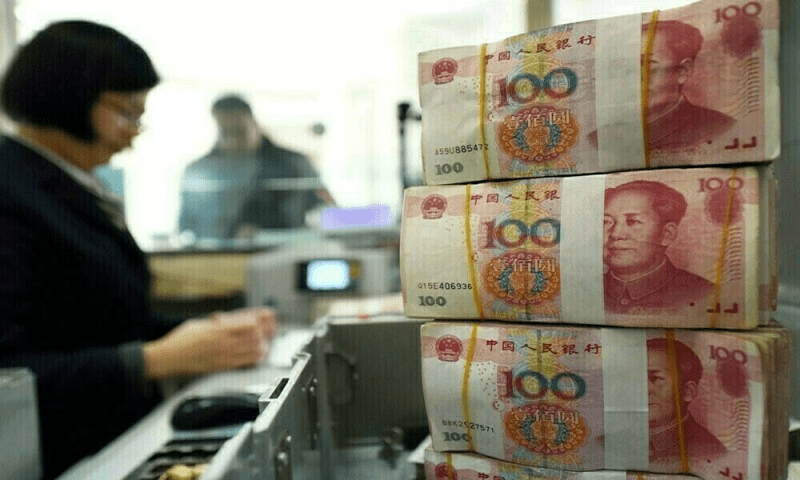

SINGAPORE/HONG KONG: China’s yuan ended at its weakest level in more than 17 years on Wednesday after its offshore counterpart fell to a record low overnight, as an escalating Sino-U.S. trade war rattled currency markets.
The onshore yuan finished the domestic trading session at 7.3498 per dollar, its weakest close since December 2007.
The declines come as a trade war between the world’s two largest economies escalates. U.S. President Donald Trump’s “reciprocal” tariffs on dozens of countries took effect on Wednesday, including massive 104% duties on Chinese goods.
China’s top leaders plan to meet as soon as Wednesday to hammer out measures to boost the economy and stabilise capital markets, people with knowledge of the matter said.
While despite the tariff pressure, China’s central bank will not allow sharp yuan declines and has asked major state-owned banks to reduce U.S. dollar purchases, people with direct knowledge of the matter said on Wednesday.
“Unless they are rolled back, the latest U.S. tariff hikes mean that China’s shipments to the U.S. will more than halve over the coming years, even assuming the renminbi weakens to 8 to the dollar,” Capital Economics said in a note to clients.
Trump’s new tariffs take effect, with 104% on Chinese goods
“This will reduce China’s GDP by somewhere between 1.0-1.5% depending on the extent of rerouting (exports through other countries). That’s a larger hit than we had assumed but will probably be met with a further expansion in fiscal support.”
The offshore yuan pared losses and climbed about 0.7% to 7.3769 yuan per dollar in Asian trade, after sinking more than 1% in the previous session and hitting its record low of 7.4288 overnight.
Market stabilization
The People’s Bank of China on Wednesday set the midpoint rate - around which the onshore yuan is allowed to trade in a 2% band - at 7.2066 per dollar, the lowest since September 11, 2023.
Based on the fixing level, the yuan is allowed to drop as far as 7.3507, a whisker stronger than the 7.3510 low struck in September 2023.
The fixing was 1,282 pips firmer than a Reuters estimate, suggesting the central bank is reluctant to see a drastic depreciation of the currency.
Chinese state-owned banks were busy selling dollars in the onshore spot market to slow the pace of yuan declines early on Wednesday morning, according to two people familiar with the matter.
Still, both the onshore and offshore yuan have fallen more than 1% so far this month, leaving them weaker since the start of the year, pressured by fears of the tariffs impact.
Trump on Tuesday accused China of manipulating its currency to offset the impact of tariffs.
A weaker yuan would make exports cheaper and alleviate some pressure on China’s trade and the broader economy, but a sharp decline could fuel unwanted capital outflow pressure and risk financial stability, economists said.




















Comments
Comments are closed for this article.