


Trump’s tariffs stoke global trade war as China, EU hit back
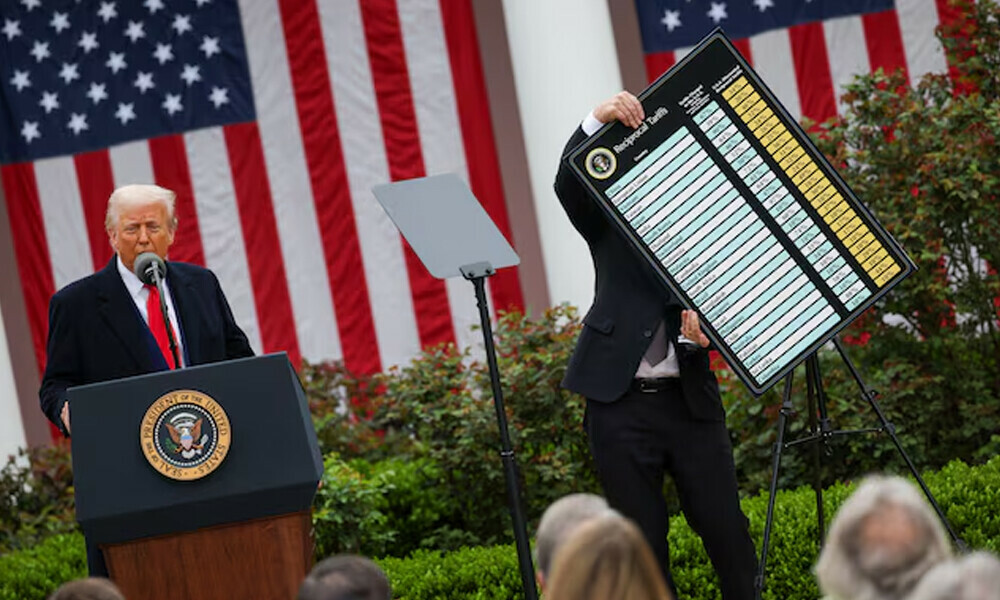

WASHINGTON/BEIJING/BRUSSELS: President Donald Trump’s move to slap a 10% tariff on most goods imported to the United States, as well as much higher levies on dozens of rivals and allies alike, has intensified a global trade war that threatens to stoke inflation and stall growth.
The sweeping penalties announced against the serene backdrop of the White House Rose Garden on Wednesday immediately unleashed turbulence across world markets and drew condemnation from other leaders now facing the end of an era of trade liberalization that has shaped the global order for decades.
As Asia digested the news on Thursday, stock markets in Beijing and Tokyo sank to multi-month lows, with U.S. and European stock futures also pointing to sharp losses as investors scrambled to the safety of bonds and gold.
Now facing 54% tariffs on exports to the U.S., the world’s No. 2 economy China vowed countermeasures, as did the European Union - Washington’s friends and foes united in criticism of measures they fear will deal a devastating blow to global trade.
Trump sparks trade war with sweeping global tariffs
“The consequences will be dire for millions of people around the globe,” EU chief Ursula von der Leyen said in a statement, adding the 27-member bloc was preparing to hit back if talks with Washington failed.
U.S. Treasury Chief Scott Bessent earlier warned that any such retaliatory moves would only lead to escalation.
Among close U.S. allies, the European Union was targeted with a 20% rate, Japan with 24%, South Korea with 25% and Taiwan with 32%. Even some tiny territories and uninhabited islands in the Antarctic were hit by tariffs, according to a list posted by the White House on X.
The base tariffs go into effect on April 5 and the higher reciprocal rates on April 9.
Trump said the “reciprocal” tariffs were a response to duties and other non-tariff barriers put on U.S. goods. He argued that the new levies will boost manufacturing jobs at home.
“For decades, our country has been looted, pillaged, raped and plundered by nations near and far,” Trump said.
Trump tariffs bad for global economy and trade, Maersk says
Outside economists have warned that tariffs could slow the global economy, raise the risk of recession, and increase living costs for the average American family by thousands of dollars.
Canada and Mexico, the two largest U.S. trading partners, already face 25% tariffs on many goods and will not face additional levies from Wednesday’s announcement.
Even some fellow Republicans have expressed concern about Trump’s aggressive trade policy.
Within hours of Wednesday’s announcement, the Senate voted 51-48 to approve legislation that would terminate Trump’s Canadian tariffs, with a handful of Republicans breaking with the president. Passage in the Republican-controlled U.S. House of Representatives, however, was seen as unlikely.
Trump’s top economist, Stephen Miran, told Fox Business on Wednesday the tariffs would work out well for the U.S. in the long run, even if they cause some initial disruption.
“Are there going to be short-term bumps as a result Absolutely,” Miran, the chairman of Trump’s Council of Economic Advisors, said.
Sri Lanka warns US tariffs threaten ‘thousands’ of jobs
Ending ‘de minimis’
The reciprocal tariffs do not apply to certain goods, including copper, pharmaceuticals, semiconductors, lumber, gold, energy and “certain minerals that are not available in the United States,” according to a White House fact sheet.
Following his remarks, Trump also signed an order to close a trade loophole used to ship low-value packages - those valued at $800 or less - duty-free from China, known as “de minimis.” The order covers goods from China and Hong Kong and will take effect on May 2, according to the White House, which said the move was intended to curb the flow of fentanyl into the U.S.
Chinese chemical makers are the top suppliers of raw materials purchased by Mexico’s cartels to produce the deadly drug, U.S. anti-narcotics officials say. A Reuters investigation last year showed how traffickers often route these chemicals through the United States by exploiting the de minimis rule. China has repeatedly denied culpability.
Trump is also planning other tariffs targeting semiconductors, pharmaceuticals, and potentially critical minerals, the official said.
Earlier in the day, the administration said a separate set of tariffs on auto imports that Trump announced last week will take effect starting on Thursday.
Singapore disappointed with 10% tariffs, will seek negotiation with the US
Trump previously imposed 25% duties on steel and aluminum and extended them to nearly $150 billion worth of downstream products.
Tariff concerns have already slowed manufacturing activity across the globe, while also spurring sales of autos and other imported products as consumers rush to make purchases before prices rise.
Now as the reality of the new tariffs sink in, companies around the world must weigh up how to adjust, with their options limited and unpalatable for their customers.
“This is how you sabotage the world’s economic engine while claiming to supercharge it,” said Nigel Green, CEO of global financial advisory deVere Group. “The reality is stark: these tariffs will push prices higher on thousands of everyday goods - from phones to food - and that will fuel inflation at a time when it is already uncomfortably persistent.”




















Comments
Comments are closed for this article.