



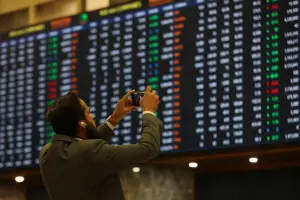
SINGAPORE: Stocks dived on Thursday and investors scrambled for the safety of bonds, gold and the yen, fearing new US tariffs have intensified a trade war threatening to tip the world into recession.
The dollar was swept to a six-month low, falling along with US bond yields after President Donald Trump imposed tariffs that raise effective import taxes to the highest levels in a century.
“This is a game-changer, not only for the US economy but for the global economy,” said Olu Sonola, head of US economic research at Fitch Ratings.
“Many countries will likely end up in a recession. You can throw most forecasts out the door if this tariff rate stays on for an extended period of time.”
Nasdaq futures dropped 3.2%, European futures were down nearly 2% and the Nikkei’s 3% fall in Tokyo - touching eight-month lows - led heavy losses across Asia.
Apple’s market capitalisation fell by more than $240 billion as its shares slid 7% in after-hours trade.
Nvidia’s market cap dropped 5.6% or $153 billion. Benchmark 10-year US Treasury yields fell more than 15 basis points to a five-month low of 4.04% and markets priced a higher chance of interest rate cuts even though the tariffs are likely to cause US inflation to spike sharply.
“You are going to have a supply-side shock via tariffs on the US economy, on prices,” said Tai Hui, Asia-Pacific chief market strategist at J.P. Morgan Asset Management.
“And then (there’s) the uncertainty when it comes to businesses and consumers, both of which could be problematic for growth.” Trump announced a baseline 10% tariff on imports with far higher levies on some trading partners, particularly in Asia.
Asian stocks bounce back from tariff woes-led drop, currencies dip
China was hit with a 34% levy, Japan got 24%, Vietnam 46% and South Korea 25%.
The European Union was hit with a 20% levy. According to Fitch Ratings, the effective US import tax rate has shot up to 22% under Trump from just 2.5% in 2024, reaching levels last seen around 1910. Vietnamese stocks slumped 6%.
China focus
Ahead of promised countermeasures from China and Europe, investors were buying up safe havens and selling exposure to global growth.
Oil, a proxy for economic activity, dropped more than 2% to put benchmark Brent futures at $73.28 a barrel.
Australian shares and the Australian dollar fell. Gold hit a record high above $3,160 an ounce and Japan’s yen jumped more than 1% to 147.29 per dollar as foreign exchange traders looked for safety outside the US dollar.
The euro rose 0.6% to $1.0912. China, for now, held its currency relatively steady, containing the yuan’s drop to about 0.4% despite eye-watering total tariffs of above 50% on Chinese exports and the hit to Vietnam seen as shutting down a popular work-around route.
China’s big domestic economy and the hope of support from Beijing limited losses in Hong Kong stocks to about 1.5% and in Shanghai to around 0.5%.
“The key focus over the next few days should clearly be China,” said Deutsche Bank strategist George Saravelos.
“How willing will China be to wait for trade negotiations … or to absorb this?,” he said. “Or will it try to ‘export’ the shock … via a devaluation of the yuan.”















Comments
Comments are closed for this article.