


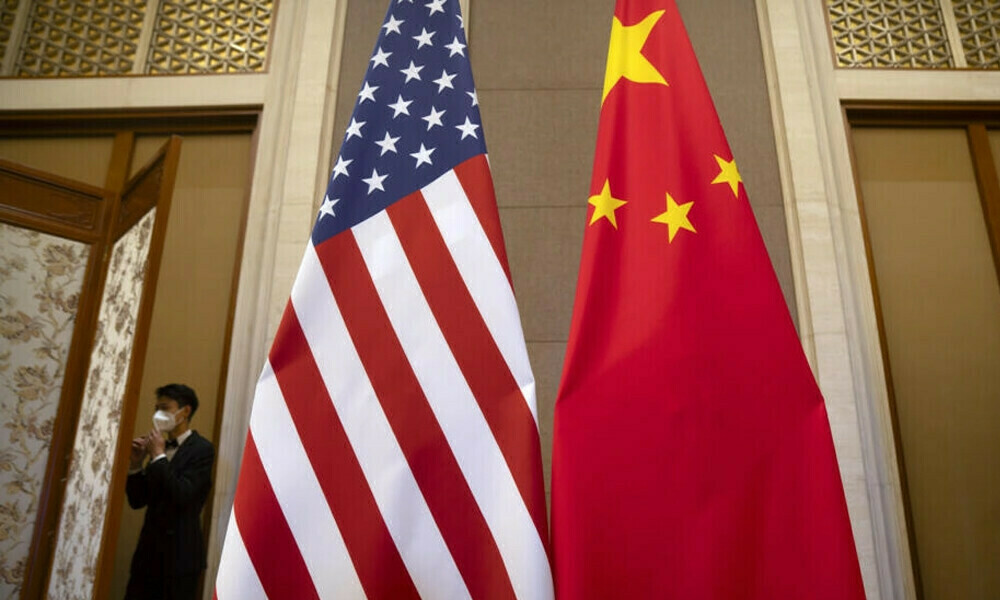

BEIJING: Trade tensions between the world’s two leading economies are set to escalate on Monday, as Beijing begins levying tariffs on certain US agricultural goods in retaliation for President Donald Trump’s latest hike on Chinese imports.
Since retaking office in January, Trump has unleashed a barrage of tariffs on major US trading partners, including China, Canada and Mexico, citing their failure to stop illegal immigration and flows of deadly fentanyl.
After imposing a blanket 10 percent tariff on all Chinese goods in early February, Trump hiked the rate to 20 percent last week.
Beijing reacted quickly, its finance ministry accusing Washington of “undermining” the multilateral trading system and announcing fresh measures of its own.
The moves will see fresh tariffs of 10 and 15 percent imposed on several US farm products, starting on Monday.
Chicken, wheat, corn and cotton from the United States will now be subject to the higher charge while soybeans, sorghum, pork, beef, aquatic products, fruit, vegetables and dairy will face the slightly lower rate.
Analysts say Beijing’s retaliatory tariffs are designed to hurt Trump’s voter base while remaining restrained enough to allow room to hash out a trade deal.
The increasing trade headwinds add to difficulties faced by Chinese leaders currently seeking to stabilise the country’s wavering economy.
Sluggish consumer spending, a prolonged debt crisis in the vast property sector and high youth unemployment are among the issues now facing policymakers.
China’s exports — which last year reached record highs — might not provide the same economic lifeline for Beijing as its trade war with Washington intensifies.
Experts say the full effects of the recent wave of tariffs have yet to be fully felt, though early signs already indicate a downturn in shipments.
China’s exports grew 2.3 percent year-on-year during the first two months of 2025, official data showed Friday, missing expectations and slowing significantly from the 10.7 percent growth recorded in December.
“As exports face downside risk with trade war looming, the fiscal policy needs to become more proactive,” wrote Zhiwei Zhang, president and chief economist at Pinpoint Asset Management.
The latest trade data came as Chinese officials congregated in Beijing for the country’s largest annual political gathering, known as the “Two Sessions”.
During a speech to delegates on Wednesday, Premier Li Qiang laid out the government’s economic strategy for the year ahead, acknowledging “an increasingly complex and severe external environment”.
Li also announced that the government’s official growth target for the year ahead would be “around five percent” — the same as 2024.
But many economists consider that goal to be ambitious, considering the hurdles facing China’s economy.
“If fiscal spending starts to ramp up again soon then that could more than offset the near-term hit to growth from tariffs,” wrote Julian Evans-Pritchard of Capital Economics.
“However, given the wider headwinds… we still aren’t convinced that fiscal support will be sufficient to deliver anything more than a short-lived boost,” he added.




















Comments
Comments are closed for this article.