


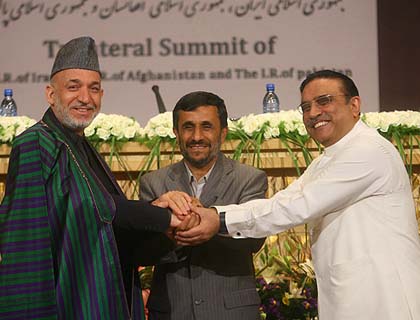
 Pakistan, Afghanistan and Iran, who share among them a proud history, common aspirations and long borders, also harbour mutual distrust and apprehensions, the latter being largely the product of recent times. Now that this region has been tossed into the vortex of what looks like the beginning of yet another spell of the Great Game, the commonality underpinning their fears and expectations have assumed critical relevance for their people and policymakers. For this the two-day summit of their heads of state held in Islamabad during the week, the third in the series, was the forum. There was extensive interaction between the leaders in their one-on-one meetings, official talks, joint press encounter as well as their bilateral meetings. No one had predicted any breakthrough in their stated positions given the fact of abounding perceptional mismatches and divergent foreign policy agendas of the participants. And it wasn't there, except for some optics, cynically perceived by some as cosmetics. Each one of the three seemed to have joined the exercise to promote self-serving, specific packages obviously constricting the space for mutual co-operation. Iran, confronted with increasing international economic isolation in the wake of some UN-mandated and other power-driven sanctions, is in search of the comfort of regional support to neutralise this pressure. The Karzai government feels left high and dry after the United States' unilateral move to woo the Taliban, bypassing its erstwhile strategic partner in Afghanistan and is therefore is in search of regional support to add to its weight as an indispensable party to these contacts. Pakistan is trapped in the limbo of its double-mindedness on the Qatar process; it does appreciate its interlocutors' concerns about the evolving scenario of the Afghan saga but finds it next to difficult, if not impossible to change horses in midstream. Given its long-nurtured strategic concept of its policy towards Afghanistan its adaptation to the emerging scenario is neither expected nor possible. How divergent are their positions was in the open as soon as the summit concluded, with Foreign Minister Khar accusing President Karzai of making the "ridiculous" demand for the extradition of Taliban chief Mulla Omar. So hemmed by these narrow confines, another high-profile regional diplomatic event has ended on another not-too-optimistic note. However that said, it would not be fair to play down the summiteers' determination to restore some order to things in their backyards. An illegal cross-border movement resulting in terrorism and the rise of sectarian extremism and the growing role of narcotics as main contributors have been identified as some of the important issues that they felt to be within their grasp to deal with. How soon the framework, as decided in the summit, would be on the ground and start to function is in the realm of the future. The point that attracted the media's attention however was the consensus that their territories would not be available to elements hostile to their countries. What that implied was, however, interpreted differently. While some thought it is the acceptance of Kabul's demand to eradicate safe havens in the tribal region, others interpreted it as the summit leaders' promise not be part of foreign aggression against Iran. But one exception to the confusion is President Zardari's public pledge not to give up on the gas pipeline project with Iran. Even more importantly this does present the encouraging prospect that the region has the will and the desired potential to emerge as a viable politico-economic option for the three countries. No doubt, as President Ahmedinejad said, most of the turmoil here is the result of the outside powers, and if and when they depart from here, there is a great future for these nations. This indeed is a great dream but definitely realisable, only if they conduct their inter-state relations with commitment and sincerity. We hope by the time they meet in Kabul later this year, substantial progress would have been made on the envisaged co-operative framework, providing them enough incentive to move speedily in order to rid them of mistrust and generate possibilities of success leading to concrete political and economic progress. Copyright Business Recorder, 2012


















Comments
Comments are closed for this article.