


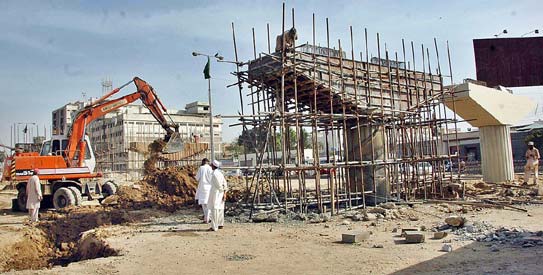
 The Planning Commission's publication Analysis/Review of Public Sector Development Programme (PSDP) dated August 2011 has raised several issues with respect to policy planning in spite of the fact that it starts with a very optimistic conclusion: "the programme has delivered! It has given us many important projects: energy and irrigation system, highway system, most of our universities, airports, hospitals, schools, basic health units etc. Evidence of the PSDP's successful completion of projects is visible in almost all corners of Pakistan". The major issues identified in the report are: (i) political and bureaucratic pressures keep driving up the stock of PSDP projects, (ii) project appraisal rules are set aside due to weak planning processes coupled with stakeholder pressure and limited capacity, (iii) PSDP is slashed when the pressure of fiscal policy builds up, (iv) project managers' personal economic interests due to allowances and control of resources hinder project quality and timely completion, (v) project sponsors support brick and mortar and purchase of equipment evident from the fact that a large number of universities have been constructed with faculty available in limited quantities, and (vi) current expenditures do not plan for projects' maintenance resulting in people not getting the maximum benefit of the project as well as its depreciation at a faster pace than it should. The report/review also highlights the disturbing fact that Pakistan central government's capital expenditure as a percentage of Gross Domestic Product (GDP) has not only declined since 1990 but was also the lowest in the region in 2009. Thus Pakistan's central government outlay as a percentage of GDP was 2.2 percent in 2009 as opposed to 5.2 percent in 1990 with India's 2009 figure of 5.1 percent, Bangladesh's 4.4 percent, Sri Lanka's 5.7 percent. Those who may argue that this many indicate greater private sector engagement in what are regarded as traditional public sector areas of activity would do well to look at the fact that private sector activity is being crowded out due to heavy government borrowing from domestic banks in the aftermath of the government's failure to get a Letter of Comfort from the International Monetary Fund due to sustained failure to implement agreed reforms. The report also reveals Pakistan's abysmal ranking in the overall Global Competitiveness Index: 123 out of a total of 139. Be that as it may, the report highlights the new growth strategy led by the Deputy Chairman Planning Commission Dr Nadeemul Haq that envisages placing "greater emphasis on incentives, institutions, markets, communities and governance with the prime objective of raising Total Factor Productivity. The new approach aims to develop the software of economic growth, increase competitiveness redefine the governments role in markets, promote investments on the basis of higher productivity, innovation and entrepreneurship, exploit the immense potential of the large domestic market, make cities and regional clusters engines of growth, improve governance and public service delivery and enhance productivity." Few would disagree with the model, however to translate the model into reality would require a major change in mindset amongst all the stakeholders including politicians which is simply not evident at present. The question is where would the money required to strengthen social sectors come from? A recent briefing given by former Secretary Finance Waqar Masood to the Prime Minister expressed helplessness in ending tax exemptions to the rich and powerful and thus being unable to raise the below 9 percent tax-to-GDP ratio. The first casualty of failure to meet the revenue targets as indicated in the Planning Commission report: the PSDP. Be that as it may the National Finance Commission award, together with the 18th Amendment, does envisage greater financial autonomy for the provinces, a long standing provincial demand, with respect to the share of the revenue from the divisible pool and allocations for the social sectors. However, it is unfortunate that to date, none of the provinces has made any effort to either support social sector development or indeed to build capacity to run the devolved social sectors efficiently. One can only hope that appropriate remedial measures are undertaken on an emergent basis. Copyright Business Recorder, 2012





















Comments
Comments are closed for this article.