


Japan records huge trade deficit as imports soar

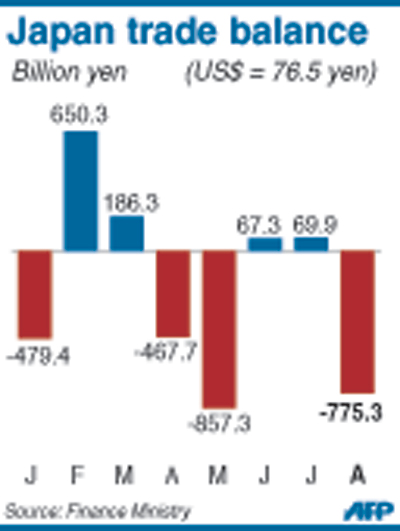 TOKYO: Japan logged a huge August trade deficit, data showed Wednesday, as utility firms imported fuel to meet electricity demand with many nuclear reactors still offline amid post-Fukushima disquiet.
The country's trade deficit reached 775.3 billion yen ($10 billion), the biggest red-ink figure for August since the finance ministry began gathering data in 1979.
It reversed the year-before surplus of 63.8 billion yen and was much bigger than deficits of less than 300 billion yen projected by economists.
However, exports posted their first growth since the March earthquake and tsunami disrupted supply chains while triggering the world's worst nuclear accident since Chernobyl at the Fukushima plant on the northeast Pacific coast.
But imports grew by a much faster 19.2 percent to 6.13 trillion yen due to rises in oil prices and record purchases of liquefied natural gas.
Utility firms have stepped up imports of fossil fuel for thermal power generation as many nuclear reactors that automatically shut down in the disaster or went offline for regular check-ups remain suspended amid local opposition.
Anti-nuclear sentiment has flared since the stricken Fukushima plant began spewing radiation into the air, soil and sea, forcing tens of thousands of people to flee their homes.
LNG imports jumped 55.7 percent from a year earlier as "its demand rose as alternative fuel", noted Satoshi Osanai, economist at Daiwa Institute of Research.
"This will likely continue to be a negative contributor (to the Japanese trade account) along with higher oil prices," he said.
Exports rose 2.8 percent on August 2010 to 5.36 trillion yen on higher shipments of automobiles, machinery and ships, posting the first year-on-year rise in six months.
The growth was smaller than economists had expected, with shipments of electronics parts falling 16.4 percent due to slowing IT business.
"A slowdown in demand for personal computers and LCD displays has resulted in lower demand for Japanese semiconductors," Osanai said.
"Exports have recovered from the disaster but it could come to a standstill largely because of a slowdown in overseas economies," he said.
"Of course the current exchange rates impair Japanese competitiveness overseas... For the immediate future, however, how the global economy will fare is a bigger factor."
The yen's strength has squeezed Japanese exporters by making their products more expensive abroad and reducing their repatriated revenue.
The yen was hovering around 76.30 to the dollar Wednesday morning, close to its postwar high of 75.95 yen touched in August.
Norio Miyagawa, a senior economist at Mizuho Research and Consulting, also said the slowing global economy was weighing on Japanese exports.
Any further slumps in global financial markets amid concern over sovereign debt woes in Europe and softening in the US economy could drag on Japan's exports in the months ahead, Miyagawa told Dow Jones Newswires.
"The key will be whether the issues in Europe can reach some kind of resolution and how global equities markets react," he said.
Copyright AFP (Agence France-Presse), 2011
















Comments
Comments are closed for this article.