



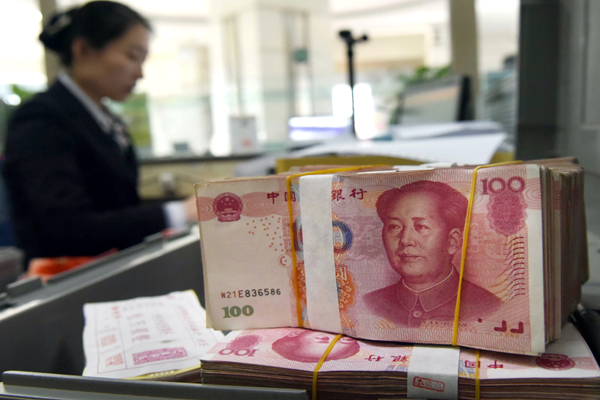
 HONG KONG: Foreign investors have welcomed China's landmark decision to open up its interbank bond market but are unlikely to jump in soon amid lingering concerns over the slowing economy and the outlook for its yuan currency.
While the move is expected to attract huge inflows into Chinese bonds in the medium- to-long term, which could help offset downward pressure on the yuan, foreigners are likely to wait for more economic and policy clarity, analysts said.
Others are likely to be more interested in higher-yielding offshore bonds, especially given expectations that China's central bank will cut interest rates further this year along with a host of other policy easing measures.
That would put further pressure on the yuan, which economists expect to fall another 3.5 percent against the dollar in the next 12 months, according to a Reuters poll.
The People's Bank of China (PBOC) said in late February that it would allow certain types of foreign investors to buy bonds in its interbank bond market and would scrap quotas for long-term investors such as pension funds and charity funds.
It significantly widened foreign access to the world's third-largest debt market from the current Qualified Foreign Institutional Investor (QFII) and Renminbi QFII (RQFII) channels, which are restricted by license and quota approvals.
"The near-term impact may be moderate, as funding costs (of the yuan) are high and the market remains more focused on yuan depreciation risk," Nomura analysts wrote in a research note.
The annualised FX implied yields that show yuan funding costs are above 4 percent for tenors beyond nine months in Hong Kong, substantially higher than the onshore government bond yields that investors receive as returns.
Overseas investors now own a meagre 2 percent of China's $7 trillion bond market, much lower than South Korea (6.5 percent) and India (4.5 percent), not to mention markets that have already been included in the JP Morgan GBI-EM diversified benchmark index.
Foreign holdings of Chinese bonds actually decreased by a record high of 49.6 billion yuan ($7.58 billion) in January, according to official data.
"Investors are taking a wait and see approach on how the yuan and economy will perform. Inflows to and outflows from my fund are flat so far this year," said a fixed-income fund manager who reported heavy redemptions at the end of last year that left much of his RQFII quota unused.
Much higher yields in the offshore yuan bond market are also stealing the thunder from onshore bonds.
"Dim sum bond yields are more attractive to us and we are overweighting dim sum bonds versus onshore bonds," said Hayden Briscoe, director of Asia Pacific fixed income at AllianceBernstein that has investments in both markets.
For onshore bond investments, Briscoe said he was targeting a yield of about 3 percent for 10-year government bonds, versus 2.88 percent now.
The yield spread between onshore and offshore yuan bond markets remains wide with three-year government bonds trading at 2.49/2.43 percent onshore versus 4.01/3.62 percent offshore.
"We can only see more foreign fund flows to the domestic interbank bond market until onshore-offshore yield gap narrows," said the head of fixed income research at a Chinese bank in Hong Kong.
Deutsche Bank expects foreign ownership of yuan bonds to rise to 8-10 percent of China's debt market in the next five years, implying approximately 8-10 trillion yuan of potential capital inflows.























Comments
Comments are closed for this article.