



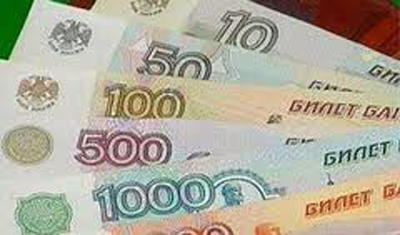
 MOSCOW: The rouble hit a new low of more than 43 to the dollar on Thursday, as speculation grew that the Russian central bank will let the rouble float freely when it meets on Friday and as comments by the U.S. Federal Reserve lifted the dollar.
By 0840 GMT, the rouble was 0.41 percent weaker against the dollar at 43.37 after earlier reaching 43.66 against the greenback. It was 0.13 percent stronger at 54.55 versus the euro.
That left the currency 0.14 percent weaker at 48.41 against the dollar-euro basket the central bank uses to gauge the rouble's nominal exchange rate.
"The market is now expecting the central bank to announce the rouble free float at tomorrow's board meeting instead of waiting until the initially planned 2015," Alfa Bank analysts said in a morning note.
"Given that the rouble is currently testing the central bank's borders on high volumes, removing support ahead of schedule would further destabilize the FX market and lead to panic contagion on other markets."
The rouble has lost nearly a quarter of its value against the dollar this year. The currency has been weakened by falling oil prices, risk aversion towards Russia because of its conflict with Ukraine and demand for foreign currency from Russian companies shut out of Western capital markets.
The central bank has spent more than $20 billion defending the rouble this month and more than $60 billion since the start of the year. Daily interventions of $2 billion to $2.7 billion have been typical in recent days.
A debut auction of forex repos by the central bank on Wednesday, which was intended to support the rouble and address a shortfall of dollars among Russian companies, met with lacklustre demand. Another auction is planned for Thursday.
Speculation the central bank will raise its key rate at its Friday rate meeting has done little to check losses in the Russian currency.
FED PRESSURE
The rouble fell to more than 43 per dollar for the first time in after-hours trading on Wednesday, after the U.S. Federal Reserve ended its monthly bond-purchase program and gave a positive assessment of the U.S. economy's prospects.
Traders moved up their expectations for an increase in U.S. interest rates accordingly. That put pressure to emerging-market assets, which have been supported by the ultra-loose monetary policy of the world's largest economy.
Adding to a nervy start on Russian markets, talks to get Russian gas producer Gazprom to resume gas supplies to Ukraine ended in failure overnight. The gas dispute has a political element, and an agreement would have been seen as a sign of easing East-West tensions over Ukraine crisis.
Brent crude futures fell around 1 percent on Thursday towards $86 a barrel, also weighing on the rouble. Oil is one of Russia's chief exports, and oil and gas sales account for up to half of federal budget revenues.
Options markets suggest there will be no relief for the rouble. One-month rouble volatility, a gauge of expected swings in its value, rose to 17.8 percent, the highest since June 2012.
Russian shares were mixed on Thursday, with the dollar-denominated RTS index down 0.5 percent at 1,054 points, linked to the weaker rouble. The rouble-based MICEX traded 0.9 percent higher at 1,451 points, extending gains made earlier in the week.
Among Russia's blue chips, shares in business conglomerate Sistema rose more than 15 percent on hopes a Moscow court hearing into the company's acquisition of the Bashneft oil producer would end favourably for Sistema.
Analysts have said top oil producer Rosneft could use the case against Sistema to gain control over Bashneft. But Igor Sechin, Rosneft's chief executive, said on Wednesday he does not see any oil assets inside the country that would be an attractive purchase for the company.




















Comments
Comments are closed for this article.