



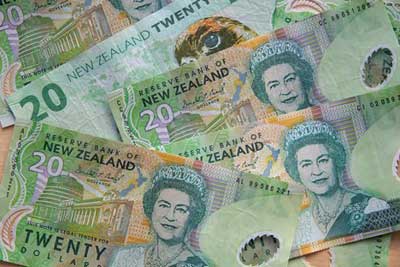
 WELLINGTON/SYDNEY: The New Zealand dollar fell to six-week lows and weighed on the Australian dollar on Monday, with markets awaiting key US events later in the week including a Federal Reserve meeting and major economic indicators.
The New Zealand dollar eased to $0.8539, matching Friday's lowest level.
It has tumbled nearly 3 percent in the past two weeks, largely after the Reserve Bank of New Zealand (RBNZ) signalled last week it was pausing its tightening cycle following four straight interest rate hikes.
The bank's aggressive warning about the unjustified and unsustainable strength of the currency, with its threat of intervention to push it lower, is still rattling around markets.
Yet many doubt the RBNZ would pull the trigger on outright intervention, especially in the size needed to make a true dent in the kiwi.
"We remain on the skeptical side of the debate, given that action to weaken the New Zealand dollar would be inflationary, and run contrary to the current stance of monetary policy - disinflationary," said BNZ strategist Raiko Shareef.
Near-term, there is minor support around $0.8518 and then $0.8500, with $0.8586 the first hurdle higher.
The kiwi's overall softness was also reflected against other major currencies, with its trade weighted basket easing to a six-week low.
Pressure on the kiwi has kept the Australian dollar in check. The Aussie eased to $0.9391, from a peak of $0.9425 Friday.
It topped out at $0.9480 last week, near this year's high of $0.9505.
"There doesn't seem to be much topside momentum above 94 cents," said a trader at a European bank in Singapore, seeing the Aussie between $0.9300 and $0.9400 this week.
Key support was found at $0.9320/25.
The Aussie has gained more than 5 percent this year and is one reason why some investors expect the next interest rate move by the Reserve Bank of Australia could be down.
Interbank futures pricing implies a one-in-four chance of a cut from record low rates of 2.5 percent by year end.
Swap markets see rates steady on a 12-month horizon. In the short term, the Antipodean currencies are likely to be driven by offshore events with the Fed policy meeting over July 29-30.
The United States will also be issuing gross domestic product and employment data in the week.
Locally, markets will be watching New Zealand dairy giant Fonterra, the country's biggest export earner, which could lower its milk payout forecast - weighing further on the kiwi.
New Zealand government bonds had a bid tone, sending yields 2.5 basis points lower along the curve. Australian government bond futures were a shade firmer.
The three-year bond contract rose 1 tick to 97.350, having touched a three-week low last week. The 10-year contract added half a tick to 96.570.

























Comments
Comments are closed for this article.