


FM sees no leeway for tax cuts

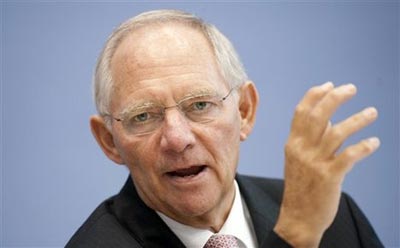 FRANKFURT: German Finance Minister Wolfgang Schaeuble warned coalition colleagues that the government cannot afford to lower taxes, telling a German newspaper that cuts of up to 10 billion euros were unrealistic.
"I'm somewhat unhappy about the public debate, which creates the impression we have a lot of leeway for tax cuts we don't," Schaeuble said in an interview with Sunday paper Bild am Sonntag.
"I would recommend everyone not to conduct debates that raise expectations and only lead in the end to big disappointment."
Philipp Roesler, the new 38 year-old Economy Minister and Vice-Chancellor, has reignited efforts to cut income taxes, a key platform for his junior coalition partner Free Democrats (FDP), who are floundering in the polls.
Even if Chancellor Angela Merkel's government were to propose tax cuts, though, it would almost certainly require the support of the upper house of parliament, which is controlled by the opposition.
Schaeuble backed up his skepticism by saying the government was still "far off" from conforming with the constitutional debt brake amendment, which requires a budget deficit of 0.35 percent of economic output by 2016.
"We have huge tasks ahead.The change in energy (away from nuclear) will mean additional costs, and we need to start making provisions for the European Stability Mechanism (ESM) beginning in 2013," he explained to Bild am Sonntag. He did signal a certain willingness to discuss changes to Germany's tax brackets, which are not automatically increased in line with inflation as in many other countries.
As a result, taxpayers receiving a cost of living adjustment can for example end up with less in their pockets once adjusted for a rise in consumer prices.
"This is an additional tax burden, whose justification is debatable. We can certainly talk about how we can eliminate this mechanism," he said.
The German taxpayers association (BdSt) calculates that the so-called "cold progression" in taxes disproportionately hurts lower income households and can easily constitute the bulk of additional taxes paid.
Separately, the conservative premier of Bavaria pushed for measured tax cuts in comments made to German weekly magazine Focus.
"There will be further tax cuts in the current election period (ending in late 2013), but in tune with the economy and without jeopardising budget consolidation," said Horst Seehofer.
Focus reported without citing sources that the coalition was considering replacing the fixed-rate "Solidarity Charge", which adds a 5.5 percent levy onto the amount of income taxes paid, with a sliding scale that starts at 1.3 percent while also raising the exemption limit.
Introduced after reunification to help rebuild the East German economy, the solidarity charge is one of the few taxes that only fills the coffers of the federal government.
As a result, changes can be passed without requiring the approval of the Bundesrat, the upper house of parliament representing the 16 federal states.
Copyright Reuters, 2011














Comments
Comments are closed for this article.