


ECB seen hiking just once this year, in July

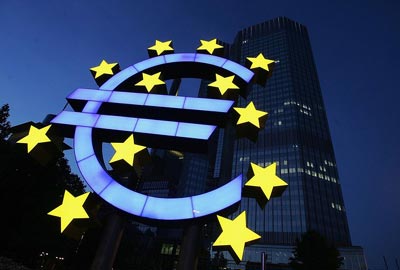 LONDON: Euro zone money markets have priced out ECB interest rate hikes between July and the end of the year following a raft of weak data globally and expectations the Greek debt situation will remain precarious.
The European Central Bank still looks set to raise interest rates by 25 basis points to 1.5 percent in July after using the code words "strong vigilance" at its June meeting, but that could change if Greece's debt crisis deteriorates sharply next week.
Greece has to pass key austerity measures next week to secure vital financing from the European Union and the International Monetary Fund and avoid a near-term default.
Manufacturing surveys out of the EU and jobs and housing data out of the United States meanwhile pointed to fatigue in the global economic recovery, suggesting a low rates' environment for a prolonged period.
The Eonia forward for the July 7 ECB meeting was last at 1.317 percent versus a spot fixing of 0.946 on Thursday . The rate is kept artificially low by abundant cash pumped into the system by the ECB through its liquidity facilities introduced to help banks hit by the Lehman crisis.
But based on their own liquidity assumptions for July, Lloyds and BNP Paribas models show around a 90 percent probability of a rate hike in July and only one hike fully priced in this year. That compares to bets after the April rate hike that the ECB would raise rates once a quarter.
"The impact of Greece to the global picture in the euro zone could be massive in terms of contagion risk to the financial system," said Matteo Regesta, rate strategist at BNP Paribas.
"Because in the euro system ... funding happens more through the banking system than through equity markets, it could affect the growth forecast of the ECB and could impact inflation and the periphery event could become a core event."
He said a lack of consensus among euro zone leaders over how to address the Greek debt problem and domestic belt-tightening exhaustion could keep pressure on the front end of the euro curve in the longer run.
While a rate hike in July looks very likely, next week's vote in Athens could call those bets into question.
"The world is not great at the moment, but if it were to fall apart, than there is a risk (for the July hike)," said Eric Wand, rate strategist at Lloyds.
"If something even more dramatic would happen with regards to Greece, if the austerity doesn't get passed and it's starting a completely risk-off move and we're heading towards another Lehman-type moment, in that case I would say we're holding off."
Nomura rate strategist Guy Mandy said the short-term euro curve could steepen in an immediate reaction if the ECB hikes rates in July.
"The euro front end is generally too flat at this stage," Mandy said. "(The ECB's) tolerance for deviation from their targeted inflation is fairly low and they are biased to act, it seems."
"On the basis of that, if we do see a hike coming in in July then front-end rates are going to steepen," he said.
VOLUMES, NOT PRICES
The spread between three-month euro Libor and overnight index swaps -- often used as a gauge of funding stress at the start of the Lehman crisis -- has risen only 6 basis points this week to 18 bps, compared to over 100 bps in late 2008.
But analysts say that means abundant ECB liquidity is hiding the stress and not that euro zone banks are relaxed and fully trust each other while waiting to see what happens to Greece.
Simon Smith, chief economist at FxPro, says it is better to look at volumes for signs of stress than at actual prices.
"Looking at Libor/OIS doesn't give you the same signals as before," Smith said. "For unsecured lending, anything beyond one month is pretty illiquid."
In contrast with the euro market, dollar funding costs for European banks remain elevated.
The euro/dollar one-year cross currency basis swap -- which widens when lenders are reluctant to offer US dollars to European banks -- was still over 30 bps but slightly off four-month lows at 37 bps hit last week.
Copyright Reuters, 2011
















Comments
Comments are closed for this article.