


US trade seeks to help Africa's people: Clinton

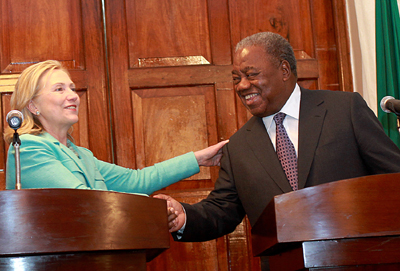 LUSAKA: Secretary of State Hillary Clinton said Saturday the United States wants to expand trade with Africa by investing in the continent's people, drawing a line with China's no-strings trade policies.
On the first leg of a three-nation African tour, Clinton came to Zambia for annual trade talks Friday with ministers from across the continent, where China has surpassed the United States as the top trading partner.
The drive to boost business was reiterated Saturday, when she opened the US-Zambia Chamber of Commerce to develop ties in a country where the government estimated Chinese investment last year at more than one billion dollars.
In an interview with South African television, she alluded to differences between China's trade policies and the United States, which attaches conditions for democracy and free markets.
"We don't want to see a new colonialism in Africa," she told the Africa 360 programme. "The United States is investing in the people of Africa, not just the elites."
Clinton highlighted a new US-built Pediatric Centre of Excellence in Lusaka, which helps prevent mother-child HIV transmission, as an example of the American approach.
The United States is believed to remain Africa's top donor, giving out $7.6 billion in 2009, but comparisons are difficult because China does not give detailed information on its aid programmes.
Clinton on Friday voiced concern about the lack of transparency in China's activities on the continent.
"China's presence in Africa reflects the reality that it has important and growing interests here on the continent," Clinton said during a press conference with Zambian President Rupiah Banda.
"The United States does not see these interests inherently incompatible with our own interests. We do not see China's rise as a zero-sum game. We hope that it will become succesful in its economic efforts," she said.
"We are, however concerned that China's foreign assistance and investment practices in Africa have not always been consistent with generally accepted international norms of transparency and good governance," she added.
Zambia's example highlights both the benefits and pitfalls of China's rapidly growing presence across Africa.
A deal signed with China's Zhougui Mining in January promises a further five billion dollars in investment in the coming years, and previous Chinese investment has created an estimated 15,000 jobs, according to the government in Lusaka.
But China's labour practices have sparked protests, with two Chinese mine managers accused of shooting and wounding 11 miners who were protesting in October against poor working conditions at the Chinese-run Collum Coal Mine.
Charges were dropped in April, and Banda had to personally sooth the public outrage.
The issue is certain to resurface later this year in national elections, as opposition leader Michael Sata campaigns against China's rapid expansion here.
Clinton's visit here is the latest sign of growing interest in African economies, which the International Monetary Fund expects to grow faster than the global average in the coming years.
Six of the world's 10 fastest-growing economies were in Africa last year, and the African Development Bank has signalled the rise of a middle class of more than 300 million people on the continent.
A US law, the African Growth and Opportunity Act (AGOA) which was subject of the talks Friday, grants 37 African nations duty-free access to the US market, with a handful of countries like Somalia, Sudan and Zimbabwe excluded because of conflicts, coups or political turmoil.
Last year, AGOA-eligible countries sent $44 billion worth of exports to the US market, but only $4 billion dollars of that was in non-oil products.
One provision of the law, which allows many countries to export clothing made from imported fabrics, has ironically helped the growth of Chinese-owned factories in countries like Swaziland.
Copyright AFP (Agence France-Presse), 2011

















Comments
Comments are closed for this article.