



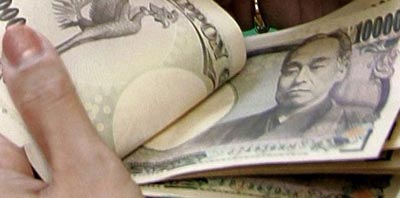
 NEW YORK: The yen slumped to a 20-month low against the US dollar and a 16-month trough versus the euro on Wednesday, after Shinzo Abe assumed office as Japan's new prime minister and reiterated his pledge to push for more drastic monetary and fiscal measures and tame the strong Japanese currency.
Meanwhile the euro traded above $1.32 against the US dollar for a seventh straight session and in early New York trading was up slightly on the day.
Traders said the euro's gain was due to position adjustment going into the end of the year, with investors continuing to reduce short bets on the currency.
Overall trading volume was thin with many global financial centers still closed for the Christmas holiday. All G10 markets except Japan were closed on Tuesday, and only Japanese and US markets were to open on Wednesday. Hong Kong and Australia also remained closed on Wednesday.
New Japan prime minister Shinzo Abe said on Wednesday his government will pursue bold monetary policy, a flexible fiscal strategy, and a growth plan to encourage private investment Abe, whose party won a landslide victory on Dec. 16, was elected prime minister by parliament's lower house on Wednesday.
"The election of Abe has had a galvanizing effect on the dollar/yen exchange rate and he has been able to accomplish more in two months of jawboning than the BoJ has...over the past several years," said Boris Schlossberg, managing director of FX strategy at BK Asset Management in New York.
The yen was further weighed down by minutes of the Bank of Japan's November policy meeting released on Wednesday which showed some board members considered policy options if the outlook for the economy and prices were to worsen.
One board member even suggested that the BoJ commit to buying assets in an open-ended manner, without setting a strict deadline, until it achieved its 1 percent consumer inflation target.
The US dollar rose as high as 85.48 yen, its highest since April 2011, breaking through resistance at its 200-week moving average around 84.95 yen. It last stood at 85.34 yen, up 0.7 percent on the day. Its next resistance seen at the dollar's April 2011 high of 85.53 yen. Options-related positions were said to lie around 85.50 yen.
"Dollar-yen has now risen six big figures since Abe started his campaign for more accommodative monetary policy and could move towards his ultimate target of 90.00 if he continues to keep the pressure on BoJ to further loosen its stance," Schlossberg said.
Against the yen, the euro rose as high as 112.92 yen, a 16-month high. It last stood at 112.68 yen, up 0.8 percent.
Technical analysts cited little resistance above last week's high, with the euro's 200-week moving average still far away, around 115.00 yen.
The European unit has not closed above that average since late Sept. 2008.
US dollar index was little changed at 79.629. On Tuesday, it rose as high as 79.780, its strongest level since Dec. 14.
Ongoing concerns about the US budget impasse continued to underpin the U.S currency.
President Barack Obama may return to Washington from his Hawaiian holiday as early as Wednesday evening to address the unfinished negotiations with Congress, according to an administration official.
The next session of the US Senate was set for Thursday, but the issues presented by "fiscal cliff" of tax hikes and spending cuts scheduled to take effect next year were not on the calendar.
US House of Representatives has nothing on its schedule this week, but its members have been told they could be called back on 48 hours notice making their Thursday return a theoretical possibility. The euro traded at $1.3204, up 0.2 percent.
Center>Copyright Reuters, 2012




















Comments
Comments are closed for this article.