



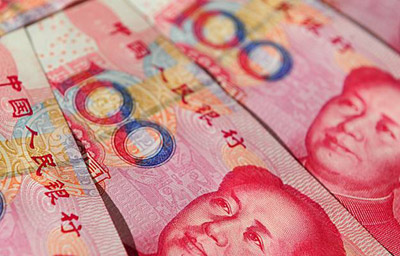
 SHANGHAI: Spot yuan closed firmer on Tuesday as the dollar index dropped in intraday trade, but investors offshore and onshore anticipate the Chinese currency will weaken further in the next 12 months.
Before trade began, the People's Bank of China (PBOC) set the yuan midpoint slightly weaker for the second consecutive day at 6.3411 to the dollar.
The central bank's move partly reflected a slight firming of the dollar index in overnight trade, which measures the greenback against a euro-dominated basket of currencies.
But spot yuan rates showed no reaction in muted trade, moving a mere 5 pips from open to 6.3575 at midday. Spot yuan then began to move abruptly downward in mid-afternoon as the euro strengthened against the dollar in global markets, sliding 50 points to close at 6.3530 against the dollar, firmer than 6.3568 on Monday.
However, volatility remains relatively restrained, traders said, citing balanced supply and demand and general consensus that the yuan is near its proper equilibrium price for now.
Traders expect spot yuan to move between 6.35 and 6.37 against the dollar in the near term.
Lack of hard information on upcoming moves by central banks in the United States, Europe and China have kept customers from making aggressive bets on appreciation or depreciation, traders said.
So far this year the yuan has depreciated just 1 percent against the dollar, having strengthened by around 23 percent against the dollar since the landmark revaluation in 2005.
Traders and economists who spoke to Reuters said that the central bank has for the first time become concerned about a destabilising market-driven decline in the yuan exchange rate as corporates unwound accumulated dollar short positions.
However, recent data showed that corporate customers stopped shedding yuan for dollars in July, suggesting that the trend may have eased for now.
China's forex regulator reported on Friday that Chinese banks returned as net buyers of foreign currencies in over-the-counter transactions in July, purchasing $500 million and reversing from June's net sale of $3.5 billion.
MORE DEPRECIATION TO COME
Investors appear to be increasingly betting on further depreciation over the next 12 months.
Offshore 1-year non-deliverable forwards NDFs have been suggesting yuan depreciation since March, although differing interest rates in Hong Kong and the mainland play a role in the gap.
However, the spread between the NDF and the spot rate has continued to widen steadily. On Tuesday, NDFs changed hands at 6.4468, around 1.4 percent weaker than the spot price.
Onshore 1-year yuan forwards took longer to change directions. Once a consistent predictor of yuan appreciation expectations in the onshore market, they swung toward predicting depreciation in July and are now trading close to the NDF price at 6.4837 per dollar.
In trade-weighted terms that accounts for inflation, the yuan's real effective exchange rate index (REER) is still up as of July from the end of 2011 at 100.69 (from a base of 100 as of December 2011), per Reuters calculations.




















Comments
Comments are closed for this article.