



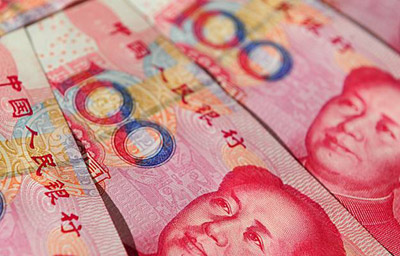
 SHANGHAI: Spot yuan prices closed up on Tuesday in reaction to a steadily weakening dollar, and after the Chinese central bank set the reference rate higher than the previous day.
The dollar index continued to slide against a basket of currencies dominated by the euro on optimism that the European Central Bank would act on its pledge to help the euro zone.
The yuan has weakened against the euro in recent weeks, bouncing off a strong point hit on July 23 when concerns about a potential Spanish bailout peaked, driving investors into dollars, but remains near a decade-long high.
It's relative strength has created a headache for Chinese exporters -- Europe buys one-fifth of Chinese exports -- and thus Beijing has tolerated measured depreciation in the yuan-dollar rate.
The People's Bank of China (PBOC) set the yuan midpoint fixing at 6.3332 per dollar, up slightly from Monday's close. Spot prices also opened up slightly but traded in a tight range as they have since Friday, closing at 6.3664.
The PBOC set the yuan midpoint near its 2012 low on Friday, which traders told Reuters was a signal that the bank will allow the yuan exchange rate to rise above 6.4 per dollar, previously considered the weakest rate the government would tolerate.
Spot prices are down 1.3 percent against the dollar this year and traders now believe further depreciation of 1 percent by year-end is possible.
Traders are also awaiting new data points following disappointing readings of manufacturing activity last week. China is set to report retail sales and import/export figures on Thursday and Friday, respectively.
Paradoxically, weak economic readings have recently exerted a positive effect on markets as traders believe more bad news will force Beijing to intervene to stimulate the economy.
Offshore yuan markets remained stable. Non-deliverable forward contracts with a 1-year tenor in Hong Kong traded at 6.4255 at close, 0.8 percent weaker than the spot price.
The intra-day rate for offshore yuan (CNH) moved to erase a brief gap that opened up over the last two days, returning to close near the spot price at 6.3740.
Beijing continues to support the development of the offshore yuan market in the face of declining growth of CNH deposits in Hong Kong this year. Hong Kong regulators opened up the CNH market to non-residents from Aug. 1.
"The higher yields and wider and deeper product classes offered in Hong Kong should attract more CNH funds currently held by non-residents outside Hong Kong to support CNH business turnover and liquidity in the city," wrote HSBC economist Donna Kwok in a research note published on Tuesday.
Kwok added that the net effect to CNH liquidity should be minimal, however, since it does not result in increased outward flows of onshore yuan -- it rather makes Hong Kong more competitive with nascent yuan trading centres in London and Singapore.






















Comments
Comments are closed for this article.