



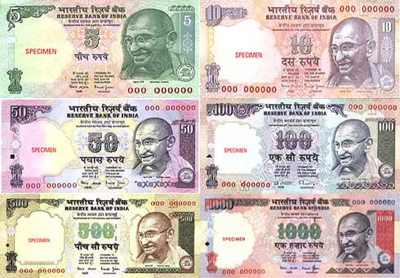
 MUMBAI: The Indian rupee rallied on Monday on hopes for government measures to halt a slump in the currency, which hit a record low on Friday, with traders saying action to boost long-term foreign investment would be the most effective step.
Finance Minister Pranab Mukherjee said at the weekend that India would unveil measures on Monday but gave no details. The fall in the rupee has mirrored a decline in economic growth to a nine-year low of 5.3 percent in the March quarter.
India may introduce bonds for non-resident Indians with an interest rate of 7-9 percent, a source with knowledge of the matter said, as speculation over imminent measures was rife in India's markets.
Traders and analysts said measures could include changes to foreign bond investment limits to attract more inflows into government and corporate securities. Another possibility would allow oil importers to buy their dollars directly from the central bank rather than via the foreign exchange market.
"The impact will be temporary unless long-term steps like boosting FDI and curtailing current account deficits are taken," said Kumar Rachapudi, fixed income strategist in Singapore at Barclays, which expects the rupee to strengthen to 52 to the dollar by the end of 2012.
However, analysts said these sorts of measures would provide only stop-gap relief and that India needed to improve its economic fundamentals, including addressing its current account deficit, to bolster the rupee.
"The problem with the rupee is fundamental, and technical measures cannot be supportive over a longer period of time," said Sanjay Mathur, an economist with Royal Bank of Scotland in Singapore.
"But it is also important to note that all the India-centric factors for the fall in the rupee, like lack of reforms, has been priced in. Further weakness will be because of the global risk-averse sentiment," he said.
The rupee's decline comes when emerging market currencies have weakened against the dollar as investors, worried about the global economic slowdown and the euro zone crisis, flee to the perceived safety of dollars.
At 12:43 p.m. (0713 GMT), the partially convertible rupee was trading at 56.57/58 per dollar, up sharply from its Friday close of 57.12/13 but off its intraday high of 56.37.
On Friday, the rupee fell to a record low of 57.32, down about 7.4 percent since the start of the year, making it the worst performing currency in Asia.
Traders said the central bank could target bringing in short-term inflows to stabilise the rupee by tapping funds held by non-resident Indians.
Morgan Stanley estimates India's current account deficit will widen to $72 billion by the end of June, from $49 billion a year earlier. That would put the current account deficit at between 4 percent and 4.5 percent of India's GDP.
"A sustainable solution would need a reduction of the current account deficit to around 2-2.25 percent of GDP with tighter fiscal policy, acceptance of slower consumption growth, and implementation of reforms that improve the business climate to encourage FDI inflows," the bank said in a client note.




















Comments
Comments are closed for this article.