



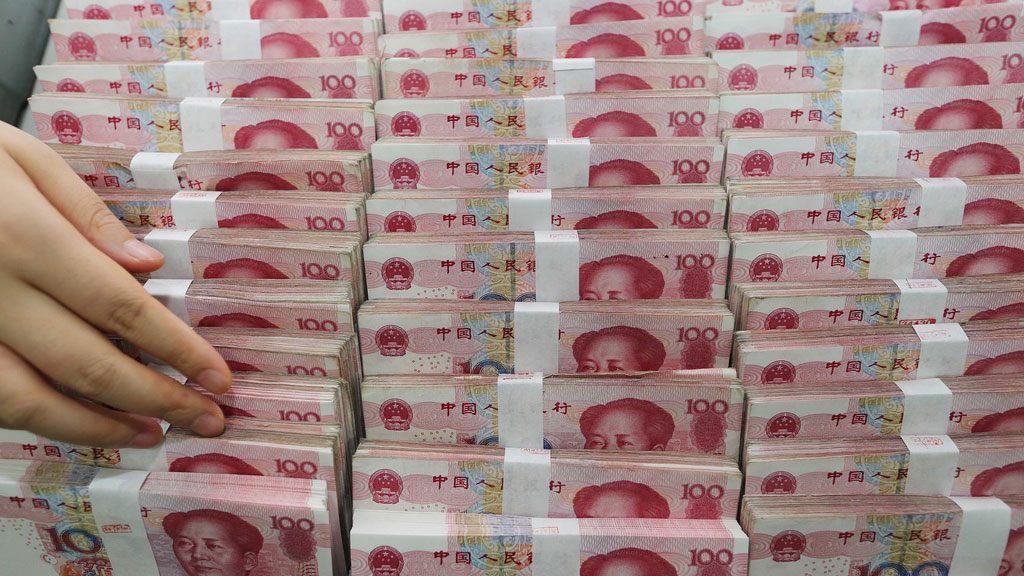
 HONG KONG: China's tumbling yuan steadied on Tuesday as authorities took steps to contain its slide, while stocks tanked after Washington labelled Beijing a currency manipulator in a sharp escalation of Sino-US trade tensions.
The currency has slumped as much as 2.7pc over the past three days, breaking through the symbolic 7-per-dollar level, pounding stocks and pushing bonds higher as investors feared the yuan's value has become a new front in the trade war.
Early in Asian trading hours, US Treasury Secretary Steven Mnuchin said Washington would designate China a currency manipulator, its first such move since 1994, sending both the onshore and offshore yuan to record lows..
China, in response, announced its companies had stopped buying US agricultural products and said labelling Beijing a currency manipulator would "severely damage international financial order and cause chaos in financial markets".
But the People's Bank of China moved to stabilise the yuan with a firmer-than-expected fixing and a bond sale, to signal that the authorities wished to stem the rout, lifting the offshore yuan nearly 0.5pc on the dollar.
"I don't think they want to see a free float," said Khiem Do, head of Greater China investments at Barings. "This to advise the market not to short the yuan too much. That is a subtle message."
In the offshore market, the Chinese currency steadied around 7.0710 per dollar in afternoon trade after hitting a low of 7.1382 earlier, following Mnuchin's announcement.
The rally came after the PBOC fixed the yuan midpoint, which sets the point around which the currency is allowed to trade, at 6.9683 per dollar, above market expectations.
The PBOC's announcement of a sale of 30 billion yuan ($4.25 billion) worth of yuan-denominated bills in Hong Kong also suggested the central bank was soaking up cash to prevent speculative short-selling.
The onshore yuan finished domestic trading up 0.2pc at 7.0321 per dollar. The offshore yuan rebounded more than 1pc mid-trade from its record low.
The stabilisation in the yuan helped major stock indexes pare some of their early morning losses in afternoon trade, but markets drifted lower again to finish in the red.
The Shanghai Composite Index fell as much as 3.1pc before recovering somewhat to close 1.6pc lower - still its lowest close since February. Hong Kong's Hang Seng Index closed at its lowest since January, but also recovered from shedding almost 3pc to end down 0.7pc.
"Renminbi weakening pressure added uncertainty to the stock market and added pressure especially for financials and property companies," said Linus Yip, chief strategist at First Shanghai Securities in Hong Kong.
Chinese policy sources had told Reuters that the currency was allowed to fall so markets could factor in concerns over the tussle between the world's two largest economies, especially after US President Donald Trump announced new tariffs last week.
Elsewhere, markets in Australia, Japan and throughout Southeast Asia also fell.
"We think the most important takeaway is the risk of US-China trade war escalating further has increased," UBS Economist Tao Wang said in a note to clients.
"As the trade war escalates further and depreciation pressure on the renminbi intensifies, we expect the dollar/yuan to trade beyond 7 more often in the rest of the year."




















Comments
Comments are closed for this article.