



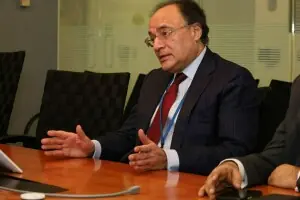
It’s not funny when a former minister expresses his helplessness, his “wounds”, over the weaknesses of institutional, organisational arrangements in the country and the practical exigencies that constraint the office of a minister. It’s actually quite sad. The man in question is former commerce minister Khurram Dastagir; the event: second national trade conference organised by the Islamabad-based think tank Prime Institute.
He was candid enough to express some of his frustrations from the battle field of commerce. He said “there is no constituency for free trade in this country”, and that all he heard during his tenure was cries for more protection and subsidies, adding that the private sector also has no intention to take individual or collective action towards reform. To that end, he flagged private sector’s resistance to comply with international standards, and their failure to manage infrastructure such as expo centres.
This is not exactly breaking views. But these are nevertheless important views to ponder on. Wish he had exhibited same candidness when he was in charge of commerce affairs. Then again, as he rightly said, trade numbers year in and year out hide both the country’s efficiencies and inefficiencies that have hardly anything to do with commerce ministry.
Some of the most important areas that affect trade – such as investment treaties, tariffs, custom procedures, supply and pricing of utilities, anti-narcotics, taxation, quality standards, labour – lie outside the domain of the commerce ministry. In fact, many of these lie in the provincial domain – such as GST on services, cess, labour.
To be fair, assuming that a thriving domestic commerce of certain products is one of the key drivers of growth and development of new products for exports, the role of provinces in creating an exportable surplus has become paramount since the devolution. That’s because after the devolution, sectors like gems, mines and minerals, livestock, dairy, meat, fisheries, housing (that can trigger construction related sectors), horticulture and so forth lie in the provincial domain.
BR Research asked Dastagir whether constitutional and legal framework allows the federal government to give some fiscal kind of incentives to provincial governments – within or without the NFC framework – to promote growth and development of sectors that lie squarely in provincial domain. And if so, what proposal/s he might have. He said there is nothing that prevents the federal government, but he did not have any specific proposal to offer.
This is where the current government should step in. Soon after the initiation of NFC negotiations, the federal government formed six sub-groups for various studies. There is one on macroeconomic framework and determining the benchmarks for the receipts and expenditures of federal and provincial governments; another on establishment of fund for national security, natural disasters etc. Then there is one on simplification of tax procedures and payment systems to facilitate businesses (i.e. promoting ease of doing business).
In the same vein, another sub-group should be formed to study how and what kind of incentives can the federal government give to provinces to foster growth and development in, for lack of a better term, ‘provincial economic sectors’, some of which are mentioned above.
One way is to give grants outside the divisible pool, pegged to specific performance indicators. Another way is to, say offer 65 percent share in the income taxes, earned incrementally from new economic sectors, instead of the current 57.5 percent as per vertical distribution formula. To be clear, this is only proposed for income tax (and/or other divisible pool taxes) collected from new sectors or new projects in poorly developed sectors, and with an appropriate sunset clause.
Here, of course the problem of horizontal distribution will emerge, because one province might promote tourism and other might develop mining – and at different pace. Which means there may be a dispute over separate treatment of what ordinarily forms a part of the divisible pool, and over the horizontal distribution of those monies. But this is exactly the kind of economic calculations that sub-groups are formed for.
Need one remind that NFC is a platform of political negotiations – the hotbed of political economy – where politicians, fiscal and economic experts sit together to strike a deal. If they can’t even agree to give this due consideration just because this kind of cutting-the-cake may be difficult then really it is just lazy-‘NFC-ing’.


















Comments
Comments are closed for this article.