



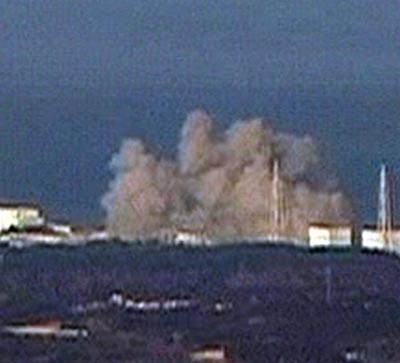
 TOKYO: Top Japanese cabinet ministers were warned of possible nuclear meltdowns at Fukushima hours after the tsunami hit last March, government papers have revealed, despite repeatedly denying the risk in public.
A summary of a government meeting held about four hours after a giant earthquake sent huge waves crashing into the atomic power station showed that one unidentified participant had cautioned of the risk of a meltdown.
"If the temperature of the reactor cores rises after eight hours, there is a possibility that a meltdown will occur," the person said, according to the summary released on Friday.
The revelation will add to the impression among the Japanese public that their political masters were less than transparent in their handling of the crisis.
Fukushima Daiichi, 220 kilometres (140 miles) northeast of Tokyo, spewed radiation after its cooling systems were knocked out by the tsunami when it crushed coastal communities, leaving more than 19,000 people dead or missing.
The meltdown warning came in the very first meeting of a task force chaired by the then prime minister Naoto Kan to deal with world's worst nuclear accident since Chernobyl in 1986.
But the chief cabinet secretary at the time Yukio Edano, the public face of the government's response to the crisis, repeatedly denied the notion of a meltdown for weeks after March 11.
Edano, now the minister of economy, trade and industry, told reporters late Friday after the records of the meetings were released: "I humbly accept criticism that I could not tell you of the possibility of meltdown."
Tens of thousands were made homeless by the nuclear crisis. Some tracts of land in a 20-kilometre (12-mile) exclusion zone are expected to be uninhabitable for decades because of radiation levels.
According to a summary of another meeting held on March 12, the then national strategy minister, Koichiro Gemba, was quoted saying: "There is a possibility of a meltdown. Is it OK with the evacuation zone set at 10 kilometres? Is there no need to reconsider?"
Later that afternoon the government expanded the evacuation zone to its current 20-kilometre radius around the plant.
The government and plant operator Tokyo Electric Power Co. (TEPCO) maintained for months there had been no meltdown at Fukushima, despite repeated warnings from independent experts.
Tokyo was seen as being quick to silence dissent on the issue, with a spokesman for the Nuclear and Industrial Safety Agency being replaced after telling a news conference the day after the disaster that meltdown was a possibility.
Only in mid-May did the government and TEPCO admit that three of the six reactors suffered meltdowns.
Last month, an independent probe revealed the government had made contingency plans to evacuate Tokyo, based on a worst case scenario that envisaged a chain of exploding reactors. The scenario was never made public.
The government said in December that the troubled reactors had reached "a state of cold shutdown".

















Comments
Comments are closed for this article.