


Three-way trade to be enhanced
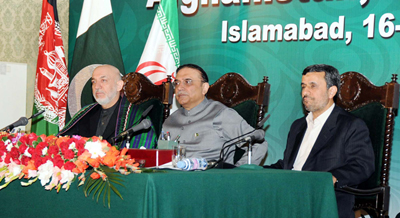
Heads of three stat

 NAVEED BUTT
ISLAMABAD: Pakistan, Iran and Afghanistan would not accept any external pressure.
Heads of three states, Asif Ali Zardari, Mahmoud Ahmadinejad and President Hamid Karzai expressed these views while addressing a joint news conference on Friday after signing the document on "Enhancing Trilateral Cooperation." Only four questions were allowed during the news conference by pre-selected journalists.
A large number of foreign journalists were not given the opportunity to ask questions from the three presidents. However, Foreign Minister Hina Rabbani Khar did respond to the queries outside the briefing hall.
Chief of Army Staff General Ashfaq Parvez Kayani, Lt General Ahmed Shuja Pasha, the Chief of the Inter Services Intelligence (ISI), Finance Minister Dr Abdul Hafeez Sheikh, Information Minister Dr Firdous Ashiq Awan and others were present on the occasion.
"Our friendship and relations are based on peace, prosperity and development and to resolve the problems of the region by using entire range of resources. We will enhance cooperation and develop strong mechanism among the countries for comprehensively realizing the shared aspirations of people for peace, security, stability and economic prosperity. The three countries will prepare and coordinate on a 'Roadmap' for Trilateral Cooperation and present it in the next Summit," they said.
"We will not allow any threat emanating from respective territories against each other. All parties agreed to commence trilateral consultations on an agreement in this regard," they said.
President Asif Ali Zardari said, "We can face forthcoming challenges by remaining united. He said Pakistan and Iran depend on each other and would not consider any pressure for their national interest.
He said terrorism is not only the issue of Pakistan but the whole world and joint efforts could help curb it. Pakistan is a frontline state as it has sacrificed a lot in war against terror. "I personally suffered a loss due to terrorism. Benazir Bhutto embraced Shahadat in a terrorist attack and still no one would tell me who was the financer of Baitullah Mahsud," he said.
The President said that Pakistan, Iran and Afghanistan are committed to working jointly to get rid of terrorism engulfing the region.
Answering a question, the President strongly dispelled the notion of international media that the armed forces are directly or indirectly involved in supporting the extremist or terrorist elements. He said that however there might be some elements in the country, which he termed as "residue of war" who could be blamed for militancy. He said these persons were the remnants of the war against Soviet Union who fought in Afghanistan.
Answering another question about the international pressure to block Iran-Pakistan Gas Pipeline Project, the President said, "Pakistan and Iran need inter-dependence. Our bilateral relationship cannot be undermined by any international pressure."
He said there is problem of drugs on the border of Pakistan and Afghanistan and he has repeatedly raised his voice internationally to urge the world to join hands in helping the region counter drug trade.
Iranian President Mahmoud Ahmadinejad said the problem in the region is due to external interference. "We will not allow external forces to interfere in the region. The problems of the region must be resolved regionally and the trilateral meeting was a step to achieve such goal," he said.
He said the three countries are determined to work out a mechanism to find solution of these problems.
"We are here to strengthen and solidify cooperation among the three countries. We are going to move towards resolving problems which were imposed on the region. We need to evolve our solution through meaningful dialogue, Ahmadinejad said.
Answering a question, he said, "our relations are not on the basis of nuclear bomb and we must go beyond it on the basis of rich deep-rooted culture, tradition, humanitarian and common values. Our friendship is based on peace.
There is a common goal of our countries and we can achieve it with mutual cooperation in future. We will stand before any external pressure in the interest of the nation. We will utilize our entire resources to bring peace, prosperity and stability in the region.
He called for denying others the opportunity to interfere in regional affairs and said the three countries had the resources to face challenges. He said the three countries had large lands, talented human resources and rich humanitarian culture.
President Karzai said the tripartite meeting is "future-oriented" and it would help and focus on recognition of opportunities and formulation of an actionable and implementable policy to act upon.
Answering a question, President Hamid Karzai expressed satisfaction over the recent engagements between the three countries as "fruitful and deep" and hoped that it would be helpful in understanding the affliction brought upon the people of Afghanistan.
According to the joint statement of the three Presidents on "Enhancing Trilateral Cooperation, "the three Presidents pledged to enhance cooperation among the countries comprehensively for realizing the shared aspiration of their people for peace, security, stability and economic prosperity.
The three presidents stressed the need for implementation of the earlier decisions taken at the trilateral summits held at Tehran in May 2009 and June 2011, respectively. While underscoring that the three countries were bound by ties of history, geography, culture and religion, the three sides agreed as follows:
i) To develop framework of comprehensive cooperation and to take pragmatic steps for realizing mutually beneficial cooperation to promote stability, peace and shared prosperity.
ii) Ensure respect for sovereignty, independence, unity and territorial integrity, as enshrined in the UN Charter.
iii) To proceed on the basis of mutual interest, mutual respect, non-interference and non-intervention in internal affairs.
iv) Not to allow any threat emanating from their respective territories against each other. All parties agreed to commence trilateral consultations in this regard.
v) Contribute to the development and reconstruction in Afghanistan.
vi) Broaden cooperation in the political, security, economic, cultural, social and educational fields and enhance people to people contacts including exchange visits of parliamentarians, academicians and journalists.
vii) Strengthen cooperation for eradicating extremism, terrorism and militancy and to address the root causes of these menaces, condemning the killings of civilians as well as any kind of assassinations.
viii) Cooperate in combating the problems of narcotic drugs production and trafficking and in combating transnational organized crimes.
ix) Prioritize cooperation for socioeconomic development.
x) Enhance three-way trade by facilitation measures, including preferential tariff and free trade arrangements as well as barter trade.
xi) Also expressed commitment to expand trade in transit and encourage the private sector to invest in the three countries.
xii) Enhance connectivity by promoting project cooperation in infrastructure, road and rail links, transport and communications.
xiii) Develop mutually beneficial cooperation in the energy, mining and minerals, agriculture and other sectors.
xiv) Cooperate for the safe, voluntary and early return of Afghan refugees to their homeland in honour and dignity.
xv) Emphasized the need for enhancing their cooperation at international level, especially within the United Nations system.
xvi) Mandated the Foreign Ministers to prepare and coordinate a Roadmap for Trilateral Cooperation for submission to the next Summit.
xvii) Also mandated the Interior/Security Ministers to develop a framework of trilateral cooperation particularly in the areas of counter terrorism, counter-narcotics and border management within six months.
xviii) Further mandated the Commerce Ministers to outline steps for enhancing three-way economic cooperation.
xix) Mandated senior officials (Deputy Foreign Minister level) to meet regularly to monitor the implementation of the decisions taken by the Trilateral Summits.
xx) Decided that the Fourth Trilateral Summit shall be held in Kabul by the end of 2012. The exact dates will be communicated through diplomatic channels.
Presidents of the Islamic Republic of Iran and the Islamic Republic of Pakistan reiterated their full support for an Afghan-led and Afghan-owned inclusive process of peace and reconciliation. They assured the President of the Islamic Republic of Afghanistan that they would extend full cooperation and stressed that any initiative in this regard must have authentic Afghan ownership.



















Comments
Comments are closed for this article.