


Pakistan is an agricultural country and substantial contribution to the GDP is through agriculture business. Increasing the yield of agricultural production is directly linked with Fertilizer production and its usage. Natural gas is the core ingredient of the fertilizer industry as well as an indigenous source of energy (Electrical Power).
The reserves of this resource are on a verge of sharp depletion and cannot meet country's present and future requirements without imported Liquefied Natural Gas. Shortage and interruptions of natural gas supply is affecting the fertilizer industry and resultantly slowing down the pace of economic activity along with inducing loss of billions of dollars to national economy.
It is vital that indigenous resources like hydro, wind, solar and coal are developed at fast pace. Meanwhile it is time to look into cost-effective energy resources, to organise, strategize and partner with local and international players to overcome the power shortages in the country to achieve a right balance of our energy mix. Pakistan has the capacity to produce one million tons of surplus Urea for export, yet in 2011-12 it imported more than 1.1 million tons. This has put additional burden on the country's foreign exchange reserves and effectively entailed the payment of millions of dollars in subsidies on account of difference between the costs of locally produced and imported urea.
Pakistan is producing merely 0.5% of its total power through coal and has tremendous potentials to generate power from coal. The Fauji Group felt compelled to contribute towards diminishing the energy crisis faced by the country. Hence, the Board of Directors conceived this coal power plant in year 2013, keeping in view the business sustainability and operational reliability of fertilizer business along with supply of electricity to National Grid.
This project shall be capable of generating 118 MW of electricity for a period of 30 years under long-term agreements. The project has a salient feature and capability to use both Imported and Indigenous coal and shall supply 52 MW electricity to K Electric on sustained basis under long term supply agreement electricity along with meeting power and steam requirement of FFBL fertilizer plant. The plant location is ideal due to its close proximity with K-Electric and FFBL systems.
The biggest task for the project team was to take this massive project on a Non EPCC (Engineering, Procurement, Construction and Commissioning) approach. This approach is an enormous challenge in itself as the concept of multi-contracting requires that the works are outsourced in a number of packages and all the risks of engineering, procurement and construction like with the owner rather than the contractor. For this scheme to work well, the Owner must possess proficient engineering and project management skills and technical experience. The Project team utilising its in-house diversified experience took this challenge head on and applying best engineering practices with no compromise on the quality of technologies in a limited budget initiated the associated works.
The project was split into optimum number of Packages with regard to the nature of work and project timeline. The high level of skill and craftsmanship of the engineering and construction teams, the construction package resulted in no major deficiencies even though quite a few variables were not known at the time.
The skill level of the team and magnitude of the project can be quantified through the facts that even though indulging into a firsthand experience the team managed to successfully cater more than 200 foreign transactions (LCs) from around the globe, we handled more than 110,000 Metric Tons of Equipment, 6000 Metric Tons of Steel and 28000 Metric Tons of cement.
In order to enhance Project socio economic benefits and to introduce standards of good practice in all Project activities, Environmental Impact Assessment Study ("EIA Study") was conducted. This study is in accordance with the standards and requirements of the World Bank and National Environmental Quality Standards (NEQS). Establishing safe working environment and opting for technologies having minimum adverse effect on the environment the Sindh Environmental Protection Agency ("SEPA") granted NOC to the Project in September 2014. Keeping the environment healthy was a major concern and therefore led to the construction of a state of the art and 1st of its kind fully covered coal storage yard on site along with extensive plantation being carried out in vicinity of the power plant.
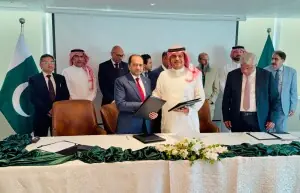
The key factor in successful completion of any financed project is the ability to achieve timely financial close. Thus by the exceptional team efforts all of the critical activities leading to a successful financial close were placed well within time and FPCL announced its first financial close in December 2015. It placed a benchmark in the success story of the Project by becoming the first Coal Fired Power Plant to achieve its financial close.
Another proud achievement of the project is its completion without a single fatality and lost time injury (-21 million man hours) which is testimony to our commitment towards safety in the corporate industrial sector. Supportive leadership and restless dedication make wonders happen.
FFBL Power Company Limited (FPCL), has achieved a great marvel of engineering and efficiency which will act as a bench mark for other upcoming projects in Pakistan and will play a leading role in development of technical human resource for Coal Power Plants in Pakistan.
FPCL will be the first single fuel, coal fired engineering marvel that will aid the Government in achieving stability for the power crises. In addition, it will also address the socioeconomic environment of the region by direct and in-direct employment generation and increase in business opportunities.
This unique venture posed unknown hurdles but they were faced head-on during the implementation of the project. Our team efforts are a testament of Fauji group's commitment as an integral National Welfare organisation.
Pakistan, as a developing economy, needs such initiatives that build the confidence of domestic and foreign investors and fortify the energy sector for economic growth. Fauji Foundation is willing to extend all possible support to the associated companies in these endeavours.
May Allah help us to achieve our objectives!

















Comments
Comments are closed for this article.