


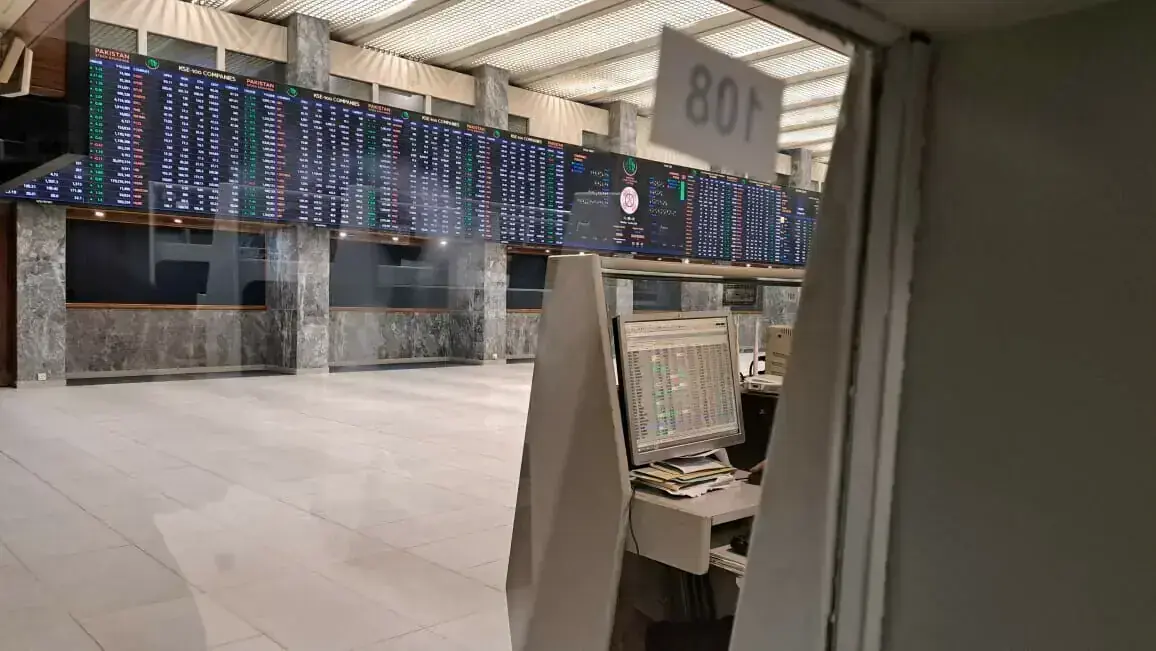
KARACHI: A sharp rise in global crude oil prices amid heightened Middle East geopolitical risks triggered widespread profit-taking at the Pakistan Stock Exchange (PSX) on Thursday.
The benchmark KSE-100 Index declined 1,138.50 points, or 0.68 percent, to close at 167,441.91 points compared to 168,580.41 points in the previous session. The index fluctuated within a range of 2,036.72 points during the session, touching an intraday high of 169,486.60 points and an intraday low of 167,449.88 points.
The BRIndex100 closed at 18,412.48 points, down 139.37 points, or 0.75 percent, from 18,551.85 points, with total volume of 282.165 million shares. The BRIndex30 declined 546.77 points, or 0.82 percent, to 66,045.40 points compared to 66,592.17 points, with total volume of 167.149 million shares.
Ali Najib, Deputy Head of Trading at Arif Habib Limited, noted that the market initially opened on a positive note following the successful IMF review, as Pakistan and the IMF reached a staff-level agreement on the 4th Extended Fund Facility (EFF) and 3rd Resilience and Sustainability Facility (RSF) reviews.
The agreement paved the way for approximately $1.2 billion in disbursements, subject to Executive Board approval, taking total disbursements under the two programmes to around USD5.7 billion.
However, he said the positive momentum faded as international oil prices surged nearly 4 percent amid heightened concerns over Middle East supply, increased shipping attacks in the Gulf and Strait of Hormuz, and disruptions to US production.
Renewed US-Iran tensions further weakened sentiment, prompting profit-taking at higher levels and pushing the market into negative territory. According to Ali Najib, UBL, FFC, SYS, EFERT, POL, PPL, HBL, FATIMA, ENGROH and BAFL collectively dragged the benchmark index down by 601 points. Trading activity in the ready market contracted sharply.
Total ready-market turnover fell to 365.870 million shares from 586.862 million shares on Wednesday, declining by 220.992 million shares or 37.66 percent. Ready-market traded value also dropped to Rs.17.722 billion from Rs.22.365 billion, down by Rs.4.643 billion or 20.76 percent.
Total market capitalization declined by Rs.149.901 billion to Rs.18.598 trillion from Rs.18.748 trillion in the previous session. Market breadth turned heavily negative, with 324 companies declining, 130 advancing and 42 remaining unchanged out of 496 active issues.
K-Electric Ltd. led the ready-market turnover with 29.663 million shares. The stock closed at Rs.5.96 against Rs.6.04.
Cnergyico PK followed with 21.323 million shares, settling at Rs.12.39 compared to Rs.12.73.
Waves Home Appliances recorded 16.919 million shares, closing at Rs.7.77.
Among ready-market gainers, Baba Farid Sugar Mills Limited recorded the largest increase, rising Rs.35.26 to close at Rs.465.22, followed by Fateh Industries Limited, which gained Rs.26.22 to finish at Rs.288.38.
On the declining side, Unilever Pakistan Foods Limited fell Rs.280.00 to Rs.25,400.00, while Sazgar Engineering Works Limited declined Rs.35.33 to Rs.1,591.47.
The BR Commercial Banks Index dropped 458.54 points, or 0.78 percent, to 58,031.91 points on turnover of 10.958 million shares. The BR Power Generation and Distribution Index decreased 114.69 points, or 0.45 percent, to 25,126.99 points, with turnover of 41.054 million shares.
The BR Oil and Gas Index fell 65.36 points, or 0.44 percent, to 14,873.90 points on turnover of 25.311 million shares, while the BR Tech. & Comm. Index declined 39.91 points, or 1.22 percent, to 3,233.25 points, with turnover of 32.545 million shares.
Analysts noted that the IMF staff-level agreement provided an initial positive trigger for the market, but the support was overwhelmed by the sharp rise in international oil prices and renewed geopolitical risks.
Ali Najib said the KSE-100 could remain volatile as IMF support is offset by elevated crude prices and geopolitical uncertainty, with the 167,000-to-170,000-point range emerging as the key technical band for the final trading session of the week. He added that investors would remain focused on international crude oil price movements and foreign institutional flows.
Copyright Business Recorder, 2026





















Comments