


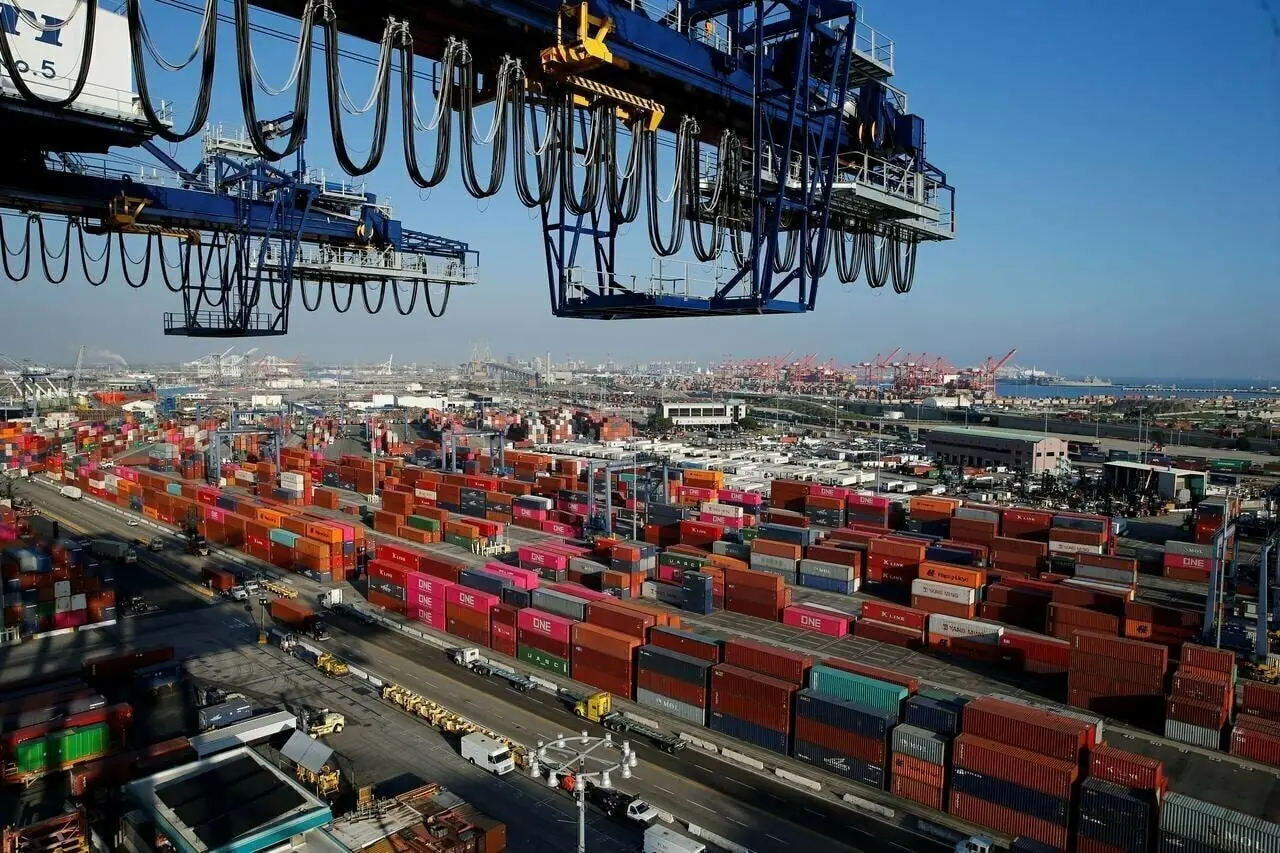

Pakistan’s textile exports increased from $17.88 billion in FY2025 to $17.93 billion in FY2026, a rise of just 0.26 percent. But should such a marginal increase even be considered growth? Incremental gains should not be mistaken for structural recovery, particularly when the manufacturing base itself remains fragile. It is therefore imperative to look beyond headline export figures and examine the underlying productive capacity.
In 2000, manufacturing accounted for a meagre 8.8 percent of Pakistan’s GDP. By 2026, its share had reached only 12.1 percent. More concerningly, after peaking at 12.5 percent in 2022, manufacturing’s share of GDP subsequently declined and failed to regain that level.
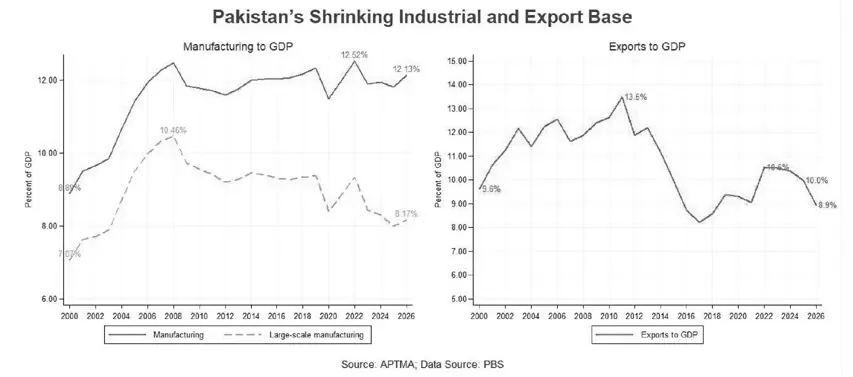
Özçelik and Özmen (2023) estimate that even developing African economies reached an average peak manufacturing share of around 14.5 percent of GDP. The concern, therefore, is not simply that Pakistan’s manufacturing growth has slowed, but that the sector appears to have stalled before acquiring sufficient scale, unlike economies that achieved a more mature stage of industrialisation.
One of the many reasons for this stagnation is the weakening of Pakistan’s textile value chain, the country’s largest export-oriented sector. Textile manufacturing carries the highest weight in Pakistan’s Large-Scale Manufacturing (LSM) index, at 18.16 percent, reflecting its scale, employment generation and extensive linkages with associated industries. Yet textile production has been contracting, most recently by 3.09 percent year-on-year in July 2026.
Given its significant share in production, sustained pressure on the textile value chain inevitably affects overall industrial performance. This is reflected in LSM’s declining contribution to GDP, which has fallen from around 10.46 percent in 2008 to 8.2 percent in 2026.
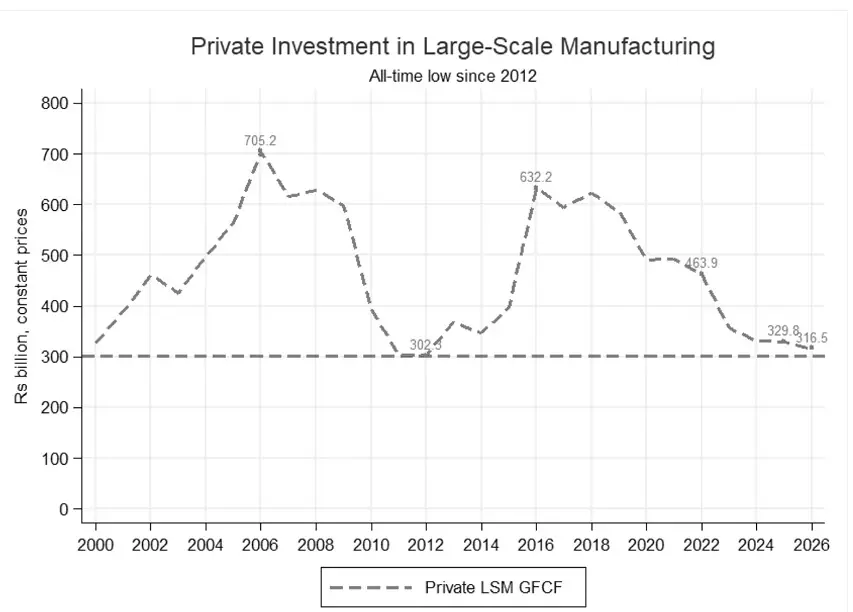
Investment has followed a similar trajectory. Real private fixed investment in LSM is now around 55 percent below its 2006 peak and 32 percent below its 2022 level, having contracted by a further 4.03 percent year-on-year in 2026 to its lowest level since 2012.
The consequences extend to exports. Among other factors, export capacity is fundamentally tied to manufacturing capacity and private investment. With both weakening, Pakistan’s export-to-GDP ratio has steadily declined from a peak of 13.5 percent in 2011 to 10 percent in 2025, and most recently to 8.9 percent in 2026 – the lowest level in the past decade.
A shrinking manufacturing footprint, dwindling investment and a falling export-to-GDP ratio point to a problem that, by now, is unmistakably structural.
Economic literature establishes that developing nations must build and sustain a sufficiently large manufacturing base to drive productivity growth, exports and, hence, convergence with advanced economies (Rodrik, 2016). However, when manufacturing begins to contract at relatively low income levels, before reaching the degree of industrialisation achieved by earlier industrialisers, an economy undergoes what Rodrik (2016) describes as premature deindustrialisation.
Pakistan increasingly appears to fit Rodrik’s description.
Together, these three declining indicators are creating pressure on the current account. Whenever Pakistan’s domestic demand or international orders gain momentum, imports increase significantly. However, exports fail to increase at a sustainable pace, as they remain constrained by a stagnant manufacturing base that accounts for just 12 percent of GDP. As evidence, between FY2024 and FY2026, textile exports grew by only 7.7 percent, while textile imports surged by 138 percent, thereby worsening the textile trade balance by 17.7 percent over the same period.
The pattern is simple: economic expansion generates import pressures, imports outpace exports, external imbalances widen, growth eventually confronts a balance-of-payments constraint, and Pakistan returns to external financing. The cycle repeats.
The only way out is export-led growth backed by strong manufacturing.
Pakistan’s textile export basket already demonstrates the potential of domestic value addition: around 86 percent of textile exports are apparel and made-ups, while only $2.5 billion of the $17.9 billion in textile exports comprises yarn and fabric. Further processing at home of even a portion of these intermediate exports into garments could generate annual export earnings much higher than the $2.5 billion currently earned from them.
For that, the reform sequence should focus on three immediate priorities.
- Fix energy, fix manufacturing
The first prerequisite is lowering the prohibitive cost of production, beginning with electricity. Pakistani factories currently face power tariffs of around 11 to 13 cents/kWh, compared with approximately 5 to 9 cents/kWh among regional competitors. Textile manufacturing and exports cannot remain competitive at these tariffs.
Electricity tariffs must therefore be brought closer to the regional benchmark of around 7 cents/kWh.
- Rationalise the tax burden on manufacturing and exports
Pakistan’s current fiscal architecture continues to strain manufacturing and restrict industrial liquidity. The standard 18 percent sales tax applied across processing stages, alongside structural minimum turnover taxes and overlapping federal and provincial levies, continues to drive up the cost of production for compliant, formal businesses. The tax burden on manufacturing must therefore be rationalised, while incentives should encourage non-exporting manufacturers to transition into high-value-added exports.
This brings us to the final recommendation:
- Strengthen and vertically integrate the domestic value chain
Policy must enable domestic manufacturers to move further up the value chain through forward integration while also strengthening the domestic supply of competitively priced inputs required by firms that are already exporting.
This is particularly important when the economy is exposed to global and regional shocks, price shocks and resulting surges in imports.
Ultimately, a marginal increase in export revenue, when the value chain has the potential to bring in substantially more dollars, is a self-inflicted loss.
It is time to set the bar higher.
Copyright Business Recorder, 2026
The writer is Chairman APTMA— North Zone. The views expressed in this article are not necessarily those of the newspaper
Sarah Javaid is an Economist by education and practice, with experience in the Ministry of Commerce, the textile sector, and think tanks. She has participated in the monitoring mission of the Pakistan Regional Economic Integration Activity for USAID. Her writings focus on international trade and export competitiveness. Currently, she serves as a Trade Economist at the All Pakistan Textile Mills Association














Comments