




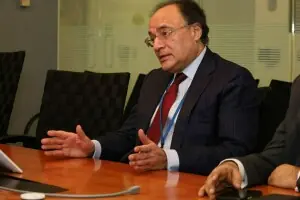
Federal Finance Minister Muhammad Aurengzeb while in the United States reportedly explored US financing opportunities for PIA upgrade, refinery upgrades and Reko Diq mining project with US Export Import Bank (EXIM) Chairman John Jovanovich.
The terms of reference of the US EXIM bank as uploaded on its website are as follows: “the official export credit agency of the United States. EXIM is an independent Executive Branch agency with a mission of supporting American jobs by facilitating the export of U.S. goods and services.
When private sector lenders are unable or unwilling to provide financing, EXIM fills in the gap for American businesses by equipping them with the financing tools necessary to compete for global sales.
In doing so, the agency levels the playing field for U.S. goods and services going up against foreign competition in overseas markets, so that American companies can create more good-paying American jobs. Because it is backed by the full faith and credit of the United States, EXIM assumes credit and country risks that the private sector is unable or unwilling to accept.
The agency’s charter requires that all transactions it authorizes demonstrate a reasonable assurance of repayment; EXIM consistently maintains a low default rate and closely monitors credit and other risks in its portfolio.”
The US EXIM noted on its website that since 2000 it provided 14.6 billion dollars to the US Treasury after paying all administrative and programme expenses.
The commercial interest reference rates (CIRR) charged by the US EXIM bank are the official lending rates of export credit agencies and are calculated on the US Treasury bond market. It will generally set the lending rate to the applicable CIRR at the time of first disbursement, except for aircraft transactions where the Large Aircraft Sector Understanding (LASU), or the Aircraft Sector Understanding (ASU) apply. While the website did not elaborate on the LASU or ASU yet it is relevant to note that with the ongoing Middle East and Russia-Ukraine conflicts and the continued weaponization of sanctions and the dollar has given rise to higher treasury rates due to (i) scaling down of US treasuries held by central banks of competitor countries - China - and allies (Japan) alike, (ii) increased use of digital Cross-Border Interbank Payment System set up by China a decade ago as opposed to SWIFT. Needless to add the low yield on US treasuries allowed the US government to access these funds at very cheap rates – a situation that no longer holds which explains the rising lament of independent US economists about the rising borrowing costs. Today the yields are as follows: (i) 3 month 4.1 percent, (ii) 6 month 4.32 percent, (iii) 2 years 4.86 percent, (iv) 5 years 5.08 percent, (v) 10 years 5.28 percent and 30 years 5.62 percent.
PIA was privatized amidst much fanfare in December 2025 with 75 percent shares sold for 135 billion rupees (25 percent retained by the government) to a consortium that included Arif Habib and Fatima Fertilizer (34.1 percent), Fauji Fertilizer (34 percent), Lake City Holdings (14 percent) and the remaining 17.9 percent shares held by City School, AKD Group. None of the consortium members had any prior experience in aviation.
The legacy debt estimated at between 268.5 billion rupees to more than double 650 billion rupees was reportedly parked into a PIA Holding Company (reminiscent of the Power Sector Holding Company) with taxpayers to fund roughly 30 billion rupees annually in restructured interest while the new buyers were tasked to manage a small amount, around 26 billion rupees, of the legacy debt.
In April 2026 the consortium acquired the remaining 25 percent shares for 45 billion rupees.
The consortium paid a total of 55 billion rupees to the government while the remaining 125 billion rupees is to be invested back in the company as new equity through a rights issue (defined as a corporate action that allows the existing shareholders the option to buy additional new shares in proportion to their current holdings, usually at a discount to the current market prices) in two tranches – an upfront payment of 83.25 billion rupees (equivalent to around 300 million dollars) with the remaining 41.625 billion rupees to be invested in 12 months.
One of PIA’s major sources of loss was its massive economically unviable over-staffing, with mainly Pakistan People’s Party accused of using PIA as a major recruitment centre for its loyalists: thus PIA’s staff strength was from 500 to 550 employees per aircraft while the global benchmark is 100 to 250 employees.
Unlike in the past when PIA privatisation came under discussion there was no strike action and the agreement provides job security to staff for around 12 to 18 months; it is unclear whether the proposal to extend it to three years is still under consideration. It is also not clear whether the redundancies expected around June next year would lead to strike action whose success would depend on the economic political system in place at the time.
So what promoted Aurengzeb to seek financing for PIA from the US EXIM Bank? Pakistan government agreed to facilitate access to financing and suppliers rather than in purchasing the aircraft directly and pledged that no taxpayer-funded loan or mandatory sovereign guarantee will be extended as financing can be secured directly against the aircraft based on creditworthiness.
Cost of a Boeing is estimated at 248 to 338 million dollars with 250 to 290 seats or, in other words, the upfront equity agreed with the government that was made part of the cost is sufficient to purchase one aircraft. Reports suggest that the new PIA management is in talks with Boeing to acquire sixteen 787 Dreamliners roughly at a cost of nearly 4 billion dollars. If the loan is for five years, perhaps a period too short to win back the clientele lost to other airlines due to ceding of routes to other airlines the annual repayment would be around 200 million dollars – an addition that would raise the cost of tickets to perhaps more than the rates prevalent in other airlines.
The question is what would be the terms if the purchase of the 16 Boeings is agreed with the US EXIM bank? The government, after approval of the International Monetary Fund, extended sales tax exemption on aircraft and parts, exemption from new taxes on jet fuel and income tax relief on dividend payments for 15 years and the legacy debt is minimal. However, the cons include the lack of experience of the private owners as well as the legacy labour problems that may resurface.
To conclude, one would hope that the new owners can make PIA a success and the need for the government held legacy debt/assets (including Roosevelt Hotel) as collateral does not arise and nor does a strike action materialize as the 16 new Boeing aircraft may well be able to adjust the excess staff.
Copyright Business Recorder, 2026














Comments