


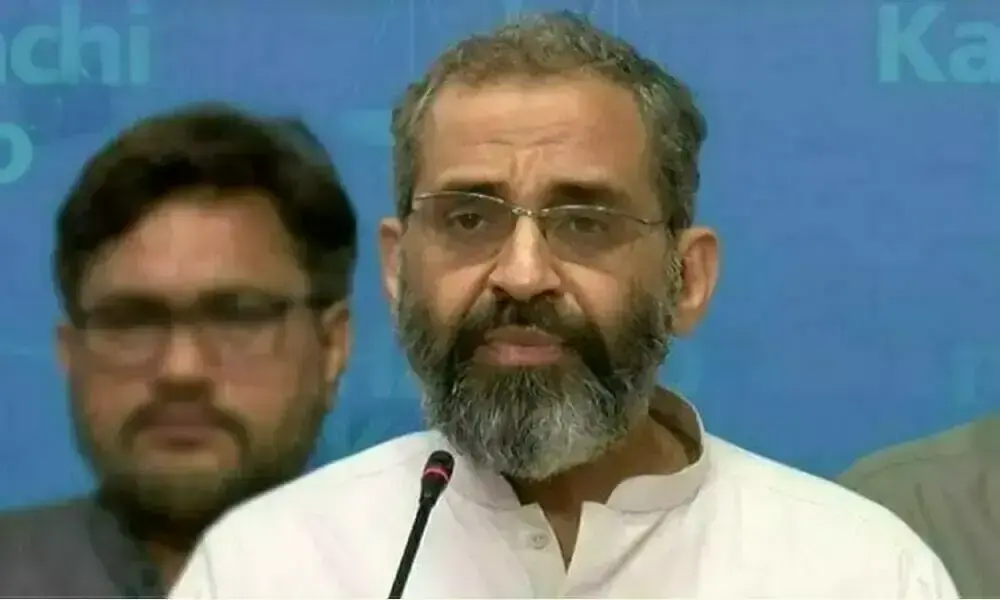

KARACHI: The Jamaat-i-Islami’s (JI) protest sit-in outside the Governor House entered its eighth consecutive day on Sunday, with Karachi chief Monem Zafar saying that the city, despite being the “engine of Pakistan’s economy”, remained deprived of basic civic necessities.
Addressing a local government convention at the protest camp, Monem Zafar said Karachi, a port city with a population of around 35 million, faced serious shortages of water, transport and other essential services.
“Half of the city does not have access to water,” he said, adding that women and elderly citizens were forced to travel in Qingqi rickshaws. He said roads were broken, infrastructure was in poor condition and the city faced up to 14 hours of loadshedding and rising street crime.
Monem Zafar said the Pakistan People’s Party (PPP) provincial government was unwilling to devolve powers and resources to the grassroots level and had done little to resolve Karachi’s problems. He also criticised the Bus Rapid Transit (BRT) projects, saying people had been “deceived in the name of BRT” and forced to suffer prolonged hardship.
“Whether it is the alleged excesses of K-Electric, Bahria Town or problems faced by citizens at Nadra, the Jamaat-i-Islami has worked to secure relief for the people,” he said. He added that the party had also protested against land grabbers and forced them to retreat.
The speakers at the convention included JI Sindh secretary and New Karachi Town chairman Mohammad Yousuf, Karachi vice chief and KMC opposition leader Saifuddin Advocate, Karachi secretary and UC chairman Taufeequddin Siddiqui, Central district chief and Nazimabad UC chairman Syed Wajih Hasan, JI women’s wing Sindh chief and City Council member Rakhshanda Muneeb, Karachi women’s wing chief Jawadan Faheem, JI minority wing Karachi president Younis Sohna Advocate and Pakistan Islamic Medical Association Karachi president Dr Zakia Aurangzeb.
Keamari district chief and City Council deputy parliamentary leader Maulana Fazal Ahad conducted the proceedings. A large number of town and UC chairmen and councillors, including women local government representatives, attended the convention.
Several resolutions were adopted during the event. A resolution moved by Safura UC chairman and City Council member Noman Ilyas strongly condemned what it described as the “incompetence, poor performance and corruption” of the mayor and the Sindh government. It said illegal construction and encroachments on government land, playgrounds and amenity plots were taking place under official patronage.
The resolution also criticised the deteriorating infrastructure, encroachments over storm-water drains and the accumulation of garbage. It said the Sindh Building Control Authority and other relevant administrative bodies had failed to perform their duties. Another resolution, moved by City Council deputy parliamentary leader and Youth Councillor Taimur Ahmed, opposed handing over government land and parks to favoured individuals for commercial use under public-private partnerships through the KMC.
Kashif Shamsi moved a resolution demanding that the Sindh government devolve powers and resources to the grassroots level. Korangi UC chairman Qari Mansoor handed over his honorarium cheque for the past 10 months to Monem Zafar for the protest fund. Engineer Sabir Ahmed presented a documentary highlighting three years of development work carried out by the JI in nine Karachi towns. Yousuf said the local government system in Sindh was “crippled” and lacked meaningful authority.
Saifuddin Advocate expressed confidence that the JI’s struggle would eventually succeed. He said the party was the only political force raising its voice for Karachi’s rights and working to resolve its problems at the City Council, town and UC levels. Taufeequddin Siddiqui said an empowered local government was the only solution to Karachi’s problems. He said Karachi generated 63 percent of federal revenue and 96 percent of provincial revenue, yet its roads and infrastructure remained in a dilapidated condition.
Syed Wajih Hasan said City Council members deserved appreciation for continuing to work despite limited resources. Rakhshanda Muneeb said women were not being allowed to speak freely in the present City Council and that their microphones were switched off.
Jawadan Faheem described the sit-in outside the Governor House as a landmark protest for Karachi’s rights. She criticised the mayor’s conduct in the City Council and demanded an end to the petroleum levy, which she termed a “ransom tax”. She also called for the cancellation of what she described as anti-people agreements with independent power producers (IPPs).
Younis Sohna Advocate said the government was “plundering” citizens in the name of the petroleum levy. The Governor House protest camp remained busy throughout Sunday, with people arriving from different parts of the city and participants showing considerable enthusiasm.
A Nasheed Night was also organised at the camp on Saturday night, featuring hamd, naat and other poetry. Participants took keen interest in the programme, which continued until late at night. Young participants also prepared haleem for people attending the sit-in.
Copyright Business Recorder, 2026











Comments