


National Assembly passes bills related to military, National Command Authority
- Opposition stages a walkout in protest against the proposed amendments
The National Assembly passed key bills amending military and nuclear command structures, following the 27th Constitutional Amendment. The cabinet also approved a National Adolescent and Youth Policy to empower youth.
- National Assembly passing military and nuclear command bills.
- Amendments to the Defence Forces Act and National Command Authority Act.
- The new Chief of Defence Forces position.
- Federal cabinet's approval of the National Adolescent and Youth Policy.
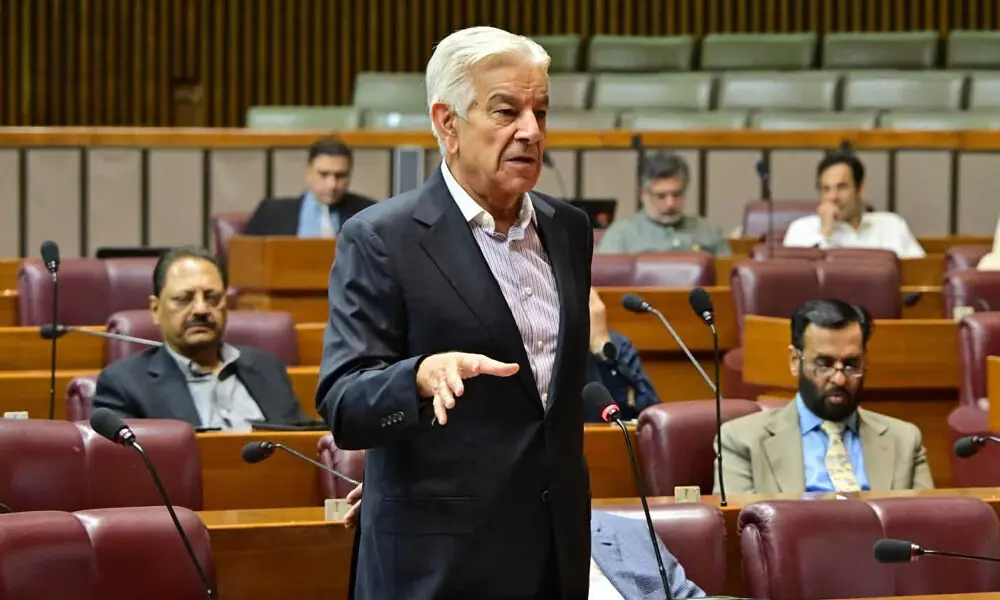
The National Assembly on Thursday passed two bills, by a majority vote, related to military and nuclear command structure – Defence Forces Act 2026 and National Command Authority Act 2010.
Defence Minister Khawaja Asif introduced both bills in the House, while the opposition staged a walkout in protest against the proposed amendments, Aaj News reported.
During the assembly session, chaired by NA Speaker Sardar Ayaz Sadiq, the House took up clause-by-clause approval of the Defence Forces Amendment Bill 2026, which was subsequently passed by a majority vote.
The federal cabinet earlier today approved amendments to Defence Forces Act 2026 and National Command Authority Act 2010, the Prime Minister’s Office stated.
The development came during a meeting of the federal cabinet, chaired by Prime Minister Shehbaz Sharif, in Islamabad.
The draft Defence Forces Act 2026, approved by the federal cabinet, has been prepared as a follow-up to the amendments introduced through the 27th Constitutional Amendment, the PMO said.
The legislation aims to define the relevant administrative matters concerning the office of the Chief of Defence Forces and the Chief of Defence Forces Headquarters, it added.
Following the approval by the cabinet and National Assembly, the bills will be presented before the Senate for approval.
Under the proposed law, the chief of army staff (COAS) will exercise the powers of the chief of defence forces (CDF), while the CDF is also proposed to be vested with powers relating to the command and control of the armed forces.
According to the proposed amendments, the chief of defence forces will have the authority to advise the prime minister on matters concerning national security and the armed forces. The CDF will also be granted broad powers relating to the organisation of the armed forces, including the authority to take necessary measures on key military matters.
The bill proposes to formally define the powers and duties of the chief of defence forces. Under the proposed framework, the CDF will exercise powers conferred under the law, while additional powers may also be assigned to the office with the approval of the prime minister.
Under the proposed law, a mechanism will be established for obtaining government approval for the exercise of powers assigned to the chief of defence forces, while the CDF will also be authorised to exercise certain powers directly.
The Defence Forces Act 2026 also proposes granting the CDF the authority to formulate rules and regulations and issue directives and orders. In case of any ambiguity regarding the proposed law, the president’s order is proposed to be considered final.
The bill further proposes that the Pakistan Defence Forces Act 2026 come into force immediately, while orders, directives and notifications issued prior to the enactment of the law would remain valid.
During the National Assembly session, a draft bill seeking amendments to the National Command Authority Act 2010 was also presented for approval. The bill was subsequently passed by the National Assembly by a majority vote.
The 27th Constitutional Amendment led to significant changes in Pakistan’s military hierarchy, including the creation of the chief of defence forces post, which is a dual-hatted position concurrently held by the COAS Field Marshal Syed Asim Munir. COAS Munir was appointed as the country’s first chief of defence forces on December 4, 2025.
National Adolescent and Youth Policy
The federal cabinet on Tuesday also granted in-principle approval to the National Adolescent and Youth Policy, aimed at creating a comprehensive national framework to empower Pakistan’s young population.
According to the PMO, the policy, proposed by the Ministry of Inter-Provincial Coordination, is intended to bring young people into the mainstream of national development and help ensure a more equitable and enabling economic and social environment for them.
The national framework is built around four key pillars: education, employment, inclusion and environment.
As part of the policy’s implementation framework, the government plans to establish a Pakistan Youth Development Council and a Federal Adolescent and Youth Agency.
The meeting was informed that the policy was formulated following an extensive nationwide consultation process, involving 32,145 surveys and feedback from more than 200,000 young people across the country.
Prime Minister Shehbaz directed that suggestions put forward by cabinet members should also be incorporated into the policy.
Meanwhile, the federal cabinet ratified decisions taken by the Cabinet Committee on State-Owned Enterprises at its meeting on July 9.
The cabinet also approved decisions made by the Economic Coordination Committee (ECC) at its August 14, 2026 meeting.
In addition, the cabinet ratified decisions of the Cabinet Committee on Legislative Cases taken at meetings held on June 18, July 30, August 5 and August 18, 2026.

























Comments