


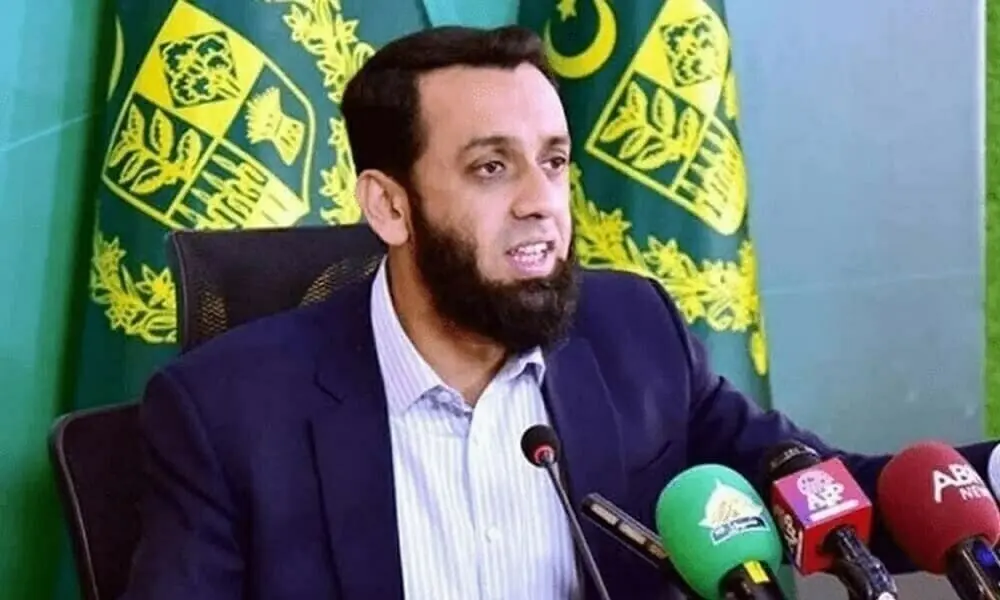

ISLAMABAD: Federal Minister for Information and Broadcasting Attaullah Tarar on Tuesday said Pakistan’s people, armed forces and society stood as a “shield” between terrorists and the rest of the world, stressing that the country’s sacrifices in the fight against terrorism had strengthened its case internationally and helped counter hostile narratives against it.
Addressing a capacity-building workshop organised by the Sustainable Social Development Organization (SSDO), the minister said Pakistan had sacrificed around 90,000 lives in the fight against terrorism, including personnel of the armed forces, police and other law enforcement agencies, politicians, civilians, doctors, engineers and children.
“If the Pakistani nation and the armed forces had not fought this war, these terrorists would have been roaming across countries around the world,” Tarar said, adding that terrorism had no colour, race or religion and attempts to impose ideologies through violence would not be tolerated.
He said perception often became more powerful than reality in information and narrative warfare, making it essential for information managers and narrative builders to narrow the gap between the two.
Referring to Marka-e-Haq, Tarar said the information and narrative battle had begun even before the military confrontation, when India accused Pakistan of involvement in the Pahalgam incident. He said Pakistan responded by questioning the basis of the allegations, and Prime Minister Shehbaz Sharif subsequently offered a transparent international investigation into the incident during his address at the Pakistan Military Academy, Kakul.
Tarar said Pakistan successfully highlighted before the international media that a country which had lost tens of thousands of lives fighting terrorism could not be equated with those it accused of sponsoring terrorism. He also cited the arrest of Indian national Kulbhushan Jadhav from Balochistan while presenting Pakistan’s case regarding alleged external involvement in terrorism.
The minister said terrorism had largely been eliminated by 2017 following coordinated efforts by federal and provincial governments, the armed forces and other institutions under the National Action Plan, creating conditions for investment to return to Pakistan. He maintained that a subsequent shift in policy undermined several years of counterterrorism gains and was undertaken without taking political parties into confidence.
He said the government, public and state institutions remained committed to eliminating terrorism, adding that defeated terrorist groups were increasingly targeting soft targets. He praised security institutions for what he described as the professional execution of the Jaffar Express rescue operation and said there was “no doubt” about external involvement in terrorism confronting Pakistan.
Tarar said the government had strengthened cybercrime laws and developed a legal framework for the digital domain. A modern Digital Communication Department had also been established, while the federal government had offered assistance to provincial governments in developing similar capacities.
On Balochistan, he said the government was prepared to facilitate the establishment of television channel bureaus in the province’s southern districts and praised the Balochistan government’s efforts on the narrative front.
He said development of Balochistan remained a government priority, adding that Prime Minister Shehbaz Sharif and Field Marshal Syed Asim Munir were committed to the province’s development and prosperity. He cited federal funding for improvements to the N-25 highway and said Punjab Chief Minister Maryam Nawaz had provided Rs15 billion to the Balochistan government for counterterrorism efforts.
The information minister also stressed the need for political consensus to ensure continuity of major national policies, citing Rescue 1122 as an example of an initiative that was continued across governments and subsequently expanded.
Tarar said Pakistan had also achieved significant diplomatic gains and emerged as a mediator on the international stage, while its soft image had improved globally.
“The power of narrative is being used to further improve Pakistan’s image around the world,” he said, adding that Pakistan had been created after immense sacrifices and would continue to stand firmly against terrorism and violent extremism.
Copyright Business Recorder, 2026










Comments