


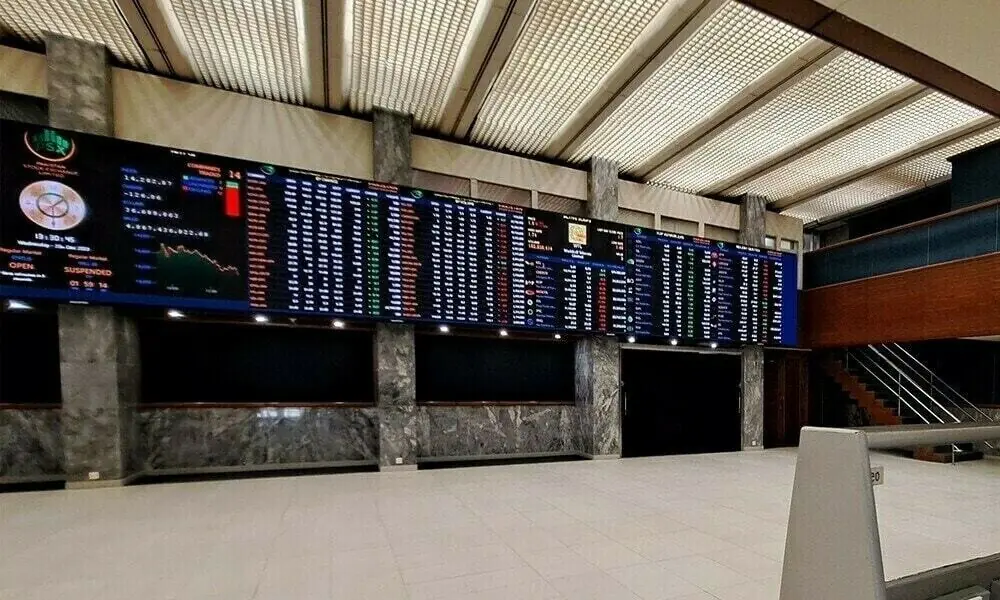
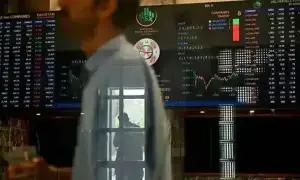
KARACHI: The Pakistan Stock Exchange (PSX) closed the week under pressure as uncertainty over the extension of the US-Iran ceasefire and concerns surrounding oil supplies through the Strait of Hormuz and Red Sea weighed on investor sentiment, despite strong domestic fiscal and external-sector indicators.
The benchmark KSE-100 Index fell 1,325.41 points, or 0.7 percent week-on-week, to close at 180,104.61 points, compared with 181,430.02 points in the previous week.
Meanwhile, the BRIndex100 opened the week at 20,022.79 points and closed at 19,856.60 points, recording total turnover of 2.84 billion shares. The BRIndex30, however, opened at 72,120.96 points and closed higher at 72,452.79 points, with total turnover of 1.78 billion shares.
Total market capitalization declined 0.5 percent week-on-week to Rs20,130.30 billion from Rs20,237.75 billion. In US dollar terms, market capitalisation fell to USD 72.50 billion from USD 72.87 billion.
Despite the decline in headline indices, trading participation improved during the week. Readyboard Average Daily Traded Volume (ADTO) increased 13.9 percent to 853.27 million shares from 749.32 million shares. Readyboard average daily traded value also rose 12.6 percent to Rs38.14 billion, equivalent to USD 137.35 million.
The main pressure on the market came from renewed uncertainty over the potential extension of the 60-day US-Iran ceasefire, which was due to expire on August 17, as well as concerns over supply disruptions in the Strait of Hormuz and the Red Sea. Against this backdrop, ICE Brent crude rose above USD 90 per barrel during the week, touching around USD 93.58 per barrel and gaining 5.06 percent week-on-week before settling around USD 86-USD 87 per barrel.
Despite the external pressures, domestic fiscal indicators remained supportive. Pakistan’s fiscal deficit for FY26 declined 46 percent year-on-year to Rs3.3 trillion, equivalent to 2.6 percent of GDP, compared with Rs6.2 trillion or 5.4 percent of GDP in FY25. The fiscal deficit was reported to be the lowest in 22 years.
The country’s primary surplus reached a record Rs3.6 trillion, or 2.9 percent of GDP, representing a 34 percent year-on-year increase. Total revenues rose 10 percent, with tax revenue increasing 12 percent, direct taxes 14 percent and sales tax 9 percent. At the same time, total expenditures declined 4 percent, while markup costs fell 22 percent year-on-year to Rs6.9 trillion.
The external sector also provided support. Overseas workers’ remittances increased 13 percent year-on-year and 4.5 percent month-on-month to USD 3.6 billion in July 2026. State Bank of Pakistan liquid foreign exchange reserves stood at USD 22.498 billion as of mid-August.
On the diplomatic and defence front, Pakistan, Saudi Arabia and Türkiye signed the Makkah Joint Defence Agreement. Meanwhile, an IMF staff mission is scheduled to visit next month for the fourth review under the Extended Fund Facility and the third review under the Resilience and Sustainability Facility, with the reviews aimed at paving the way for around USD 1.2 billion in disbursements.
Sector-wise, refineries emerged as the strongest performers, gaining 11.0 percent during the week. The sector’s performance was supported by reports that the Petroleum Ministry expects to sign formal agreements worth USD 5 billion for refinery upgrades next month.
Oil and Gas Exploration companies also remained in positive territory, gaining 0.9 percent, supported by higher crude spot prices. The automobile sector remained unchanged on a weekly basis, while July auto sales increased 74 percent year-on-year, partly due to a low base in the same period last year and lower financing rates. The federal minister also called for revival of the automobile sector to support the country’s USD 63 billion national export target.
Other major sectors remained under pressure. Power declined 3.1 percent, Fertilizer 2.7 percent, Technology and Communication 2.4 percent, Cement 1.0 percent, while Commercial Banks fell 0.2 percent.
At the individual-stock level, CNERGY emerged as the leading gainer, rising 14.6 percent to Rs13.68. PSEL gained 6.5 percent to Rs934.94, GAL increased 5.9 percent to Rs646.23, GHNI advanced 5.3 percent to Rs1,305.17 and ATRL rose 5.0 percent to Rs1,037.57.
Among the major losers, AICL declined 8.4 percent to Rs88.31, PAKT fell 6.3 percent to Rs1,364.29, HUBC lost 5.6 percent to Rs212.96, BOP declined 5.2 percent to Rs34.58, TRG fell 5.1 percent to Rs60.09 and FFC shed 4.5 percent to Rs557.16.
Investor flows also remained mixed. Local individuals recorded net buying of USD 16.3 million, while commercial banks and insurance companies registered net selling of USD 11.2 million and USD 6.3 million, respectively.
Despite the week’s decline, AKD Securities retained a bullish long-term outlook and projected the KSE-100 Index to reach 263,800 points by December 2026. The brokerage cited forward price-to-earnings valuation of 7.9 times, an easing interest-rate environment and expectations of regional stability.
Analysts say overall, the week’s performance reflected a market caught between external geopolitical risks and improving domestic economic fundamentals. While higher oil prices and uncertainty surrounding regional tensions continued to weigh on equities, stronger fiscal indicators, higher remittances, improved trading participation and positive developments in selected sectors provided some support to the market.
Copyright Business Recorder, 2026


















Comments