


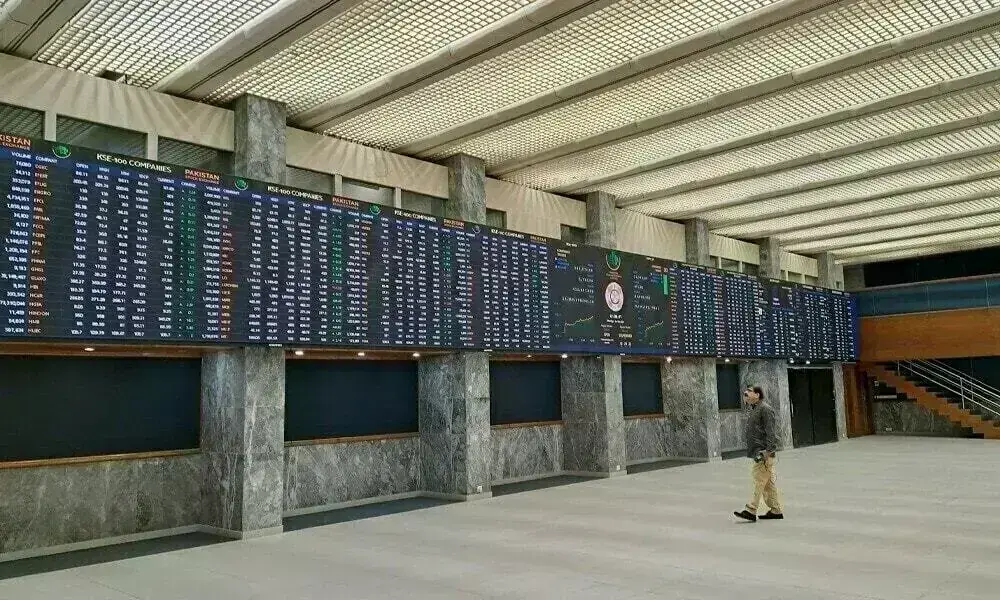

KARACHI: The Pakistan Stock Exchange (PSX) staged a strong recovery during the week ended August 7, 2026, as progress in diplomatic talks between Iran and Oman over shipping through the Strait of Hormuz, along with expectations of a broader US-Iran agreement, eased geopolitical concerns and improved investor sentiment.
The benchmark KSE-100 Index gained 5,335.89 points, or 3.0 percent week-on-week, to close at 181,430.02 points, compared with the previous week’s close of 176,094.13 points.
The market’s advance was supported by easing international oil prices and strong earnings announcements from the banking sector. Commercial banks alone contributed 1,919 points to the KSE-100 Index during the week, making the sector the largest contributor to the benchmark’s gain.
The broader market also recorded significant gains. The BRIndex100 opened the week at 19,346.81 points and closed at 20,022.79 points, rising 675.98 points, or 3.49 percent. Its total weekly turnover stood at 3.067 billion shares, translating into an average daily turnover of approximately 613.35 million shares over five trading sessions.
The BRIndex30 increased from 69,567.15 points to 72,120.96 points, gaining 2,553.81 points, or 3.67 percent during the week. The index recorded total turnover of 1.731 billion shares, with average daily turnover standing at approximately 346.19 million shares.
The overall market capitalization of the PSX increased by 2.4 percent week-on-week, rising to Rs20,237.75 billion from Rs19,755.71 billion. In US dollar terms, market capitalization increased to US$72.87 billion from US$71.11 billion.
The improvement in geopolitical sentiment was linked to diplomatic efforts involving Iran and Oman concerning a framework for shipping through the Strait of Hormuz, alongside expectations of a broader understanding between Washington and Tehran. The developments reduced market anxiety over regional tensions and supported a decline in global oil prices.
Brent crude fell by 9 percent week-on-week to US$82.1 per barrel, with prices briefly moving below US$80 per barrel during the week before settling around US$82. The decline in international oil prices was accompanied by domestic fuel relief, with the government reducing petrol prices by Rs8.2 per litre and High-Speed Diesel prices by Rs13.4 per litre.
On the macroeconomic front, national consumer price inflation slowed to 9.2 percent year-on-year in July 2026, returning to single digits for the first time in four months. The reading, however, remained above some market expectations.
Pakistan’s trade deficit widened by 25 percent year-on-year to US$3.95 billion in July 2026, with imports increasing by 18 percent year-on-year compared with a 10 percent increase in exports. On a month-on-month basis, however, the trade deficit narrowed by 15 percent, supported by stronger export receipts.
The Federal Board of Revenue collected Rs816 billion in July 2026, exceeding its monthly target by Rs36 billion.
Meanwhile, Pakistan formally requested China to expedite the refinancing of USD1.3 billion in commercial loans as the country sought to strengthen its foreign exchange reserves. SBP foreign exchange reserves edged up by US$13 million to US$17.00 billion.
In the domestic debt market, the government raised Rs789 billion through Treasury Bills and Rs882 billion through Pakistan Investment Bonds in recent auctions. PIB yields increased by 16 to 26 basis points across various maturities, while T-bill yields remained largely unchanged.
Trading activity on the ready market was mixed. Average daily turnover declined by 9.9 percent week-on-week to 749.32 million shares. However, average daily traded value increased by 7.0 percent to Rs33.87 billion, equivalent to US$121.94 million.
Sector-wise, Property accounted for 7 percent of total market volume, while Investment Banks and Securities and Refinery sectors each contributed 12 percent. Technology & Communication and Commercial Banks each represented 9 percent of total volume, while the remaining 51 percent was attributed to other sectors.
Refineries led sectoral price performance with a 5.0 percent weekly gain, followed by Cement at 4.0 percent, Power at 3.9 percent, Oil Marketing Companies at 3.6 percent, Fertilizer at 3.5 percent, and Commercial Banks at 3.3 percent.
Exploration & Production companies gained 2.7 percent, Engineering 2.6 percent, and Technology & Communication 2.4 percent. Chemicals advanced 1.3 percent, Pharmaceuticals 1.0 percent, Autos 0.9 percent, Food 0.7 percent, while Textile Composite recorded the smallest gain of 0.3 percent.
Among individual KSE-100 constituents, Gadoon Textile Mills (GADT) was the strongest performer, gaining 23.9 percent to close at Rs341.05. Power Cement (POWER) rose 16.2 percent to Rs23.47, while Cnergyico PK (CNERGY) gained 11.2 percent to Rs11.94.
Other notable gainers included Nishat Power (NPL), up 9.7 percent to Rs71.98; Bank of Punjab (BOP), up 8.9 percent to Rs36.46; Ghani Global Holdings (GHGL), up 8.8 percent to Rs42.06; and Sui Southern Gas Company (SSGC), up 7.9 percent to Rs27.28.
On the losing side, MEHT fell 22.8 percent to Rs150.14, while IBFL declined 13.4 percent to Rs265.84. Nestlé Pakistan (NESTLE) fell 4.0 percent to Rs7,599.87, followed by PGLC, down 2.9 percent, KTML, down 2.7 percent, SHFA, down 2.4 percent, and HGFA, down 2.3 percent.
The weekly market performance therefore reflected a broad-based recovery at the PSX, with geopolitical easing, lower international oil prices and strong banking-sector earnings providing the principal support to equities, while trade pressures, external financing requirements and elevated domestic borrowing costs remained among the factors requiring continued monitoring.
Copyright Business Recorder, 2026

















Comments