


China July factory-gate inflation eases to 3-month low, CPI slows
- China's leaders, confronting a two-speed economy of strong factory output and exports but weak domestic demand
China's July inflation eased more than expected due to lower energy prices and weak demand, prompting leaders to accelerate fiscal spending to bolster a slowing economy.
- China's cooling producer and consumer inflation in July.
- Government plans for accelerated fiscal spending to boost growth.
- Weak domestic demand impacting manufacturers and job security.
- Slowing factory activity and new orders in July.
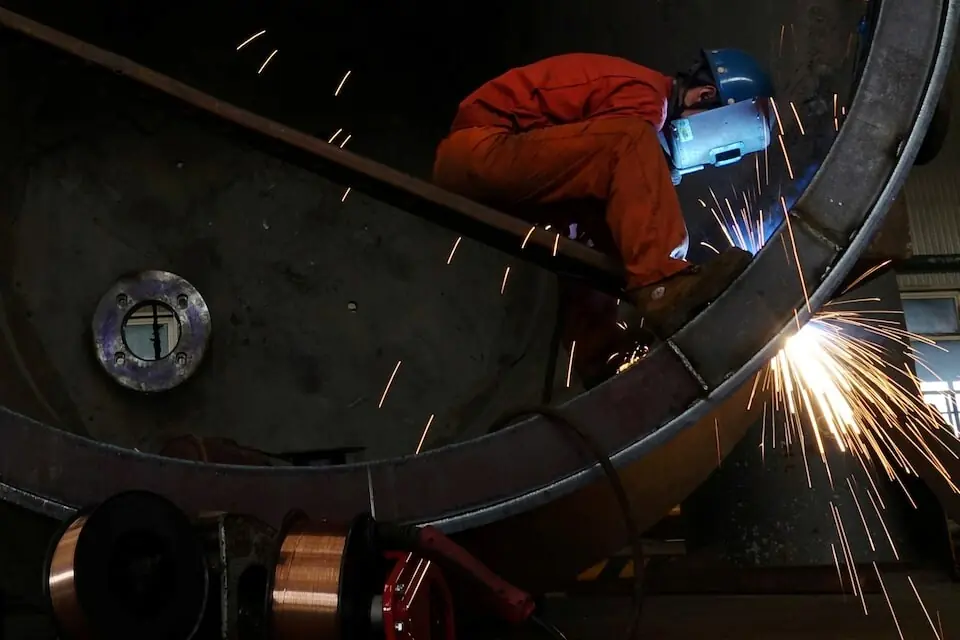

BEIJING: China’s producer price inflation eased more than expected in July to its weakest in three months, while consumer inflation also cooled, official data showed on Sunday, as global energy prices retreated despite the US-Israel war against Iran.
China’s leaders, confronting a two-speed economy of strong factory output and exports but weak domestic demand, have pledged to bolster growth by accelerating fiscal spending on already budgeted infrastructure projects through year-end.
“Lower oil prices, combined with weakening demand, caused both (consumer and producer price inflation) in July to come in below expectations.
Oil price trends remain uncertain, meaning their impact on inflation is also likely to be uncertain,“ said Zhaopeng Xing, ANZ’s senior China strategist.
“On the demand side, the effect of faster fiscal spending in the second half of the year is likely to be felt with a lag of about one quarter. We maintain our view that inflation will follow an M-shaped trajectory this year.”
Fiscal lag, limited effect on quelling price wars
The producer price index rose 3.5% from a year earlier in July, National Bureau of Statistics data showed, easing from 4.1% in June to its lowest in three months. It was below economists’ expectations for a 3.8% increase in a Reuters poll.
The core consumer price index, which excludes volatile costs for food and energy, rose 0.9% on year, food prices fell 1.5%.
From the previous month, CPI edged down 0.1%, compared with an expected 0.2% gain and following a 0.3% dip in June.
Zhiwei Zhang, chief economist at Pinpoint Asset Management, said the slower inflation was consistent with other activity data such as the PMI reading.
China factory growth slows to 4-month low in July, survey shows
“The economic momentum softened in Q2,” Zhang said. “The Politburo in July signalled stronger fiscal spending as the policy response. The transmission of the fiscal spending will take time.”
ANZ forecasts full-year PPI of 2.5% and CPI of 1.0%.
Although some of China’s upstream and high-tech sectors have maintained strong profit growth, more domestic market-facing manufacturers struggled against sluggish demand as overall economic growth lost steam. Rising input costs risk further squeezing their profit margins and dampening confidence.
Higher producer prices were driven mainly by increases in the mining and raw materials sectors, the statistics agency said. By contrast, prices declined for food and daily consumer goods.
Price shocks stemming from the US-Israeli war on Iran and the closure of the Strait of Hormuz, the key oil and gas passage, have lifted producer prices and helped flip China’s years-long deflationary streak. Government efforts to curb fierce price wars in major industrial sectors and stabilise prices had previously achieved only limited effects.
With household demand for goods still subdued by a property market slump and low job security, deflationary pressures likely remained, economists say.
Factory activity contracted in July in an official survey and slowed to a four-month low in a private-sector survey, with both data sets showing weakening new orders.
China’s top leaders, at a key meeting in late July, signalled stronger support for the economy and vowed to continue cracking down on competition—price wars among manufacturers chasing market share at the expense of profits.
They also pledged to introduce pragmatic and effective new policies in a timely manner, and more forcefully expand domestic demand and improve supply.


















Comments