


Asian stocks rise after US tech earnings, oil at six-week highs
- MSCI’s broadest index of Asia-Pacific shares outside Japan gained about 1% in early trading
Asian stocks rose on tech spending plans, but escalating Middle East conflict pushed oil prices higher, renewing inflation fears, while the yen remained weak.
- US tech giants' significant AI infrastructure spending.
- Escalating Middle East conflict and rising oil prices.
- Japanese yen's near 40-year lows and intervention watch.
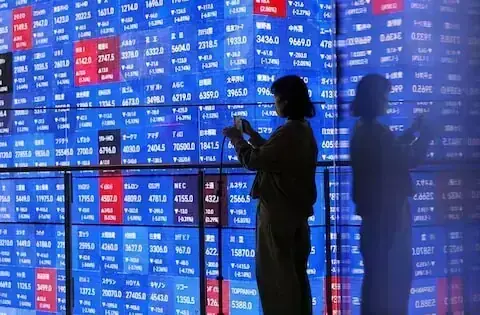

SINGAPORE: Asian stocks rose on Thursday after U.S. technology firms outlined significant capital spending plans that are likely to benefit chipmakers in the region, while the escalating war in the Middle East sent oil prices to six-week highs.
Rising oil prices have also renewed inflationary concerns, pushing short-term US Treasury yields to 17-week highs as traders wager the Federal Reserve may need to raise interest rates sooner rather than later.
Brent crude futures rose 2% to $96 per barrel in early trading after the U.S. launched a new round of strikes on Iran and Yemen’s Houthis targeted oil tankers in the Red Sea, widening the scope of a conflict that has cast a shadow on the global markets.
Thierry Wizman, global FX & rates strategist at Macquarie Group, said the rise in oil prices had renewed concern about the impact on global growth.
Nearly five months of war have depleted global stockpiles and stoked inflation worldwide, with analysts warning the closure of both the Strait of Hormuz and Bab el-Mandeb in the Red Sea would disrupt shipping routes for more than a quarter of the world’s oil and gas.
“The worries about global growth are well-placed, we think,” said Wizman.
Tech tonic for markets
Earnings from Alphabet and Tesla showed no slowdown in the vast spending on AI infrastructure. The search giant raised its capital expenditure plans for the year and now expects to spend between $195 billion and $205 billion.
A lot of the spending is expected to boost Asian chipmakers. That took South Korea’s KOSPI up more than 3%, led by SK Hynix and Samsung Electronics. Japan’s Nikkei was up 1%.
MSCI’s broadest index of Asia-Pacific shares outside Japan gained about 1% in early trading, set for a 3% rise for the week, snapping a two-week losing streak.
Gary Tan, portfolio manager at Allspring Global Investments, said the key positive for Asia’s chipmakers was that stronger cloud growth was validating higher AI capex, reinforcing the hyperscaler spending cycle still has legs.
“The bigger takeaway is that AI is rapidly moving from infrastructure to disruption, with hyperscalers increasingly using AI to challenge incumbent platforms across search and e-commerce, reinforcing the AI disruption trade,” Tan said.
Much of the focus this earnings season will be on whether the huge amount of spending on AI is resulting in significant profit growth and whether the sky-high valuation of some of the firms is warranted.
“We will still see a bit of a wary trading session ahead as the good news from earnings competes with the escalating conflict in the Middle East,” said Nick Twidale, chief market strategist at ATFX Global in Sydney.
Yen shackled near 40-year lows
In currency markets, the Japanese yen remained in the spotlight and was at 163.1 per dollar, giving up its gains from the previous session after Bloomberg News reported that Bank of Japan officials were open to raising rates at a faster pace.
The currency slipped to 163.23 on Tuesday, its lowest level since December 1986, with traders on alert for signs of intervention from Tokyo. Japan’s finance minister has repeatedly issued verbal warnings that have barely helped the yen.
“While the risk of FX intervention or stronger GPIF demand for domestic assets could help curb JPY weakness, neither is likely to fundamentally alter the JPY’s role as a funding currency,” said OCBC strategists.
“A more durable shift towards the JPY becoming an investment currency would likely require the BOJ to accelerate the pace of rate hikes,” they said.
The U.S. dollar stood tall amid safe-haven flows as well as on the back of rising wagers the Fed will increase rates. Traders are pricing in 42 basis points of hikes this year with a hike fully priced in for September.





















Comments