


Tokenising Pakistan’s energy crisis
- Tokenisation is process of representing rights to underlying asset in a digital token on a blockchain
Pakistan's energy crisis, marked by circular debt, can be mitigated by asset tokenization of renewable projects, attracting investment and enhancing transparency in the power sector.
- Pakistan's energy sector circular debt crisis.
- Asset tokenization for renewable energy investment.
- Attracting diaspora investment via digital assets.
- Global examples of tokenized energy finance.
- Challenges and pilot projects for implementation.


The power sector is in a vicious circle in Pakistan. Circular debt has been maintained above PKR2.4 trillion so far as early 2025 and the country is still paying huge fixed capacity charges to the Independent Power Producers (IPPs) despite most of the plants are running below utilization. Meanwhile, home and business solar installations are quickly becoming the new trend to avoid the escalation of tariffs. This has led to a reduced paying customer base, increased unit costs and additional strain on the system.
But in this crisis is a hidden opportunity. Pakistan has some of the best solar and wind energy resources in Asia, a growing digital economy, one of the world’s biggest remittance corridors, and a population is getting well versed in crypto-assets and blockchain-based finance. Pakistan is in a unique situation to consider an emerging financial asset: asset tokenisation.
Tokenisation is the process of representing the rights to an underlying asset in a digital token on a blockchain. It opens up the possibility of fractional ownership, which can be securely and transparently traded on regulated digital platforms. The revenue from a solar farm in Bahawalpur, for instance, could be split into thousands of digital investment units that can be made available to domestic and foreign investors.
It is no longer an experimental technology. In developed markets, tokenised energy finance is on the verge of becoming more of a reality than a pilot. In Italy, the MiCA regulatory framework has been implemented by Enel, the country’s largest utility, with electricity blockchain-based fractional ownership schemes. In Australia, Powerledger has enabled peer-to-peer renewable energy trading based on blockchain technology, and in the United States companies like Plural Energy have developed tokenisation solutions for mid-sized clean energy projects to attract larger numbers of investors. It’s not some spec-theaters. It’s real-life transactions being processed in real business models.
The case is particularly strong in Pakistan given the country’s situation.
Firstly, there is financing and transparency failure due to the circular debt crisis. Many of the elements of the existing system involve opaque receivables, delayed settlements, sovereign guarantees and fiscal bailouts on an ad hoc basis. The tokenisation of energy linked securities backed by future electricity revenue may add further transparency, automated settlement processes and market-based pricing discipline to parts of the system. Although tokenisation may not remove structural inefficiencies, it can make the industry more transparent in an industry that has been criticised for its financial opacity.
Second, the Pakistani diaspora also has a long way to go as their investment capacity is relatively limited. Though the workers’ remittances are likely to reach more than USD38 billion, most of the overseas Pakistanis don’t have any trustworthy and transparent long-term investment platform linked with the domestic infrastructure. A regulated tokenised stake in a solar or hydropower project with periodic returns may be more appealing than traditional paper securities by financially challenged public sector entities.
Third, the regulatory context is changing in such a manner that experimentation is possible in Pakistan. The PVARA and PDAA’s creation is yet another sign of the Pakistani government’s acceptance of blockchain-based finance entering the mainstream economy. In the absence of clarity from the Pakistani regulators, Pakistan is also one of the best markets for crypto adoption in the world. The demand side already exists; only a credible and regulated system that can direct digital capital to productive sectors of the economy not speculation exists.
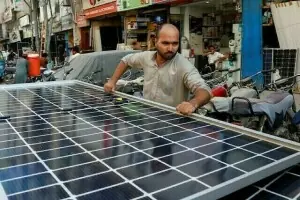
Fourth, the distributed solar growth in Pakistan has been a quiet revolution in one of the fastest-growing developing world countries. Cumulative net metered rooftop solar capacity is currently approaching 6 GW and imports of solar panels have increased greatly in the last two years, as consumers sought alternatives to the skyrocketing electricity prices. The decentralised energy transition is taking place outside conventional financing frameworks. These dispersed renewable energy sources could be linked to formal capital markets via renewable-energy certificates, carbon-credit schemes and fractional investment models based on verified generation data, to name just a few.
But the challenges are great and must not be underestimated. Digital securities, token custody, investor protection, taxation, and dispute resolution are still under consideration to be addressed in a comprehensive manner in Pakistan. While smart contracts can enhance efficiency, coding flaws and governance issues can lead to substantial financial risks. There are also potential issues with State Bank capital controls and IMF programme conditions for cross-border tokenised investment structures.
Better yet, investor confidence is Pakistan’s biggest problem. Over the last 20 years the country has experienced several renegotiations of IPP contracts, which has undermined the sanctity of the contract. The future will be determined by international investors by whether there is enforceability of the rights that are “on the token”.
There’s also a fair equity issue. Urban, banked and technologically adept populations naturally are favored by digital investment platforms. If it’s not intentional, then tokenisation can end up focusing energy ownership among the wealthier in the community, even as the cost of energy rises for those more at risk of falling into poverty.
Such is the approach that does not negate the concept. They just shoot the reminder that caution is required for correct sequencing.
Pakistan should start with strictly controlled pilot projects instead of far-reaching nationwide projects. The PVARA and PDAA,
with the help of the Securities and Exchange Commission of Pakistan (SECP), may create a regulatory sandbox that allows for a limited number of renewable-energy tokenisation pilots focused on the diaspora investors. There would be the least risk in beginning with existing solar and wind installations in identified renewable energy zones. At the same time, there should be transparency in the regulations of disclosure requirements, digital custody, trading in the secondary market and investor protection.
The current reform of the electricity market in Pakistan under Competitive Trading Bilateral Contract Market (CTBCM) is another opportunity to modernise the financial settlement architecture from day one instead of trying to modernise it at a later stage.
The solution to energy crisis in Pakistan is not tokenisation alone. It needs a good governance, better regulations and rightly designed tariff structures. However, one thing Pakistan’s energy sector is sorely lacking: a mechanism that can expand investment base, increase transparency and unlock new investment opportunities for renewable infrastructure.
The technology is well developed. There is a demand for investors. The capacity of the renewable resource base is indisputable. For the first time, Pakistan is also starting to put in place institutional structures required for regulated digital finance.
The issue would be whether policymakers would use the tokenisation as a viable tool for economic reform or as yet another fashionable idea talked about for a few moments and then forgotten in the vast reservoir of policies that have never materialized.
The author is an energy and climate finance policy expert and researcher of digital assets – is a former managing director of the National Energy Efficiency and Conservation Authority. He can be reached at [email protected]















Comments