


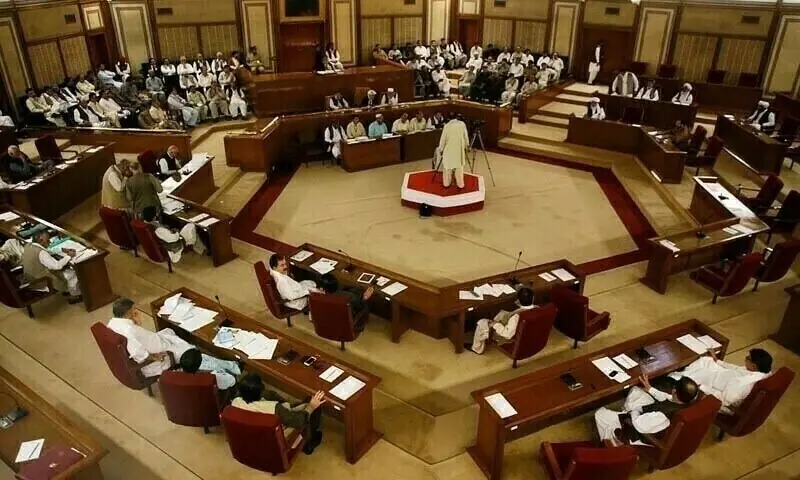
QUETTA: The Balochistan Assembly on Sunday approved the provincial budget for the 2026-27 fiscal year, clearing expenditure proposals worth total of Rs1.089 trillion.
During the session, lawmakers approved 98 demands for grants presented by Provincial Minister Mir Shoaib Nosherwani. The budget was passed after the assembly endorsed both development and non-development spending allocations for the coming financial year.
According to the approved budget, Rs291 billion has been allocated for development projects through 45 demands for grants. Meanwhile, 53 demands for grants amounting to Rs797.88 billion were approved for non-development expenditures.
READ MORE: Balochistan unveils surplus budget
The proceedings moved swiftly, with the assembly approving the high-value budget within approximately one hour of debate and consideration.
Notably, opposition members did not submit any cut motions seeking reductions in the proposed expenditures, allowing the demands for grants to pass without amendment.
The approval marks a significant step in finalising the province’s fiscal framework for the next financial year, with the government expected to focus on both development initiatives and the financing of routine administrative operations.
The Balochistan government on Wednesday unveiled a Rs1.089 trillion surplus budget for fiscal year 2026-27, increasing salaries and pensions of government employees by seven percent, expanding allocations for health and education, and announcing a series of tax relief measures without imposing any new taxes.
Provincial Finance Minister Mir Shoaib Nosherwani presented the budget in the Balochistan Assembly during a session presided over by Speaker Captain Abdul Khaliq Achakzai (retd). He said the budget reflected the government’s commitment to fiscal discipline, development and public welfare despite economic challenges.
The minister also claimed that 115 percent of the allocated development funds had been utilised during the outgoing fiscal year, describing it as the highest utilisation rate in the province’s history.
Nosherwani told the assembly that the total budget outlay for FY2026-27 had been fixed at Rs1,089.26 billion, while total revenues were estimated at Rs1,134.92 billion, creating a surplus of Rs45.66 billion.
He said the province expected to receive Rs800.13 billion through federal transfers, while revenue from provincial resources had been projected at Rs170.09 billion.
The government expects to receive Rs65.34 billion for foreign-funded projects, while project financing and capital receipts are estimated at Rs68.75 billion.
Cash carry-forward balances amounting to Rs30.61 billion will also contribute to provincial revenues. The finance minister said the positive balance between income and expenditure reflected prudent financial management and fiscal discipline.
The minister said Rs797.82 billion had been allocated for current expenditure during the next fiscal year.
Foreign-funded projects will account for Rs40.38 billion in spending, while federal development projects will receive Rs44.56 billion.
The Provincial Public Sector Development Programme (PSDP) has been set at Rs206.61 billion. According to budget documents, the overall development budget stands at Rs291.55 billion, including federal and foreign-funded projects, underscoring the government’s focus on infrastructure and public service delivery.
Providing relief to government employees, the provincial government announced a seven percent increase in salaries and pensions on the pattern of the federal government.
Nosherwani said the increase had been approved despite fiscal pressures and reflected the government’s commitment to supporting public servants amid rising living costs. The finance minister described the budget as a tax-free budget, emphasising that no new taxes were being imposed.
Instead, the government introduced several incentives aimed at encouraging investment and economic activity. Capital value tax and stamp duty on property transfers have been reduced from two percent to one percent. Sales tax on educational services has been reduced to zero percent, while taxes on new electric vehicles have been waived.
The government has also abolished sales tax on public transport and public property insurance. In addition, provincial taxes on foreign investment in export processing zones have been waived to attract industrial investment and stimulate economic growth. Education emerged as one of the largest recipients of public spending in the new budget.
The government has allocated Rs127 billion for school education and Rs31 billion for higher and technical education. Budget documents show that total spending on the education sector will reach Rs157.28 billion during FY2026-27. To support students from disadvantaged backgrounds, the government has earmarked Rs2.82 billion for the Balochistan Education Support Fund and Rs54 million for the Shaheed Benazir Bhutto Scholarship Programme. The finance minister said these initiatives were aimed at improving access to education and reducing barriers faced by deserving students.
The health sector also received a substantial increase in funding. Nosherwani announced an allocation of Rs96 billion for health services, including Rs6 billion for development schemes and Rs90 billion for non-development expenditure. The government has also added Rs1.5 billion to the Balochistan Health Card Programme to improve healthcare access for citizens. The minister said strengthening hospitals, expanding medical facilities and improving healthcare services remained among the government’s priorities for the coming fiscal year.
Maintaining law and order remains a major focus of the provincial government.
The finance minister proposed Rs243 million for development projects in the law and order sector and Rs1.2 billion for operational expenditure. Budget documents show that the broader law and order sector will receive Rs107.92 billion during FY2026-27, highlighting the government’s commitment to security and public safety.
Agriculture and allied sectors received significant allocations in the new budget. The agriculture sector has been allocated Rs23.6 billion overall, including Rs4.4 billion for development projects and Rs19.2 billion for non-development expenditure. The livestock sector will receive Rs1 billion for development activities and Rs8 billion for operational expenditure.
The Irrigation Department has been allocated Rs12.8 billion for development projects and Rs5.79 billion for non-development spending, while the drinking water sector will receive Rs7.6 billion for development projects and Rs12.4 billion for operational expenditure. The government said these allocations would support food security, agricultural productivity and access to water resources across the province.
The government has earmarked substantial resources for infrastructure development.
The Communications and Works Department will receive Rs27 billion for development projects and Rs20 billion for operational expenditure. The Transport Department has been allocated Rs1.5 billion for development schemes and Rs1.29 billion for non-development spending.











Comments