


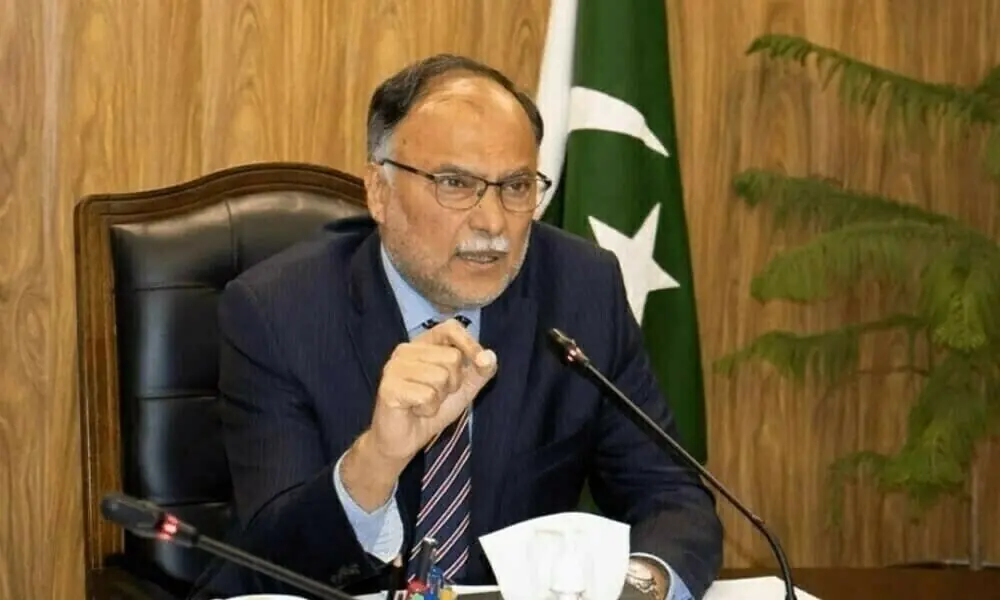

ISLAMABAD: Federal Minister for Planning, Development and Special Initiatives Ahsan Iqbal said that average inflation in Pakistan rose to 5.7 percent during July–March FY2025–26, compared to 5.3 percent in the same period last year.
He added that monthly inflation in March 2026 surged sharply to 7.3 percent, up from just 0.7 percent in March 2025, driven mainly by rising energy costs and non-food price pressures.
However, the minister said that Federal Board of Revenue (FBR) revenues reached Rs 9.3 trillion during July–March FY2025, reflecting a 10.1 percent increase, supported by improved enforcement and administrative reforms.
READ MORE: Fuel price hike-induced inflation: Provinces asked to take steps to curb pressures
Remittances remained strong at USD 30.3 billion, growing by 8.2 percent, while exports of goods and services reached USD 30.6 billion during July–March FY2026. Services exports grew significantly by 17 percent to USD 7.3 billion, resulting in a 7 percent reduction in the services deficit.
The current account also showed resilience, posting a surplus of USD 1.07 billion in March 2026, although the cumulative surplus for July–March stood at USD 8 million compared to USD 1.67 billion last year.
On development and economic indicators, large-scale manufacturing recorded a strong recovery of 5.9 percent growth during July–February FY2026, with 15 out of 22 sectors showing positive performance, including automobiles, textiles, food, tobacco, apparel, and non-metallic minerals,” the minister expressed these views while addressing media representatives virtually at the launch of the Ministry’s Monthly Development Report April 2026 on Monday at P-Block Secretariat.
He said that monthly inflation in March 2026 increased sharply to 7.3 percent from 0.7 percent in the same month last year. He explained that this increase was primarily driven by non-food components, especially energy costs linked to global oil price shocks and tariff adjustments, while food inflation remained relatively contained, requiring continued monitoring and targeted policy interventions.
Ahsan Iqbal said that exports of goods and services reached USD 30.6 billion, while imports stood at USD 56.3 billion during July–March FY2025–26.
He added that services exports increased by 17 percent to USD 7.3 billion, while services imports rose by 10.1 percent to USD 9.5 billion, reducing the services deficit by 7 percent to USD 2.1 billion.
He emphasized that Pakistan needs to increase exports to USD 4–5 billion per month for sustainable economic progress.
The minister said that despite challenging global conditions, Pakistan’s economy has demonstrated notable stabilization during the first eight months of the current fiscal year.
However, he said economic activity has improved significantly, with growth rising to 3.8 percent in the first half compared to 1.9 percent last year. He said this improvement reflects better performance in both external and fiscal sectors, supported by ongoing reforms and prudent economic management.
He said the government is finalizing the 14th Joint Cooperation Committee (JCC) minutes, aiming to accelerate Phase-II of strategic development cooperation.
Referring to global developments, Ahsan Iqbal said the conflict in the Middle East has emerged as a major external shock for the world economy, affecting growth and inflationary trends.
He stated that the International Monetary Fund (IMF) has revised global growth projections downward to 3.1 percent for 2026, compared to the pre-war estimate of 3.3 percent, while global headline inflation is expected to rise to 4.4 percent from 3.8 percent.
He added that the conflict poses significant risks for Pakistan’s economy through higher global oil prices, increased import bills, inflationary pressures, and vulnerabilities in the external sector including exports and remittances.
The minister emphasised that the government has adopted a balanced and proactive approach to manage energy price volatility.
He said the government took difficult decisions, including an increase of Rs. 55 per liter in petrol and diesel prices while absorbing a fiscal burden of Rs. 129 billion to shield citizens from full pass-through of global oil prices.
Subsequently, due to the closure of the Strait of Hormuz and sharp increases in global oil prices, petroleum prices were further adjusted upward by Rs 137 per liter for petrol and Rs 184.5 per liter for diesel,” he said.
He said that as global prices stabilized, the government passed on relief to the public by reducing petroleum prices, including a Rs. 80 per liter reduction in petroleum levy, followed by a price cut of Rs 12 per liter in petrol and Rs 135 per liter in diesel on April 11, 2026.
He said that in view of the upcoming harvesting season, diesel prices were further reduced by Rs. 32.12 per liter on April 17, 2026, ensuring relief for farmers and the agriculture sector.
He said these measures reflect the government’s commitment to protecting citizens from global price volatility while safeguarding purchasing power.
On fiscal and development performance, the minister stated that PSDP utilization reached 42 percent (Rs. 415 billion), higher than last year’s 36.4 percent, reflecting increased development activity.
Copyright Business Recorder, 2026




















Comments