


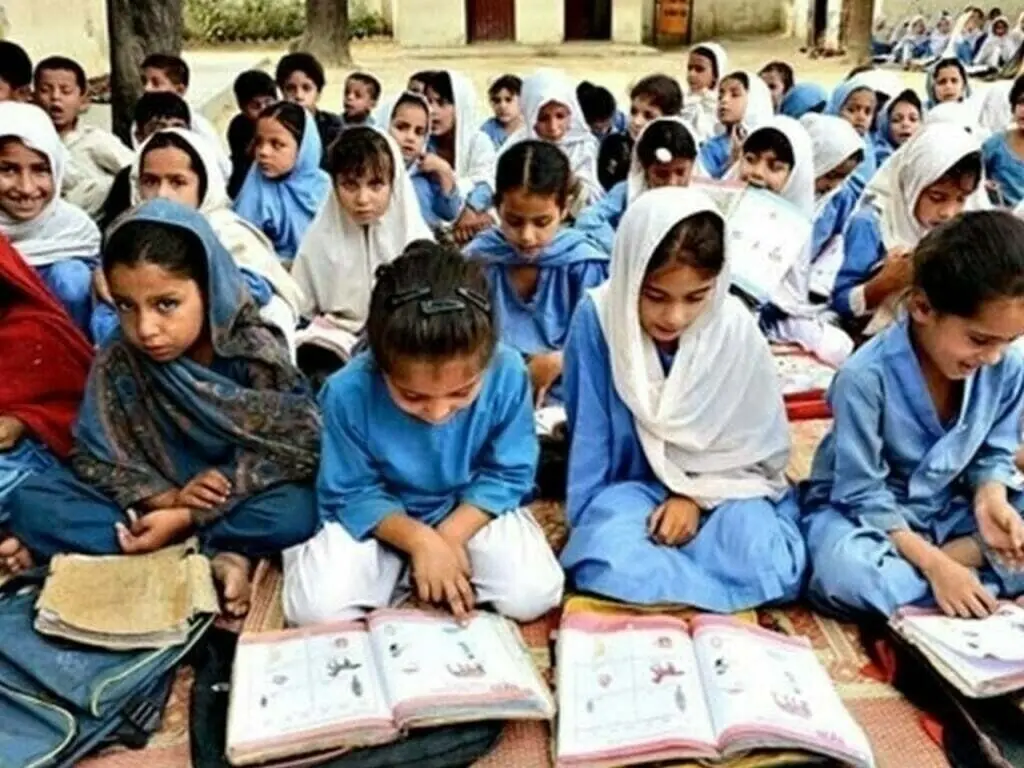

Pakistan’s latest education financing report lays bare a hard truth: the country’s constitutional promise of education is not being matched by public spending, and millions of children are paying the price.
According to “Public Financing in Education 2025–26”, published by the Pakistan Institute of Education under the Ministry of Federal Education and Professional Training, Pakistan continues to underfund education in ways that are now too serious to ignore.
The Constitution is clear. Article 25-A guarantees free and compulsory education for every child between the ages of five and sixteen, while Article 37(b) commits the state to eliminating illiteracy.
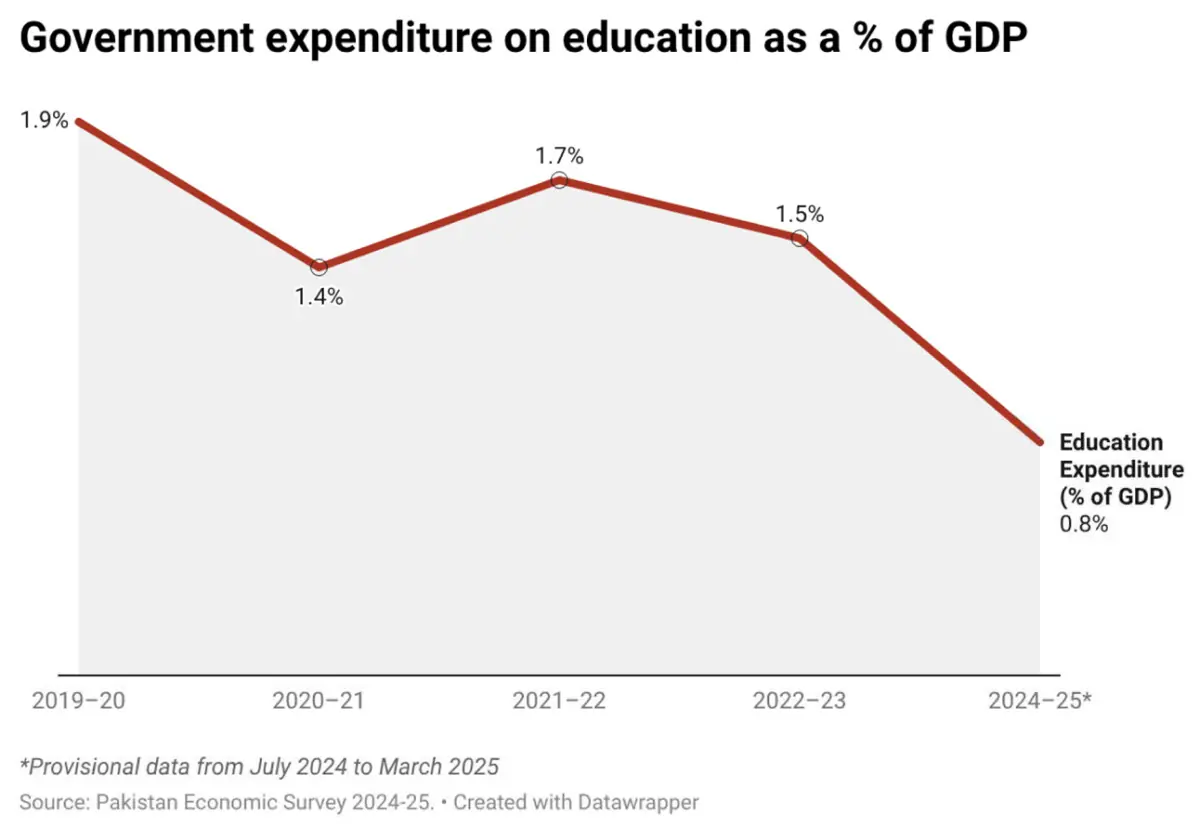
Pakistan has also signed on to Sustainable Development Goal 4. But the financing tells a quite different story. Education spending was 1.9 percent of GDP in 2019–20 and has fallen to a provisional 0.8 percent in 2024–25, far below the UNESCO benchmark of 4–6 percent.
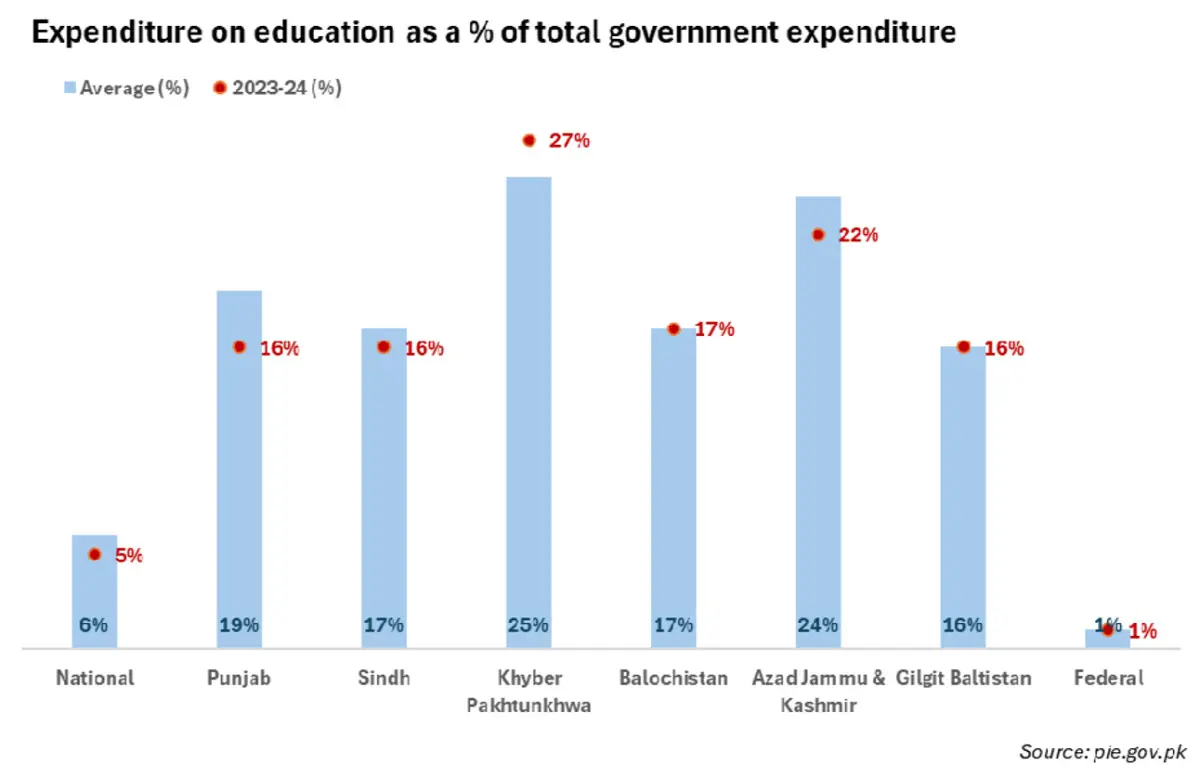
As a share of total government expenditure, education received only 5 percent in 2023–24, again well short of the recommended 15–20 percent. This is combined public education spending — federal + provincial as education in Pakistan is largely provincial after the 18th Amendment.
This chronic underinvestment has real consequences. Pakistan still has 25.37 million out-of-school children, while learning poverty remains alarmingly high, with 77 percent of ten-year-olds unable to read and understand a simple text.
These are not abstract numbers. They reflect a system that is failing too many children, made even worse by the damage caused by the 2022 floods.
At first glance, the spending trend may appear encouraging. Between 2019–20 and 2023–24, national education expenditure rose by 72 percent in nominal terms, reaching around PKR 1.54 trillion.
But once inflation is considered, the picture changes completely. In real terms, education spending actually fell by 12 percent. Punjab saw real spending fall by 21 percent, while Sindh and Khyber Pakhtunkhwa recorded no real growth — effectively stagnating in purchasing power terms.
Gilgit-Baltistan saw a decline of 16 percent, Azad Jammu and Kashmir 15 percent, and the federal government 29 percent. Balochistan was the only major exception, recording a real increase of 25 percent.
That matters because budgets are not just numbers on paper. What counts is what those budgets can actually buy. And in real terms, the system’s purchasing power has been shrinking. That means fewer resources for classrooms, teachers, learning materials, repairs, and facilities, even when headline spending appears to be rising.
The structure of spending is another problem. In 2023–24, 91 percent of national education expenditure went to current spending, while only 9 percent was allocated to development.
Within the recurrent budget, salaries absorbed the overwhelming share, leaving limited room for the non-salary spending that keeps schools functional.
Nationally, non-salary expenditure made up just 20 percent of current spending. In Punjab, it was only 12 percent, and in Azad Jammu and Kashmir just 1 percent. In many cases, schools are being funded to pay staff but not properly funded to operate.
Development spending also remains weak. These are the budgets meant for school infrastructure, capital investment, and long-term improvement, yet utilisation stayed below 90 percent across all provinces. Sindh and Khyber Pakhtunkhwa underperformed in particular, with the report pointing to delayed cash releases and cumbersome approval processes as key bottlenecks.
There are, however, important provincial differences. Khyber Pakhtunkhwa used 110 percent of its education budget, while Gilgit-Baltistan reached 122 percent, pointing to genuine spending demand.
Punjab, by contrast, utilised only 83 percent of its allocation, a notable underspend given its weight in total national education expenditure.
The report is equally blunt on equity. Pakistan still lacks enough disaggregated data on spending by gender, locality, disability, and school type. That means it is still difficult to tell whether girls, rural communities, or children with disabilities are receiving a fair share of resources. In itself, that lack of visibility is a governance failure.
Its recommendations are practical and overdue. Pakistan needs to move steadily toward spending 4–6 percent of GDP on education. It also needs budgeting systems that make spending on girls, rural areas, and individual school needs visible and trackable.
At its core, the message is simple. Pakistan cannot keep treating education spending as just another routine budget item. It must move toward a system that is more transparent, fair, and focused on results.
The promise of education for every child means little unless the money, systems, and political commitment are there to support it. With more than 25 million children still out of school, the cost of delay will be felt for generations.




















Comments
Comments are closed for this article.