


High-level Saudi delegation in Pakistan ahead of Crown Prince’s visit
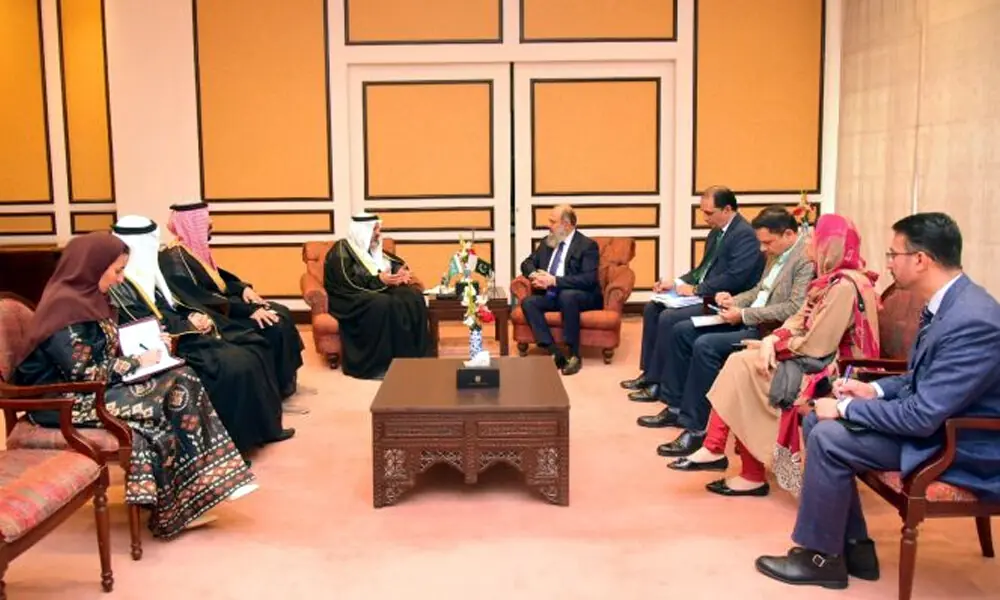

ISLAMABAD: The Saudi government has dispatched a high-level delegation to Pakistan to explore avenues of cooperation in various sectors, apparently to finalise a priority agenda ahead of the expected visit of Saudi Crown Prince and Prime Minister Mohammed bin Salman.
Currently, Ibrahim Al-Mubarak, Assistant Minister of Investment of the Kingdom of Saudi Arabia, is in Islamabad, while another delegation from the office of Mohammad Al-Tuwaijri, Advisor at the Royal Court and Chair of the Pak–KSA Task Force, is also visiting Pakistan to conduct a final review workshop of all sectoral working groups to finalize the SP-ECF framework.
In this regard, a sectoral session covering Finance, Commerce, and Energy with the Al-Tuwaijri office team will be held on February 13, 2026, at a local hotel in Islamabad.
READ MORE: Trade & investment: Jam engaged in strategic meetings with KSA leaders
Secretaries of the Finance Ministry, Petroleum Division, Power Division, and Commerce Division will give presentations. The Saudi side will also share its presentation, followed by deliberations on cooperation across various sectors.
The Finance session will be attended by the Minister for Finance, Minister of State for Finance, and Secretary Finance, while the Commerce session will include the Commerce Minister and Secretary Commerce.
The Energy session will be attended by the Ministers for Petroleum and Power, along with the Secretaries of the respective divisions.
Minister for Climate Change Dr. Musadik Malik, Minister for Economic Affairs Ahad Khan Cheema, Special Assistant to the Prime Minister (SAPM) on Industries and Production Haroon Akhtar Khan, Chairman Federal Board of Revenue Rashid Mehmood Langrial, Pakistan’s Ambassador to Saudi Arabia, the Additional Secretary of the Ministry of Finance, and the Deputy Governor of the State Bank of Pakistan will also participate in the sessions.
On Wednesday, Federal Minister for Commerce Jam Kamal Khan held a comprehensive meeting with Ibrahim Al-Mubarak to review and advance bilateral cooperation in trade, investment, and joint engagement in regional markets. The meeting reflected strong convergence of views on adopting an investment-led, partnership-based approach to economic cooperation. Both sides emphasized enhancing competitiveness, scaling up production, and strengthening value chains to unlock Pakistan’s export potential and sustainably meet growing regional demand.
A key focus of the discussions was the joint exploration of regional markets, particularly Central Asia, Africa, and ASEAN countries, which were identified as high-growth regions offering significant opportunities for collaboration.
The two sides agreed that by leveraging their respective strengths, Pakistan and Saudi Arabia could position themselves as complementary partners—combining Pakistan’s production capacity with Saudi Arabia’s capital strength, market access, and regional connectivity.
In the rice sector, the Saudi side expressed interest in corporate farming in Pakistan. It was noted that Pakistan already meets required quality standards, and that investment in corporate-scale farming, mechanization, storage, and logistics could enable consistent rice exports to Saudi Arabia under structured, long-term arrangements.
More broadly, discussions on agriculture and food security covered cooperation in rice, fodder (including alfalfa), meat, and selected agri-products were held. Both sides explored the potential role of Saudi financing institutions in supporting export-linked agricultural and infrastructure projects in Pakistan, particularly those aligned with guaranteed off take arrangements for Saudi Arabia.
The meeting also examined corporate farming and mechanization as long-term solutions to productivity challenges, including in crops such as cotton, where declining yields and high manual input costs have reduced competitiveness. The Commerce Minister noted that export-oriented investment models could help revive agricultural output while supporting downstream industries, including textiles and yarn.
Human resource development emerged as another key area of collaboration. Both sides agreed that the most acute shortages in Saudi Arabia—across healthcare, hospitality, and services—exist in nurses, caregivers, technicians, and mid-tier hospitality staff, rather than senior professionals. Ibrahim Al-Mubarak shared Saudi Arabia’s experience in vocational training and skills development and expressed openness to replicating train-to-deploy models in Pakistan, linking training programs directly with overseas employment opportunities.
Opportunities in building materials and construction inputs were also discussed. The Saudi side highlighted substantial import requirements for products such as limestone, marble, aggregates, and other materials not locally available. It was agreed that targeted engagement between Pakistani suppliers and Saudi building material trading companies could yield early results through direct private-sector matchmaking.
READ MORE: KSA eyes corporate farming investment in Pakistan
Both sides also exchanged views on expanding cooperation in pharmaceuticals, sports goods, footwear, and light manufacturing, recognizing Pakistan’s growing industrial base and the potential for joint ventures, contract manufacturing, and split-production models targeting regional and global markets.
The meeting concluded with an understanding to pursue follow-up through sector-specific workshops and business-to-business engagements aimed at translating policy alignment into tangible trade flows, investment projects, and employment generation, thereby further strengthening Pakistan–Saudi Arabia economic relations.
Copyright Business Recorder, 2026


























Comments
Comments are closed for this article.