


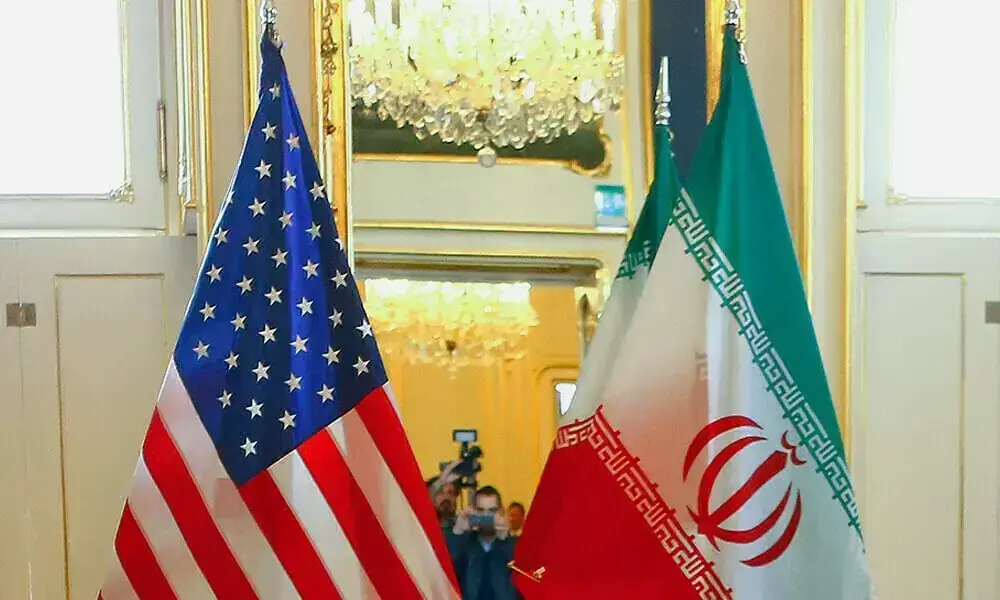

ABOARD AIR FORCE ONE: US President Donald Trump said that Washington had “very good talks” on Iran after the two sides held an indirect dialogue in Oman, pledging another round of negotiations next week.
Iran for its part said it expected to hold more negotiations with the United States, hailing a “positive atmosphere” during a day of talks in the Gulf sultanate.
With an American naval group led by an aircraft carrier in Middle Eastern waters, US and Iranian delegations held talks in Muscat on Friday mediated by Oman without publicly meeting face-to-face.
“We likewise had very good talks on Iran,” Trump told reporters on board Air Force One en route to his Mar-a-Lago resort in Florida. “We’re going to meet again early next week,” he added.
Shortly after the talks concluded, the US announced new sanctions against shipping entities and vessels, aimed at curbing Iran’s oil exports.
Trump also signed an executive order Friday enabling his administration to impose tariffs on goods from countries doing business with Iran, with any potential levies threatening trade with countries including China, Germany and the United Arab Emirates. It was not clear if the moves were linked to the talks, which were the first between the two foes since the United States joined Israel’s war with Iran in June with strikes on its nuclear sites. While Iran warned against further threats after Washington raised the spectre of new military action, Trump said: “If they don’t make a deal, the consequences are very steep.”
Foreign Minister Abbas Araghchi, who led Iran’s delegation in Muscat, said talks “focused exclusively” on the Iranian nuclear program, which the West believes is aimed at making an atomic bomb but Tehran insists is peaceful.
The US delegation, led by Middle East envoy Steve Witkoff and Trump’s influential son-in-law Jared Kushner, had also wanted Tehran’s backing for militant groups, its ballistic missile program and treatment of protesters on the agenda.
“In a very positive atmosphere, our arguments were exchanged and the views of the other side were shared with us,” Araghchi told Iranian state TV, adding that the two sides had “agreed to continue negotiations.”
Speaking to the official IRNA news agency, Araghchi expressed hope that Washington would refrain from “threats and pressure” so that “the talks can continue.”
Admiral Brad Cooper, the commander of US Central Command, was present at the talks, according to images published by the Oman News Agency.
Multiple sessions of talks in the morning and afternoon involved both sides shuttling to and from the residence of Omani Foreign Minister Badr Albusaidi.
The foreign ministry of US ally Qatar expressed hope the talks would “lead to a comprehensive agreement that serves the interests of both parties and enhances security and stability in the region.”
The White House has made clear it wants the talks to rein in Tehran’s ability to make a nuclear weapon, an ambition the Islamic republic has always denied.
French Foreign Minister Jean-Noel Barrot said on Friday that Iran should stop being a “destabilising power,” citing its nuclear program and support for “terrorist” groups.
Barrot also called on “groups supported by Iran” to exert “the utmost restraint” in the event of any military escalation involving the Islamic republic.
Tehran provides support for numerous groups in the region, including Hezbollah in Lebanon, Hamas in Gaza, the Houthis in Yemen and various armed groups in Iraq.
Trump initially threatened military action against Tehran over its crackdown on protesters last month, which rights groups say killed thousands, and even told demonstrators “help is on its way”.
Regional powers including Turkey, Saudi Arabia and Qatar urged the United States not to intervene, calling on Washington and Tehran to instead return to talks.
The US-based Human Rights Activists News Agency (HRANA) said Friday it has confirmed 6,505 protesters were killed, as well as 214 members of the security forces and 61 bystanders.
Those numbers are expected to climb because the magnitude of the crackdown has been masked by the blanket internet shutdown imposed by the authorities for more than a fortnight, rights groups say. At 51,000 people have been arrested amid “the growing use of forced confessions,” according to HRANA.
Trump’s rhetoric in recent days, however, has focused on reining in the Iranian nuclear program and the US has moved a naval group led by aircraft carrier USS Abraham Lincoln into the region.
Iran has repeatedly vowed it will hit back at US bases in the region if attacked.
The new sanctions to curb Iran’s oil exports come with Trump “committed to driving down the Iranian regime’s illicit oil and petrochemical exports under the administration’s maximum pressure campaign,” State Department spokesman Tommy Pigott said in a statement.
Meanwhile, Iranian Foreign Minister Abbas Araghchi said on Saturday he hoped talks with the United States would resume soon, while reiterating Tehran’s red lines and warning against any American attack.
According to excerpts published on his official Telegram channel during an interview with the Al Jazeera network, Araghchi said that Iran’s missile programme was “never negotiable” in Friday’s talks in Oman.
He warned that Tehran would target US bases in the region if the US attacked Iranian territory.
However, Araghchi also said that despite the talks in Muscat being indirect, “an opportunity arose to shake hands with the American delegation”.
He called the talks “a good start”, but added that building trust would take time. He said the talks would resume “soon”.
US President Donald Trump on Friday called the talks “very good”, and pledged another round of negotiations next week.
Despite this, he signed an executive order effective from Saturday that called for the “imposition of tariffs” on countries still doing business with Iran.
The United States also announced new sanctions against numerous shipping entities and vessels, aimed at curbing Iran’s oil exports.
More than a quarter of Iran’s trade is with China, with $18 billion in imports and $14.5 billion in exports in 2024, according to World Trade Organization data.
Araghchi told Al Jazeera that nuclear enrichment was Iran’s “inalienable right and must continue”.
“We are ready to reach a reassuring agreement on enrichment,” he said. “The Iranian nuclear case will only be resolved through negotiations.”
He also said Iran’s missile programme was “never negotiable” because it relates to a “defence issue”.
Washington has sought to address Iran’s ballistic missile programme and its support for militant groups in the region — issues which Israel has pushed to include in the talks, according to media reports. Tehran has repeatedly rejected expanding the scope of the negotiations beyond the nuclear issue.
Friday’s unprecedented talks between the two arch enemies came amid a major US military buildup in the region in the wake of Iran’s crackdown on protests that began in late December, driven by economic grievances.
Aragchi warned that Iran “will attack their (US) bases in the region” if Washington targets Iranian territory.
The negotiations were the first since nuclear talks between Iran and the United States collapsed last year following Israel’s unprecedented bombing campaign against Iran, which triggered a 12-day war.
During the war US warplanes bombed Iranian nuclear sites.
Araghci told Al Jazeera that if attacked again, “we will attack their bases in the region”, referring to the United States.
The authorities in Iran have acknowledged that 3,117 people were killed in the recent protests, publishing on Sunday a list of 2,986 names, most of whom they say were members of the security forces and innocent bystanders.
International organisations have put the toll far higher.
The US-based Human Rights Activists News Agency (HRANA), which has kept a running toll since the onset of the protests, says it has verified 6,872 deaths, mainly of protesters, and has another 11,280 cases under investigation. It has also counted more than 50,000 arrests.
At Friday’s talks in Oman the US delegation was led by Trump’s Middle East envoy Steve Witkoff and his influential son-in-law Jared Kushner.
“In a very positive atmosphere, our arguments were exchanged and the views of the other side were shared with us,” Araghchi told Iranian state TV after the talks, adding that the two sides had “agreed to continue negotiations”.
Speaking to the official IRNA news agency, Araghchi expressed hope that Washington would refrain from “threats and pressure” so that “the talks can continue”.
On Saturday, Araghci criticised what he labelled a “doctrine of domination” that allows Israel to expand its military arsenal while pressuring other states in the region to disarm.
He was speaking at the Al Jazeera Forum conference in Qatar, but in his speech made no reference to Friday’s talks in Oman with the United States.




















Comments
Comments are closed for this article.