


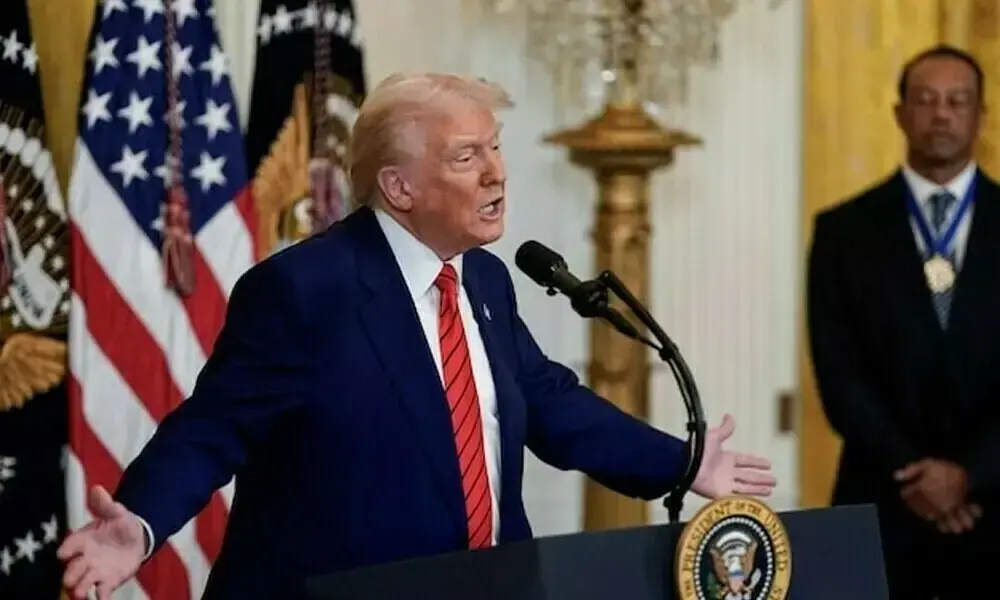

President Donald Trump’s casual but chilling reference to an “armada” of US warships heading toward the Middle East has once again pulled the world into a familiar but deeply unsettling theater of power, pressure, and peril.
Speaking aboard Air Force One, he framed the movement of naval force as a precaution—“just in case”—while pointing to what he called a “good sign” that Iran had paused the hanging of protesters. Yet behind this language of conditional restraint lies a strategic pattern that many across the developing world, and especially in the Middle East, recognize all too well: the choreography of threat, softening, and sudden strike.
That Trump’s “armada” comment resonates far beyond Washington or Tehran is a fact. It revives fears of a scenario in which the visible calming of tensions becomes the prelude to a more devastating escalation. The strategic geography makes those fears sharper. The Middle East is not just a battlefield of ideologies and alliances; it is the heart of the global energy system. The Strait of Hormuz, a narrow maritime artery through which a significant share of the world’s oil supply passes, lies within the range of any serious confrontation between the United States, Iran, and their respective allies.
Copyright Business Recorder, 2026
The writer is a former Press Secretary to the President, An ex-Press Minister at Embassy of Pakistan to France, a former MD, SRBC Macomb, Detroit, Michigan




















Comments
Comments are closed for this article.