


BR RESEARCH: Service exports and the rise of ‘ Other Business Services’


Pakistan’s services exports continued to expand in the first five months of FY26 (5MFY26), reflecting a gradual shift in the structure of the country’s external sector. According to State Bank of Pakistan (SBP) data, services exports reached $4.77 billion in 5MFY26, compared to $4.09 billion in 5MFY25, representing a growth of around 16.5 percent.
However, this growth has not been uniform across sectors. Instead, it points to a reorientation of Pakistan’s services export base—from traditional segments such as transport and travel toward modern, higher-value services, particularly IT and other business services.
Historically, services exports were closely linked to merchandise trade and tourism cycles, with transport and travel accounting for a large share. Over time, their relative importance has declined, while modern services have gained prominence.
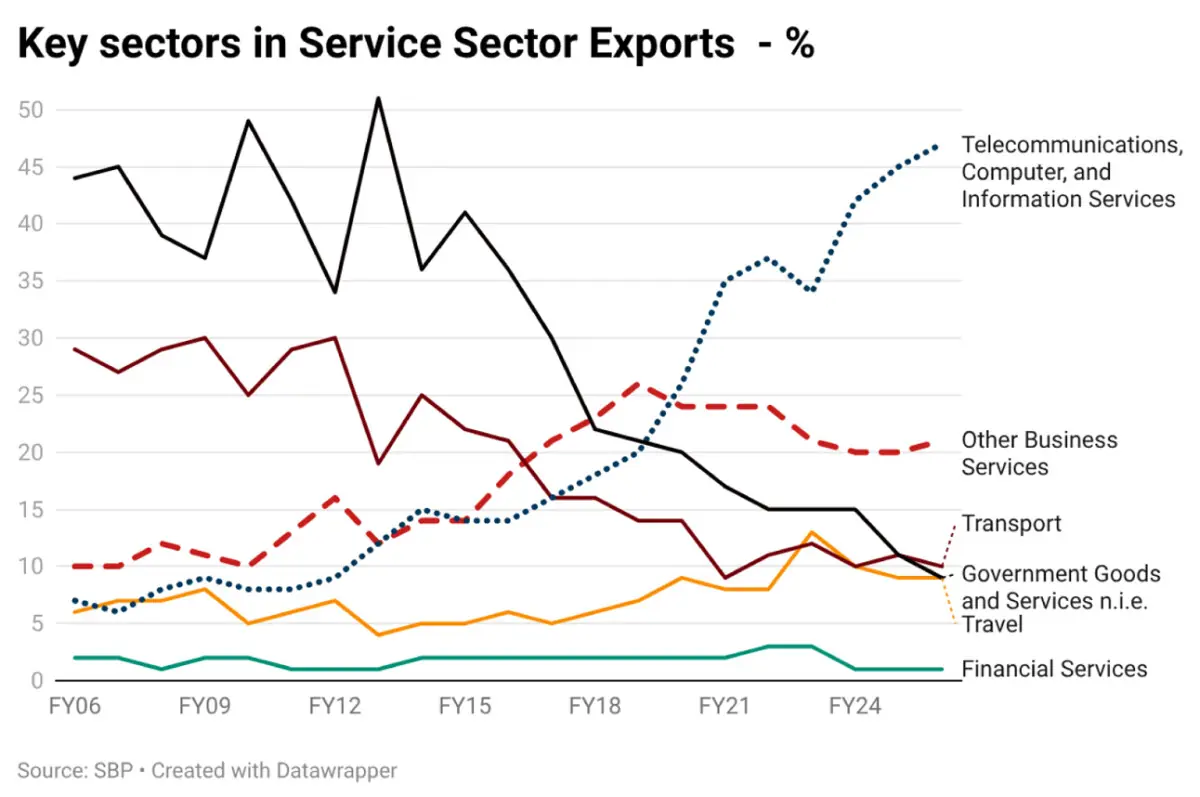
Recent data suggests that Pakistan’s services export performance is becoming less dependent on traditional trade dynamics and increasingly shaped by demand in the global digital economy.
In 5MFY26, telecommunications, computer, and information services remained the primary contributor to growth, supported by sustained demand for outsourcing and digital services. Alongside IT, Other Business Services (OBS) has emerged as a significant contributor, with a steadily rising share in the services export mix.
In balance-of-payments terms (IMF BPM6 classification), Other Business Services cover a broad range of commercially traded professional, technical, and business services that fall outside IT and financial services. These include management and professional consulting, legal and accounting services, engineering and technical services, marketing and creative services, research, and analytical services, etc.
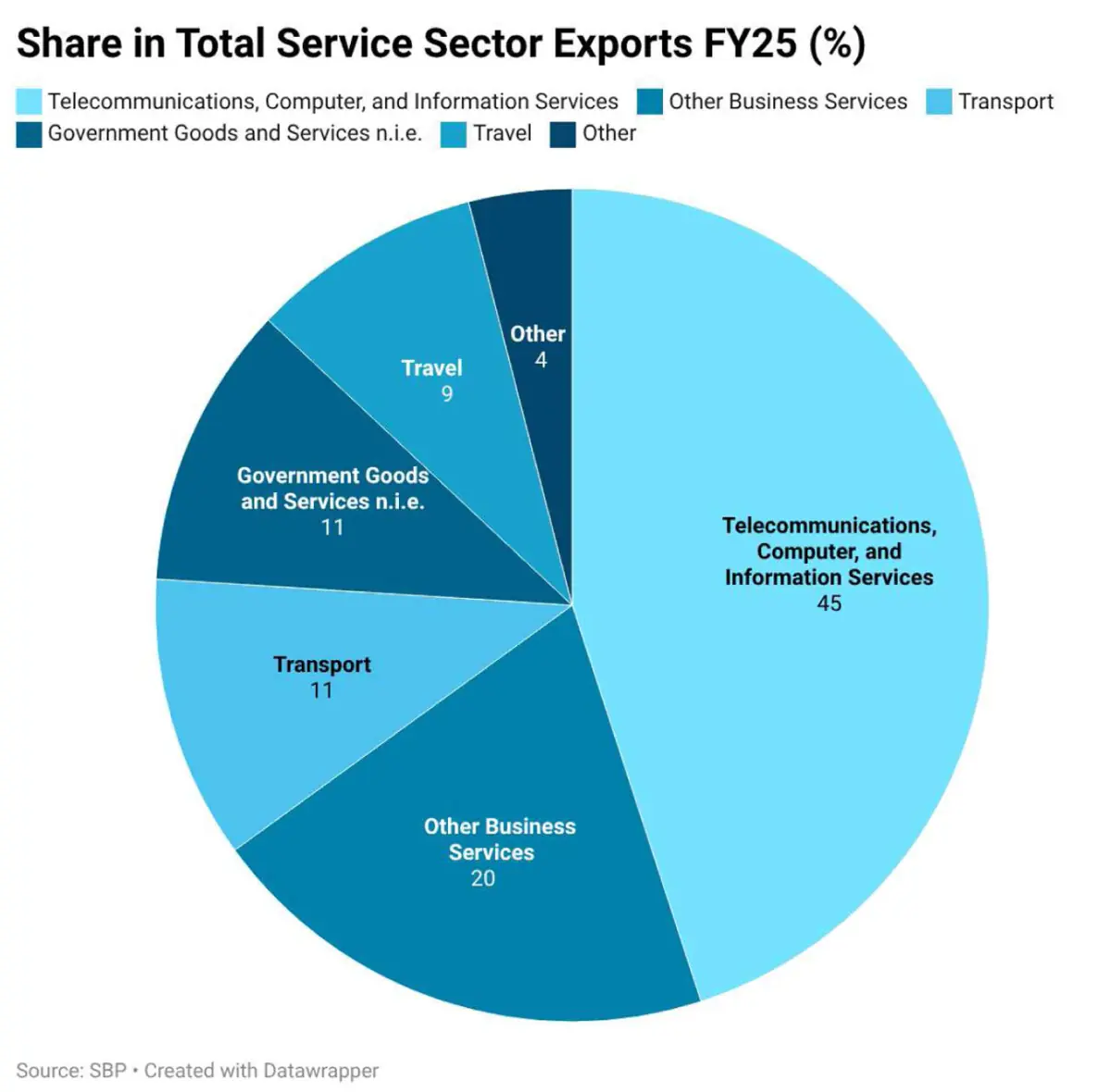
Together, these segments reflect Pakistan’s growing participation in global professional and knowledge-based services markets beyond traditional IT exports.
Over the past two decades, OBS exports have shown a sustained upward trend. SBP data indicates that OBS exports increased from $361 million in FY06 to $1.69 billion in FY25, representing nearly a 4.7-fold rise. This expansion has been driven by a combination of factors, including rising global demand for professional services, the growth of outsourcing and BPO, and the gradual emergence of Pakistan’s freelance and SME services ecosystem. Over time, OBS exports have also diversified across consulting, engineering, digital marketing, and research-oriented activities.
By FY25, OBS accounted for a meaningful share of Pakistan’s services exports. In FY25, OBS exports amounted to $1.69 billion out of total services exports of $8.41 billion, representing roughly 20 percent of the services export basket. The trend has continued into FY26: in 5MFY26, OBS exports reached $1.01 billion, compared to $812 million in 5MFY25, translating into year-on-year growth of around 25 percent, outpacing overall services export growth. This reflects continued outsourcing activity, steady demand for professional services, expansion of freelance and digital services, and improved documentation of export receipts.
Taken together, these developments indicate a gradual but tangible shift in Pakistan’s export structure. While goods exports remain constrained by structural challenges, services exports—particularly IT and OBS—are becoming a more important source of foreign exchange. The rise of OBS, in particular, underscores the increasing role of human capital and professional capabilities in Pakistan’s external sector.
Yet the sustainability of this trend is not guaranteed. Without improvements in skills development, regulatory clarity, and digital infrastructure, the expansion of modern services exports could face constraints. Whether services exports can evolve from a supplementary contributor into a durable pillar of Pakistan’s export base will ultimately depend on the consistency of policy and the depth of investment in the country’s knowledge economy.



























Comments
Comments are closed for this article.