


EDITORIAL: Pakistan’s decision to join US President Donald Trump’s Board of Peace, while predictably drawing sharp criticism from opposition parties and a sceptical public that sees little prospect of meaningful relief for Gaza’s devastated population, reflects the hard calculus of survival in a world increasingly driven by raw power and where there is little space for strategic autonomy.
The move can be framed as one necessitated by a new global order where a country like ours — economically constrained by external account pressures and geopolitically exposed amid regional volatility — has little choice other than to remain on the right side of a capricious president to protect core national interests, even if it comes at the cost of diplomatic optics and ethical dilemmas.
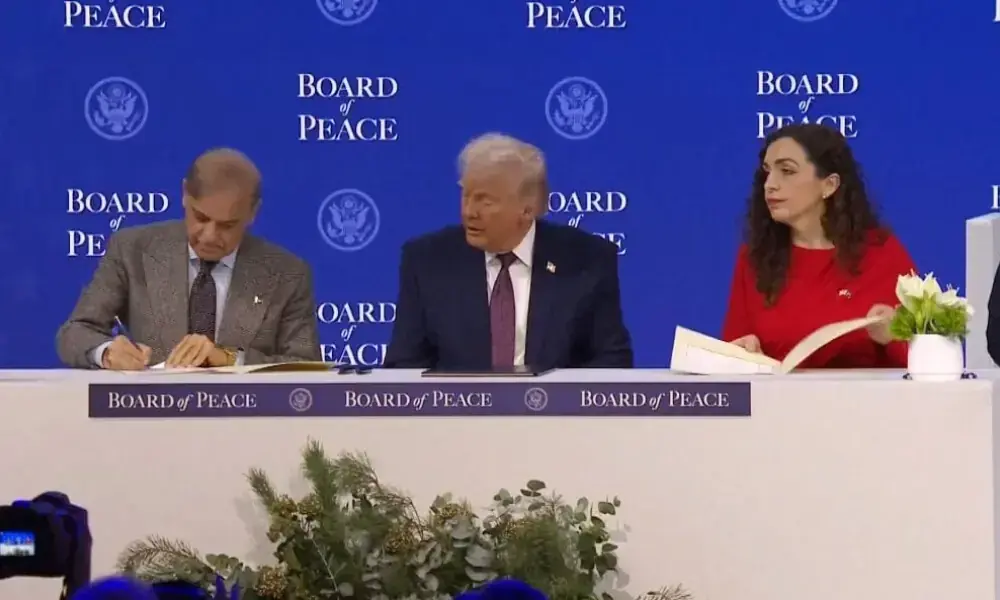
So, when Prime Minister Shehbaz Sharif signed the charter of the Board of Peace in Switzerland on January 22, it is perhaps best to view this as an opportunity to exercise strategic pragmatism. Sitting inside the room may prove to be more consequential than remaining outside, as engagement will at least offer a narrow but tangible chance to influence decision-making and outcomes, and in doing so, to make a more meaningful contribution for the Palestinians than principled disengagement may allow.
Moreover, several of Pakistan’s close allies, including the UAE, Turkiye and Saudi Arabia, are also part of the Board of Peace, creating the possibility of forming a coordinated front that could shape deliberations, and however modestly, advance the cause of peace.
READ MORE: PM signs Gaza ‘Board of Peace’ charter
Furthermore, joining at this juncture may offer the country greater leverage and strategic mileage than a delayed entry, particularly given that several traditional US allies, including permanent UN Security Council members like France and the UK, have yet to join, positioning Pakistan to shape discussions from an early, influential vantage rather than play catch-up once the agenda and alliances are already set.
The reality, however, is that whatever the official justifications offered, and whichever lens one applies to this decision, at the end of the day this was about Pakistan’s economic fragility.
Mounting external debt obligations, anaemic exports and floundering FDI have entrenched a deep dependence on international financial institutions, including the IMF, World Bank and the ADB. These are organisations where US influence remains decisive, leaving little room for independent policymaking. This is not the first time that Pakistan has found its foreign policy choices shaped by the hard constraints of economic weakness.
As long as our economy stays precarious and our reliance on IFIs persists, the country’s fiscal realities will continue to take a toll on its sovereignty and influence its foreign affairs posture.
The most disappointing aspect is that even if national interest warranted kowtowing to President Trump, the government gave such little importance to parliamentary input on the matter. It could have brought lawmakers into confidence, explaining why it believed joining the Board of Peace served Pakistan’s strategic interests. Instead, it pressed ahead without public or parliamentary debate, rendering such a consequential decision opaque and raising questions about transparency and parliamentary oversight.
One can only hope now that Pakistan leverages its three-year term on the Board of Peace to make a meaningful impact.
Originally envisaged as a mechanism to address the fallout of Israel’s war on Gaza and oversee reconstruction, aid delivery and security coordination, the board now claims a broader mandate, describing itself as an “organisation that seeks to… secure enduring peace in areas affected… by conflict”. Yet its ability to deliver tangible relief for Gaza remains uncertain, with no Palestinian representation and controversial figures like Tony Blair and Jared Kushner on its executive board. At a minimum, the forum must restrain Israel’s worst impulses and curb its impunity, or Gaza’s population will see little relief.
Copyright Business Recorder, 2026




















Comments
Comments are closed for this article.