


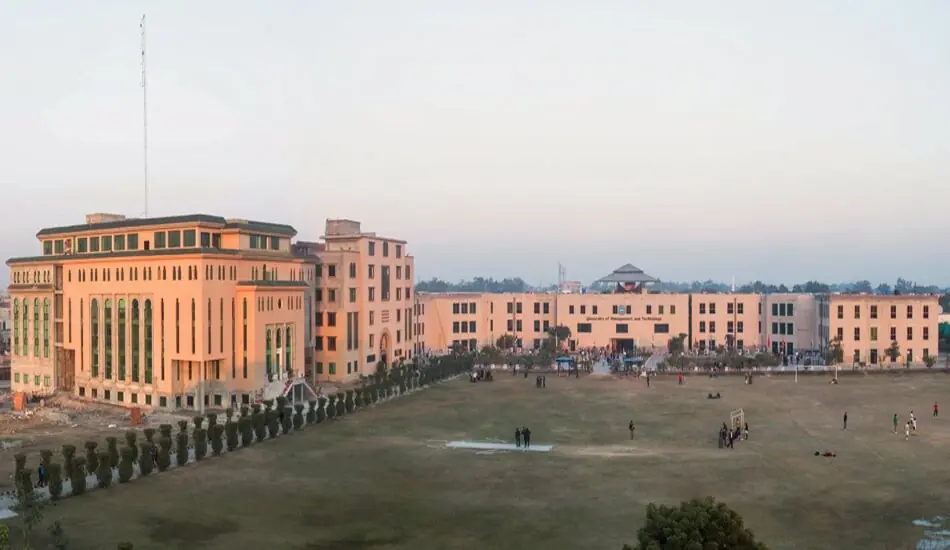

Pakistan says it wants a “knowledge economy” – but it is starving the very institutions meant to build it.
Walking into any public university in Pakistan today reveals a troubling arithmetic: increasing salary expenditures, crumbling infrastructure, outdated laboratories, and a decline in both government funding and student enrollment. Vice-chancellors discreetly admit their struggles to meet payroll on time. The Higher Education Commission (HEC) has cautioned that if the freeze on federal funding persists, students may face higher fees and reduced scholarships.
Pakistan allocates a smaller share of its national income to education than nearly any country aiming for serious development. Official data reveals that education spending has dropped to approximately 0.8 percent of GDP in FY 2024–25 for the entire education sector, not just higher education, marking a decline from already insufficient levels in previous years.
World Bank statistics indicate that Pakistan’s public expenditure on education stood at about 1.87 percent of GDP in 2023, compared to a global average of 4.4 percent. Regardless of the source, the conclusion remains the same: Pakistan invests roughly half the amount in education as most countries do as a percentage of their national income.
Furthermore, the development budget of the Higher Education Commission (HEC) has been reduced by around 35 percent, falling from Rs 61.1 billion in FY 2024–25 to Rs 39.5 billion in FY 2025–26. This significant cut directly impacts scholarships and infrastructure projects, ultimately hindering university development and quality. This situation should not be characterized merely as “belt-tightening”; it amounts to a slow and deliberate suffocation of the education sector.
The underfunding of the education system occurs within a framework that is already inadequate for Pakistan’s youth. According to Pakistan Education Statistics 2022–23, the country has around 247 universities, yet only about 1.94 million students. UNESCO estimates show Pakistan’s tertiary gross enrollment ratio at a mere 12 percent (as of 2019), indicating that fewer than one in eight young people of university age are actually engaged in higher education. Moreover, data from Gallup Pakistan reveal that only around 1 in 11 Pakistanis possesses a bachelor’s degree or higher. This underscores the fact that we are under-enrolled even before fee hikes and scholarship reductions drive more families away from the system.
The “student shortage” that many universities quietly acknowledge is far from a mystery. If tuition fees continue to escalate in a country where real incomes are declining, and if scholarships for underprivileged students are cut, a significant portion of society will inevitably be priced out of higher education. The funding crisis is not just a financial concern; it represents a social justice issue that endangers equitable access for marginalized groups and vulnerable communities across Pakistan. Women, along with students from Balochistan, interior Sindh, Southern Punjab, merged districts, and remote areas of Khyber Pakhtunkhwa (KP), are likely to bear the brunt of this challenge.
This issue extends beyond mere financial considerations; it encompasses governance, priorities, and credibility. Weak internal accountability results in financial leaks, programme duplication, and poorly conceived expansions. Governance failures do not relieve the state of its essential responsibilities. The IMF’s recent diagnostic report on Pakistan clearly indicates that the country’s pervasive governance and corruption challenges are suppressing growth by an estimated 5–6.5 percent of GDP over the next five years. The same reasoning applies to higher education: it is impossible to cultivate a high-trust, high-skill economy on the shaky foundation of low-trust, underfunded public institutions.
Currently, Pakistan allocates a larger share of its financial resources to debt servicing than to education and healthcare combined. It is important to recognize that every rupee not invested in our universities today has the potential to hinder economic growth, reduce productivity, exacerbate inequality, and contribute to social frustration in the future.
Our universities present a valuable opportunity for Pakistan to break free from its cycle of low growth and high debt. They can empower skilled administrators, visionary policymakers, innovative entrepreneurs, and scientifically literate citizens who can propel the nation forward. By focusing on development and support, we can enhance these institutions, ensuring they provide high-quality education and services.
Addressing the challenge of unfunded mandates as they pertain to higher education will require a collaborative and proactive approach. If Pakistan is committed to fostering a sustainable future, it is essential to view higher education not as a discretionary expense but as a fundamental investment in our national well-being and prosperity. This perspective can help galvanize support for our universities, positioning them as vital contributors to our collective success.
If we want our universities to go beyond being mere examination boards, Pakistan needs to shift decisively from superficial declarations to actionable structural reforms. A strong reform strategy should include the following essential measures:
-
It is crucial to reverse the significant reductions made to the development budget of the Higher Education Commission (HEC). We should establish a multi-year, inflation-adjusted funding structure that allows universities to plan beyond the limitations of a single fiscal year.
-
Set a legally mandated minimum spending target for education—such as 4 percent of GDP over a specified time frame with a clear and progressively increasing proportion allocated to higher education. This pledge demonstrates our commitment to cultivating future generations.
-
Implement performance-based funding tied to specific, transparent criteria that include teaching quality, the relevance of research, employability of graduates, governance improvements, and equitable access. This approach should incentivize universities that excel in assisting underrepresented groups and building strong collaborations with industry and community.
-
Broaden the availability of need-based scholarships and income-contingent loans, with funding derived in part from the government and augmented by a small graduate tax on higher earners. Furthermore, any increase in tuition fees should depend on the provision of substantial financial aid packages, especially for students from public schools and low-income families.
-
It is vital to remove politics from appointments by ensuring that search committees consist of academic representatives and follow transparent selection criteria. We must strengthen oversight bodies and quality assurance systems and enforce strict standards across both public and private institutions. Additionally, universities should release annual “social accountability” reports detailing funding sources, expenditures, and achieved outcomes.
-
Motivate universities to build endowments, encourage alumni contributions, develop executive education initiatives, and pursue industry-funded research. These efforts are essential since Pakistan is currently among the lowest in comparable developing economies.
If Pakistan continues to treat universities as discretionary expenditures rather than national assets, it will remain locked in a cycle of low growth, low skills, and low trust. Reversing this trajectory requires more than speeches and symbolic reforms. It demands predictable funding, accountable governance, equitable access, and the political courage to invest in people before crises force the bill upon us.
Higher education is not Pakistan’s fiscal burden—it is its most credible exit strategy. The choice is stark: invest now in universities that produce thinkers, innovators, and leaders, or continue paying the far higher price of stagnation tomorrow.
Universities Are Not the Cost—They Are the Exit Strategy.
Copyright Business Recorder, 2026
The author is a Professor at the Pakistan Institute of Development Economics (PIDE). She can be reached at Email: [email protected]




















Comments
Comments are closed for this article.