


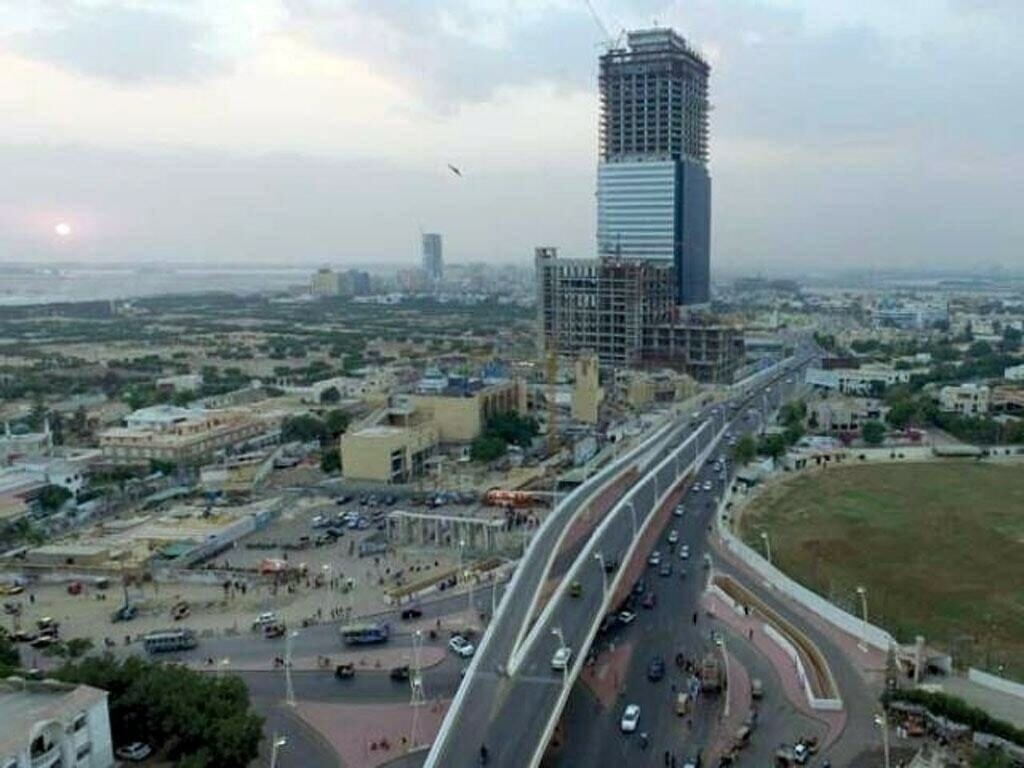
EDITORIAL: The UN’s latest Asia-Pacific Disaster Report 2025 delivers an alarming warning: Karachi’s relentless concrete sprawl and vanishing green cover are steering the city towards extreme temperatures that will outpace most of Asia. This is an especially grim reality for a metropolis where heat waves have increasingly become a feature of its climate over the last decade, making the prospect of an even hotter city all the more frightening.
Without urgent interventions, unplanned urbanisation, dense construction and shrinking natural buffers could push temperatures a disturbing 2°C-7°C above global warming levels, intensifying the urban heat island effect and pushing the country’s financial hub increasingly towards unliveability.
While the report places Karachi among nine Asian cities most vulnerable to soaring temperatures in the years ahead, it has also projected that Pakistan could become one of the world’s most arid countries between 2041 and 2060, with life-threatening heat and water scarcity set to redefine the disaster landscape.
There is, of course, a persistent — and justified — tendency to highlight how advanced industrialised economies have driven global ecological breakdown through decades of unchecked emissions, leaving countries like ours to bear the harshest consequences. That reality, however, does not excuse the self-serving, short-sighted and often incompetent governance frameworks that have compounded our own vulnerability.
Nowhere is this starker than in Karachi, which is routinely ranked among the least livable urban centres in the world, a status shaped not just by climate exposure but also by years of institutional neglect, fragmented authority and policy paralysis that have, in turn, intensified environmental stresses, locking the city into a destructive cycle.
Since Independence, Karachi has seen six master plans, with a seventh — the Greater Karachi Regional Plan 2047 — unveiled earlier this year. These largely failed to grapple with the city’s fundamental challenges: runaway population growth, unplanned urbanisation, collapsing municipal services, chronic transport dysfunction, encroached waterways, incompetent waste mismanagement and the steady erosion of public and green spaces.
All this can largely be attributed to an ineffectual local government system. The city’s destiny is not shaped in any meaningful manner by those who live in it, but by a provincial apparatus that has progressively absorbed powers that should reside with the metropolitan administration.
The transformation of the erstwhile Karachi Building Control Authority into the provincially controlled Sindh Building Control Authority is a telling example of how key institutions have been wrested from city-level oversight. With planning and regulatory authority politicised and fragmented, Karachi is expanding without coherence or accountability, and it is this very chaotic urbanisation that will amplify its susceptibility to climate stress.
The fact remains that urban planning in Karachi — as in Pakistan’s other major cities — remains driven more by political interests and the desire for centralised control than by scientific evidence or the input of local experts on population growth and climate needs.
Karachi has seen illegal land reclamation and the unchecked spread of concrete, high-rises and construction threatening coastal communities, traditional fishing practices and the city’s few remaining protected parks, fuelling the urban heat island effect and turning the metropolis into a furnace of its own making.
The fragmented governance structure means that less than half of Karachi falls under the city government’s authority, so even if there is an inclination to pursue climate-informed policies, implementing them uniformly across the city would remain an uphill task.
It goes without saying then that what Karachi — and for that matter Pakistan’s other major urban centres — needs first and foremost is an accountable local government system. Municipal bodies must be answerable to the city, with master plans shaped by climate experts and residents rather than vested interests, and climate considerations embedded into every decision-making process.
Copyright Business Recorder, 2025

























Comments
Comments are closed for this article.