


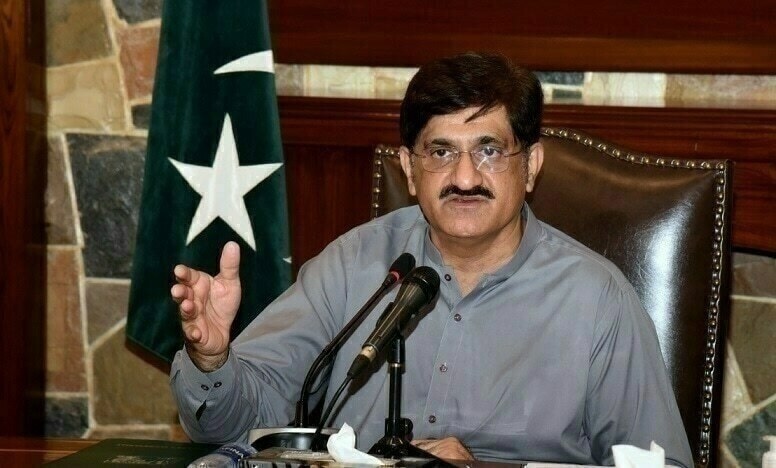

KARACHI: Sindh Chief Minister Syed Murad Ali Shah approved Rs 25 billion for the reconstruction of 315 internal roads and streets, as well as 60 major roads, in the city.
“The funds will not be an obstacle for providing relief to citizens suffering from dilapidated infrastructure and traffic congestion, but immediate reconstruction needs to be started at the earliest.
The meeting, held at CM House on Monday, was attended by Minister for Local Government Syed Nasir Shah, Mayor of Karachi Murtaza Wahab, Chief Secretary Asif Hyder Shah, PSCM Agha Wasif, Senior Member of the Board of Revenue Khalid Hyder Shah, and other key officials.
“I want Work Done,” the CM acknowledged the extensive damage, especially in the aftermath of recent heavy monsoon rains. “Karachi’s roads are in a state of disrepair following the heavy rains,” he stated.
“Furthermore, ongoing mega projects are contributing to traffic woes. I want development work in the city to be expedited so that the public does not have to endure further hardship.”
Murad Shah made it unequivocally clear that delays would not be tolerated, telling the City Mayor, “Funds are not an issue; I want work must be done on a war footing,” he said.
Mayor Karachi Murtaza Wahab briefed the chief minister on the extent of the damage and the proposed plan for rehabilitation.
Internal Streets: The Mayor highlighted that 315 inner-city streets are severely damaged and require urgent attention. The CM promptly ordered the approval of all internal street schemes, stressing that work should commence rapidly.
Major Roads: Murtaza Wahab informed the CM that 60 major roads across the city are scheduled for reconstruction. The estimated cost for the entire program is approximately Rs 25 billion.
Integrated Utility Systems: Crucially, the chief minister instructed that all reconstruction work must be comprehensive.
“The sewerage system for the streets being built must be properly constructed,” he directed.
He further mandated that the drainage system for the 60 major roads should be constructed simultaneously alongside the roads themselves to prevent future damage.
Focusing on Public Welfare and Security, Murad Ali Shah also took the opportunity to congratulate Mayor Wahab on the inauguration of new Reverse Osmosis (RO) plants in Keamari, emphasising the government’s broader commitment to public welfare. “We have to ensure clean water, good roads, and excellent law and order for the public,” he remarked.
The CM also noted an improvement in city-wide traffic safety, adding that the implementation of the Safe City project has already led to a reduction in traffic accidents. The accelerated push for infrastructure development underscores the Sindh government’s commitment to transforming the city’s appearance and improving the quality of life for its millions of residents by the end of the current development cycle.
Minister of Local Government Syed Nasir Shah also briefed the chief minister on the progress of the major infrastructure projects, including the Korangi Causeway Bridge and the Shahrah-i-Bhutto Expressway. Both projects are nearing completion, with sections already or imminently opening to traffic within the next two months.
Korangi Causeway Bridge :(New Elevated Structure)
The construction of the new, elevated Korangi Causeway Bridge is designed to replace the old causeway, which frequently submerged during heavy rains, causing massive traffic jams and connectivity issues for Korangi’s industrial and residential areas.
Nasir Shah said that the project is reported to be over 80 percent complete.
Projected Opening: The entire Korangi Causeway Bridge is expected to be operational by December 2025 or early January 2026. At this, the chief minister said that its completion will provide a permanent, rain-proof connection between Korangi and the rest of the city, alleviating a long-standing civic and economic problem.
Copyright Business Recorder, 2025




















Comments
Comments are closed for this article.